

Top 7 Best API Application Penetration Testing Course Providers in India
Application Programming Interfaces (APIs) have become the backbone of modern software architecture. They facilitate data exchange and functionality sharing between different systems, enabling seamless integration and enhanced user experiences. However, this increased reliance on APIs also introduces significant security risks.
APIs, if not properly secured, can become vulnerable entry points for malicious actors, leading to data breaches, service disruptions, and financial losses. As a result, API penetration testing has emerged as a critical aspect of cyber security.
In India, a country with a rapidly growing IT sector and increasing reliance on digital services, the demand for skilled API penetration testers is soaring. Several training providers have emerged to address this demand, offering specialized courses designed to equip individuals with the knowledge and skills necessary to identify and mitigate API vulnerabilities.
This article will explore the Top 7 Best API Application Penetration Testing Course Providers in India, highlighting their key features, course content, target audience, and overall value proposition.
List of Top 7 Best API Application Penetration Testing Course Providers in India
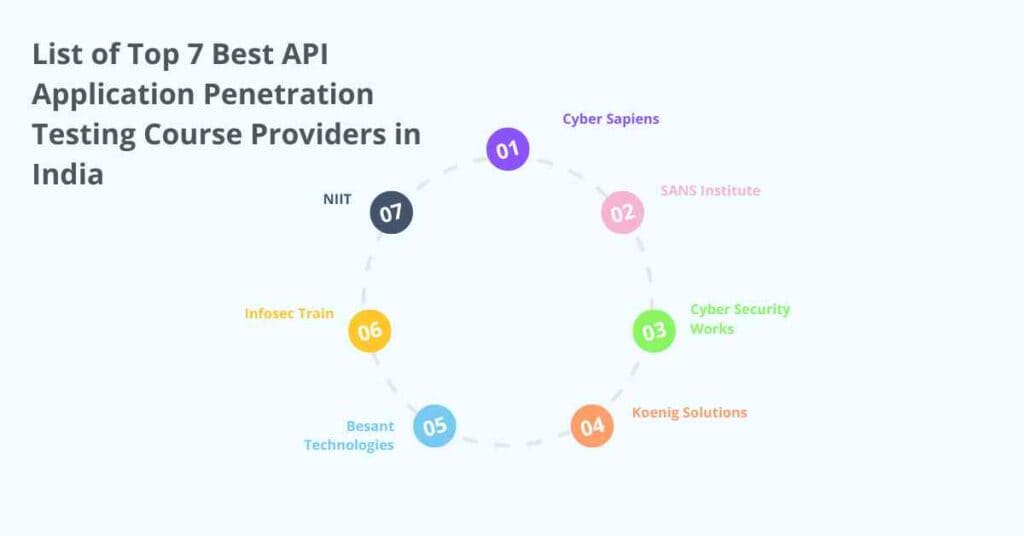
1. Cyber Sapiens
CyberSapiens is the best and leading API Application Penetration Testing Course Provider. Our API VAPT Penetration Testing Services are designed to safeguard your Application against potential threats and vulnerabilities caused by affected API.
We provide customized API VAPT Audit that helps identify all the hidden vulnerabilities that might be missed by others.
How do CyberSapiens conduct API Application Penetration Testing?
1. Scope Definition
Define the scope of the assessment, including which APIs will be tested, the testing environment, and specific objectives.
2. Reconnaissance
Gather information about the APIs, such as endpoints, protocols, and communication methods.
3. Threat Modeling
Identify potential threats and vulnerabilities that could affect the APIs and their users.
4. Vulnerability Scanning
Utilize automated tools to scan for common vulnerabilities, including injection, authentication, and authorization issues.
5. Manual Testing
Perform manual testing to identify vulnerabilities that automated tools may miss, such as logical flaws and business logic issues.
6. Authentication Testing
Evaluate the strength of authentication mechanisms in place to prevent unauthorized access.
7. Authorization Testing
Assess the effectiveness of authorization controls, ensuring that users can access only the appropriate data and functions.
8. Data Encryption Testing
Verify that data transmitted and stored by the APIs is properly encrypted to protect sensitive information.
9. Session Management Testing
Examine how sessions are managed to prevent session hijacking and fixation.
10. Input Validation Testing
Check for input validation flaws that could lead to injection attacks, such as SQL injection or Cross-Site Scripting (XSS).
2. SANS Institute
The SANS Institute is a leading provider of cybersecurity training and certifications. Their SEC540: Cloud Security and DevSecOps Automation course includes a significant focus on API security in cloud environments. SANS courses are known for their in-depth technical content and hands-on labs.
3. Cyber Security Works
Cyber Security Works offers specialized API penetration testing training programs designed to equip individuals with the skills to identify and exploit API vulnerabilities. Their courses often include real-world case studies and hands-on labs to provide practical experience.
4. Koenig Solutions
Koenig Solutions is a training provider that partners with various cybersecurity vendors to offer their training programs. They offer courses covering API security testing and secure API development practices. They often incorporate vendor-specific tools and technologies into their training.
5. Besant Technologies
Besant Technologies is an IT training institute that offers cybersecurity courses, including those with API security components. Their courses are designed to provide a foundational understanding of API security principles and practices.
6. Infosec Train
Infosec Train is a cybersecurity training provider that offers a variety of courses, including those related to web application and API security. They often incorporate hands-on labs and real-world scenarios into their training programs.
7. NIIT
NIIT is a well-established IT training company that offers a range of technology courses, including cybersecurity programs. While they might not have a dedicated “API penetration testing” course, their web application security courses often include modules on API security testing.
Factors to Consider When Choosing a Course Provider

When choosing an API penetration testing course provider, consider the following factors:
1. Course Curriculum
Does the course cover the topics that are most relevant to your needs? Does it include hands-on labs and real-world case studies?
2. Instructors
Are the instructors experienced and knowledgeable in API security? Do they have practical experience in penetration testing?
3. Reputation
What is the reputation of the course provider in the industry? Do they have positive reviews from past students?
4. Cost
How much does the course cost? Does it fit within your budget?
5. Certification
Does the course lead to a recognized certification? Is the certification valuable in the industry?
6. Learning Style
Does the course provider offer a learning style that suits your needs? Do they offer online, in-person, or blended learning options?
Conclusion
API penetration testing is a critical skill for cybersecurity professionals in India and around the world. The course providers listed in this article offer a range of training programs designed to equip individuals with the knowledge and skills necessary to identify and mitigate API vulnerabilities. By carefully considering your needs and the factors outlined above, you can choose the course provider that is best suited to help you achieve your career goals in the field of API security.
As APIs become increasingly integral to the digital world, investing in API penetration testing skills is an investment in a secure and reliable future.
Summary: Top 7 Best API Application Penetration Testing Course Providers in India
- CyberSapiens
- SANS Institute
- Cyber Security Works
- Koenig Solutions
- Besant Technologies
- Infosec Train
- NIIT
FAQs
1. What exactly is API penetration testing, and why is it important?
API penetration testing is a security assessment that simulates real-world attacks on your Application Programming Interfaces (APIs) to identify vulnerabilities before malicious actors can exploit them. It’s important because APIs are often direct pathways to sensitive data and core application functionality.
2. How does API penetration testing differ from regular web application penetration testing?
While there’s overlap, API pen testing focuses specifically on the unique characteristics of APIs, such as authentication methods (e.g., OAuth, API keys), data formats (e.g., JSON, XML), and the logic exposed through API endpoints. Web application testing takes a broader approach.
3. What are some common vulnerabilities that API penetration testing looks for?
Common vulnerabilities include broken authentication/authorization, injection flaws (like SQL or NoSQL injection), data exposure, rate limiting issues, security misconfigurations, and insufficient logging/monitoring. We also look at vulnerabilities in third-party APIs integrated into your application.
4. When should API penetration testing be performed?
Ideally, API pen testing should be integrated throughout the software development lifecycle (SDLC). It’s crucial during the design phase, after significant code changes, before a major release, and periodically on production APIs.
5. What tools are commonly used in API penetration testing?
Testers often use tools like Burp Suite, OWASP ZAP, Postman (for crafting requests), and specialized API testing tools designed to automate certain tasks and identify common vulnerabilities. Custom scripts are frequently used too.
