

Top 7 Best Cloud Penetration Testing Course Providers in India
Cloud computing has revolutionized the IT landscape, offering businesses scalability, flexibility, and cost-efficiency. However, this shift to the cloud also introduces new security vulnerabilities. Cloud penetration testing, the practice of simulating cyberattacks to identify weaknesses in cloud infrastructure, is therefore crucial.
As demand for skilled cloud security professionals grows, India has seen a surge in training providers offering cloud penetration testing courses. This article explores the Top 7 Best Cloud Penetration Testing Course Providers in India evaluating their curriculum, instructors, methodology, and overall value proposition.
List of Top 7 Best Cloud Penetration Testing Course Providers in India
1. CyberSapiens
CyberSapiens is the best and leading Cloud Penetration Testing Course Provider. Our Cloud Penetration Testing services are tailored to fortify your cloud infrastructure against potential security threats and vulnerabilities.
We offer a personalized Cloud VAPT Audit that meticulously uncovers hidden vulnerabilities, ensuring comprehensive security coverage.
How do we conduct Cloud Penetration Testing?
1. Scope Definition
Define the scope of the assessment, identifying the cloud systems, services, and applications to be tested.
2. Threat Intelligence
Gather threat intelligence relevant to your cloud environment to understand potential risks.
3. Vulnerability Scanning
Use automated tools to scan your cloud infrastructure for known vulnerabilities.
4. Risk Assessment
Assess the identified vulnerabilities based on their severity and potential impact on your business.
5. Penetration Testing
Conduct ethical hacking tests to simulate real-world attacks on your cloud systems.
6. Security Configuration Review
Examine your cloud configuration settings to ensure they align with security best practices.
7. Data Encryption Analysis
Assess the encryption mechanisms in place to protect data in transit and at rest.
8. Authentication & Authorization Testing
Evaluate user authentication and access control mechanisms for weaknesses.
9. Web Application Testing
If applicable, perform web application testing to identify vulnerabilities in cloud-hosted apps.
10. Network Analysis
Analyze network traffic patterns within your cloud environment for anomalies.
2. SANS Institute
SANS Institute is renowned for its in-depth, hands-on cybersecurity training. While SEC522 isn’t exclusively cloud-focused, it provides a strong foundation in web application security, which is directly applicable to cloud environments. SANS courses are known for their high quality and practical approach.
3. Koenig Solutions
Koenig Solutions offers a dedicated cloud security and penetration testing course that covers AWS, Azure, and GCP. The course includes hands-on labs and focuses on identifying and exploiting common cloud vulnerabilities.
4. RedTeam Hacker Academy
RedTeam Hacker Academy’s course focuses on advanced penetration testing techniques specific to cloud environments. It covers topics such as serverless security, container security, and advanced IAM exploitation.
5. Cyber Vault Solutions
Cyber Vault Solutions’ CCSE program offers a comprehensive overview of cloud security, including a significant module on penetration testing. It covers various cloud platforms and security tools.
6. InfosecTrain
InfosecTrain provides cloud security training that includes elements of penetration testing. They often tailor their courses to specific cloud platforms like AWS or Azure. They also offer courses aligned with certifications like CCSP and CCSK.
7. Craw Security
Craw Security offers a dedicated Cloud Penetration Testing Masterclass designed to equip professionals with the skills to identify and mitigate vulnerabilities in cloud
Why Cloud Penetration Testing Matters?
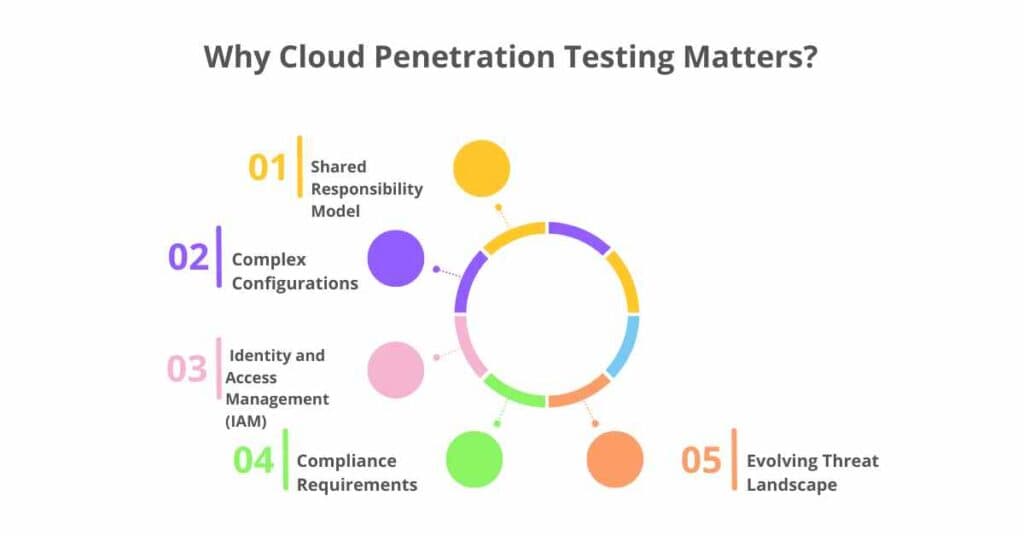
Before diving into the best course providers, let’s underscore the importance of cloud penetration testing. Traditional penetration testing focuses on on-premises infrastructure. Cloud environments, however, present unique challenges:
1. Shared Responsibility Model
Cloud security is a shared responsibility between the provider (e.g., AWS, Azure, GCP) and the customer. Penetration testers must understand which aspects are the customer’s responsibility to secure.
2. Complex Configurations
Cloud environments involve intricate configurations of virtual machines, networks, storage, databases, and various cloud-native services. Misconfigurations are a leading cause of cloud breaches.
3. Identity and Access Management (IAM)
IAM is critical in the cloud. Penetration testers need to assess the effectiveness of IAM policies and identify potential privilege escalation vulnerabilities.
4. Compliance Requirements
Many industries have strict compliance requirements (e.g., HIPAA, PCI DSS) that apply to cloud environments. Penetration testing helps ensure compliance.
5. Evolving Threat Landscape
The cloud threat landscape is constantly evolving, with new attack vectors emerging regularly. Penetration testers must stay up-to-date on the latest threats and techniques.
Conclusion
Cloud penetration testing is an essential skill for security professionals in today’s cloud-centric world. The providers listed above offer a range of courses to suit different skill levels and career goals.
When choosing a course, carefully consider your specific needs and the factors outlined in this article. Remember to prioritize hands-on experience and choose a provider with a strong reputation and experienced instructors. By investing in quality training, you can equip yourself with the knowledge and skills necessary to protect cloud environments from cyber threats.
Summary: Top 7 Best Cloud Penetration Testing Course Providers in India
- CyberSapiens
- SANS Institute
- Koenig Solutions
- RedTeam Hacker Academy
- Cyber Vault Solutions
- InfosecTrain
- Craw Security
FAQs
1. What exactly is cloud penetration testing, and how does it differ from traditional penetration testing?
Cloud penetration testing is the process of simulating cyberattacks on a cloud environment to identify security vulnerabilities. Unlike traditional penetration testing, it needs to account for the shared responsibility model, complex cloud configurations, and unique cloud services.
2. Why is cloud penetration testing so important for businesses using cloud services?
It’s crucial because it proactively identifies weaknesses that attackers could exploit. This helps organizations protect sensitive data, maintain compliance, and prevent costly data breaches, which can severely impact reputation and finances.
3. What’s the “shared responsibility model” in cloud security, and how does it affect penetration testing?
The shared responsibility model means that security is a joint effort between the cloud provider (like AWS, Azure, or GCP) and the customer. The provider secures the infrastructure, while the customer is responsible for securing what they put on that infrastructure (data, applications, configurations). Penetration testers must understand this division to target the correct areas.
4. What are some common vulnerabilities found during cloud penetration tests?
Common vulnerabilities include misconfigured cloud services (like S3 buckets), weak Identity and Access Management (IAM) policies, insecure APIs, unpatched software on virtual machines, and vulnerabilities in custom cloud applications.
5. What skills are essential for a cloud penetration tester?
A cloud penetration tester needs a strong understanding of cloud computing concepts, networking, security principles, common attack vectors, and experience with penetration testing tools. Knowledge of scripting languages (like Python) and cloud-specific technologies (like Docker, Kubernetes, serverless functions) is also very beneficial.
