

Top 7 Best Mobile Application Penetration Testing Course Providers in India
Mobile applications have become an integral part of our lives. From banking and shopping to social networking and entertainment, we rely on mobile apps for a wide range of tasks. However, the increasing reliance on mobile apps has also made them a prime target for cyberattacks. As a result, mobile application penetration testing has become a critical skill for cyber security professionals.
Mobile application penetration testing, also known as mobile app pentesting, is the process of evaluating the security of a mobile application by simulating real-world attacks. The goal of pentesting is to identify vulnerabilities in the app’s code, design, and infrastructure that could be exploited by malicious actors. By identifying and addressing these vulnerabilities, organizations can improve the security of their mobile apps and protect their users’ data.
List of Top 7 Best Mobile Application Penetration Testing Course Providers in India
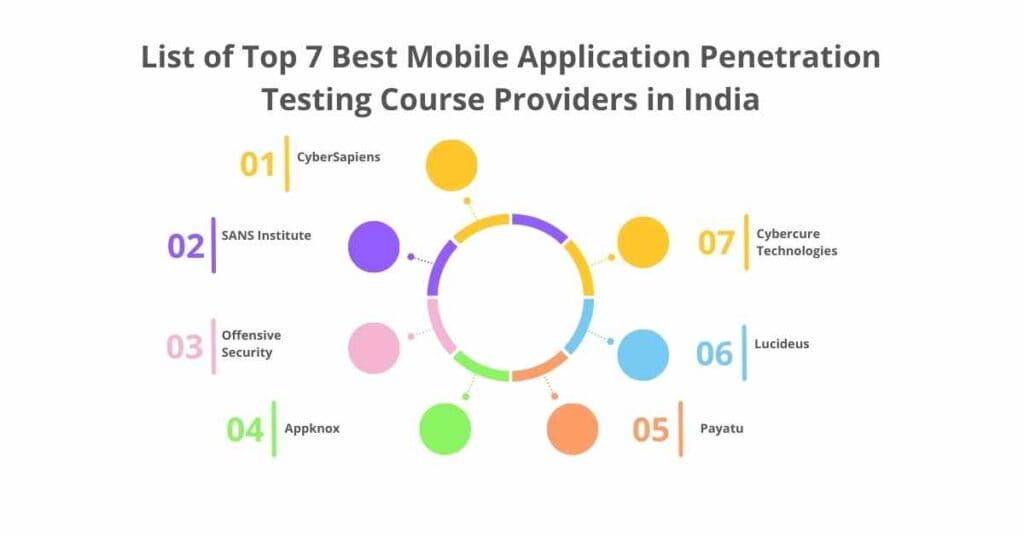
1. CyberSapiens
CyberSapiens is the best and leading Mobile Application Penetration Testing Course Provider. Our Mobile Application Penetration Testing services are designed to safeguard your Application against potential threats and vulnerabilities.
We provide a customized Mobile Application VAPT Audit that helps identify all the hidden vulnerabilities that might be missed by others.
How do CyberSapiens conduct Mobile Application Penetration Testing?
1. Preparation
Understand the app’s functionalities, architecture, and potential threat vectors.
2. Vulnerability Assessment
Employ automated tools and manual analysis to scan the app for known vulnerabilities.
3. Threat Modeling
Identify potential attack vectors and scenarios specific to the app.
4. Penetration Testing
Skilled professionals simulate real-world attacks, attempting to exploit vulnerabilities.
5. Exploitation
Actively exploit vulnerabilities to understand their impact and potential risks.
6. Analysis
Assess the severity of vulnerabilities and potential consequences for the app’s security.
7. Reporting
Provide a detailed report outlining identified vulnerabilities, their impact, and remediation steps.
8. Recommendations
Offer actionable recommendations to mitigate vulnerabilities and enhance app security.
9. Remediation
Address vulnerabilities based on the provided recommendations to improve app security.
10. Reassessment
Conduct a reevaluation to ensure that vulnerabilities have been effectively addressed.
2. SANS Institute
SANS Institute is another leading cybersecurity training provider that offers a comprehensive mobile application penetration testing course. Their SEC575: Mobile Device Security and Ethical Hacking course is designed to provide students with the skills and knowledge to assess the security of mobile devices and applications.
3. Offensive Security
Offensive Security is a well-known cybersecurity training provider that specializes in penetration testing and ethical hacking. Their Advanced Web Attacks and Exploitation (AWAE) course includes a module on mobile application penetration testing.
4. Appknox
Appknox is a mobile security company that offers a comprehensive mobile application penetration testing course. Their course is designed to provide students with the skills and knowledge to identify and exploit vulnerabilities in mobile apps.
5. Payatu
Payatu is a cybersecurity consulting and training company that offers a specialized mobile application penetration testing course. Their course is designed to provide students with the skills and knowledge to conduct thorough mobile app security assessments.
6. Lucideus
Lucideus is a cybersecurity risk assessment and digital security services provider that also offers training programs. Their mobile application penetration testing course is tailored to provide a practical understanding of the mobile security landscape.
7. Cybercure Technologies
Cybercure Technologies is a cybersecurity training and consulting company that offers a comprehensive mobile application penetration testing course. Their course is designed to equip students with the skills and knowledge to identify and mitigate mobile app vulnerabilities.
Conclusion
Mobile application penetration testing is a critical skill for cybersecurity professionals in India. The demand for mobile app pentesting professionals is increasing in India, and several training providers offer comprehensive mobile application penetration testing courses.
The top 7 best mobile application penetration testing course providers in India are EC-Council, SANS Institute, Offensive Security, Appknox, Payatu, Lucideus and Cybercure Technologies. These providers have been selected based on their course curriculum, faculty expertise, training methodology, and industry reputation.
Summary: Top 7 Best Mobile Application Penetration Testing Course Providers in India
- CyberSapiens
- SANS Institute
- Offensive Security
- Appknox
- Payatu
- Lucideus
- Cybercure Technologies
FAQs
1. What exactly is mobile application penetration testing, and why is it important?
Mobile application penetration testing (or “pentesting”) is a simulated cyberattack against a mobile app designed to uncover security vulnerabilities. It’s crucial because it proactively identifies weaknesses before malicious actors can exploit them, protecting user data, preventing financial losses, and maintaining brand reputation. Think of it as a “stress test” for your app’s security.
2. What types of vulnerabilities are typically found during mobile app pentesting?
Pentesters often uncover vulnerabilities like insecure data storage (sensitive info stored unencrypted), weak authentication (easily guessed passwords or bypassed login), code injection flaws (attackers injecting malicious code), and API vulnerabilities (weaknesses in how the app communicates with servers). These weaknesses can allow attackers to steal data, compromise accounts, or even take control of the app.
3. How does mobile app pentesting differ from web application pentesting?
While both aim to find vulnerabilities, mobile app pentesting focuses on aspects specific to mobile platforms. This includes testing the app’s interaction with the mobile operating system (Android or iOS), analyzing how data is stored locally on the device, and assessing the security of mobile-specific features like biometrics and push notifications. Web app pentesting focuses on server-side vulnerabilities and browser-based security.
4. What are the different phases involved in a mobile app pentest?
A typical mobile app pentest involves several phases: Reconnaissance (gathering information about the app and its infrastructure), Threat Modeling (identifying potential attack vectors), Vulnerability Analysis (scanning for weaknesses), Exploitation (attempting to exploit found vulnerabilities), and Reporting (documenting findings and recommending remediation strategies).
5. What tools are commonly used for mobile application penetration testing?
Pentesters utilize a variety of tools, including static analysis tools (to examine the app’s code without running it), dynamic analysis tools (to analyze the app’s behavior during runtime), network proxies (to intercept and analyze network traffic), and specialized mobile pentesting frameworks like Frida and MobSF.
