
Top-rated GRC Course in India
Governance, Risk, and Compliance (GRC) has become one of the most critical functions in modern organizations. As businesses increasingly rely on digital systems, cloud infrastructure, and data-driven operations, managing risks and ensuring regulatory compliance is no longer optional, it’s a strategic necessity. From cybersecurity threats and data breaches to regulatory penalties and audit failures, companies today face complex challenges that require structured GRC frameworks.
In India, the demand for skilled GRC professionals is growing rapidly across industries such as IT, fintech, healthcare, banking, and SaaS. Organizations are actively seeking professionals who understand ISO standards, risk assessment methodologies, internal controls, compliance management, and audit practices. This surge in demand has led to the rise of specialized GRC training programs designed to bridge the gap between theoretical knowledge and real-world implementation.
Choosing the right GRC course can significantly impact your career trajectory. Whether you are a beginner looking to enter the field, an IT professional transitioning into governance and compliance, or an experienced auditor aiming to upskill, enrolling in a top-rated GRC course in India can provide you with practical exposure, industry-recognized credentials, and better job opportunities.
What is GRC?
GRC stands for Governance, Risk, and Compliance. It is a structured approach that helps organizations align their business objectives with IT operations, manage risks effectively, and ensure adherence to laws, regulations, and industry standards.
Instead of handling governance, risk, and compliance separately, GRC integrates them into a unified strategy that improves decision-making, reduces vulnerabilities, and strengthens organizational resilience.
Governance
Governance refers to the framework of policies, processes, and controls that ensure an organization achieves its objectives ethically and efficiently.
It includes:
- Defining roles and responsibilities.
- Establishing policies and procedures.
- Strategic alignment between business and IT.
- Performance monitoring and accountability
Frameworks such as COBIT and COSO are widely used for governance implementation.
Risk Management
Risk management focuses on identifying, assessing, and mitigating risks that could impact the organization’s operations, finances, or reputation.
This includes:
- Risk assessments
- Threat modeling
- Business impact analysis
- Risk treatment plans
Compliance
Compliance ensures that an organization follows applicable laws, regulations, and industry standards.
Examples include:
- Data protection regulations.
- Industry-specific compliance requirements.
- Security standards such as ISO/IEC 27001.
Compliance reduces legal penalties, avoids fines, and builds customer trust.
Why GRC Matters Today?
With increasing cyber threats, regulatory scrutiny, and digital transformation, businesses cannot afford disconnected processes. GRC provides:
- Better visibility into organizational risks.
- Stronger internal controls.
- Improved audit readiness.
- Enhanced stakeholder confidence.
- Long-term sustainability.
GRC helps organizations operate securely, ethically, and efficiently while minimizing risks and staying compliant.
Why Pursue a GRC Course in India?
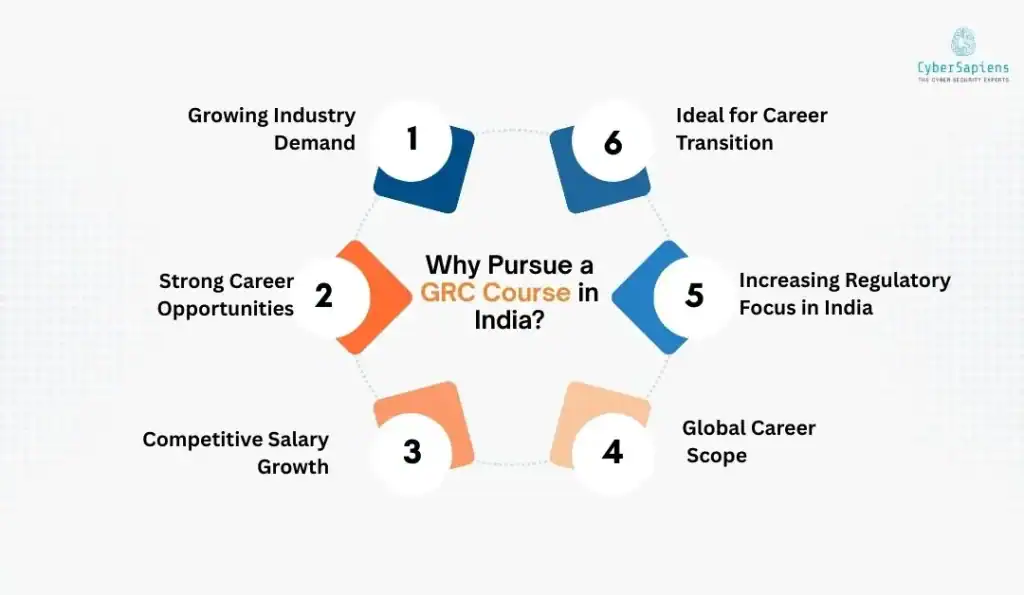
As organizations in India strengthen their cybersecurity posture and regulatory compliance frameworks, Governance, Risk, and Compliance (GRC) has emerged as a high-demand career domain. With increasing audits, global client requirements, and evolving data protection laws, companies are actively seeking professionals who understand structured risk management and governance practices.
Here’s why pursuing a GRC course in India is a smart career move:
- Growing Industry Demand: India’s rapid digital transformation across IT, fintech, healthcare, SaaS, and banking sectors has increased the need for structured Governance, Risk, and Compliance practices. Organizations are adopting global standards such as ISO/IEC 27001, COBIT, and ISO 31000 to strengthen security and regulatory alignment, creating strong demand for skilled GRC professionals.
- Strong Career Opportunities: A GRC course opens doors to roles like GRC Analyst, Risk Consultant, Compliance Officer, and IT Auditor across startups, enterprises, and consulting firms. As businesses expand and face stricter audits, the need for professionals who understand governance frameworks and risk controls continues to grow.
- Competitive Salary Growth: GRC professionals often command higher salaries compared to many entry-level IT roles. With experience, individuals can progress into leadership positions such as Risk Manager or Chief Information Security Officer, making it a financially rewarding career path.
- Global Career Scope: GRC knowledge is aligned with international standards and regulatory frameworks, making these skills globally transferable. Professionals trained in governance and compliance can work with multinational corporations, global SaaS companies, and international audit firms.
- Increasing Regulatory Focus in India: With evolving data protection laws and sector-specific regulations, Indian organizations must maintain stronger compliance programs. This has significantly increased the demand for trained professionals who can conduct risk assessments, manage audits, and implement internal controls effectively.
- Ideal for Career Transition: GRC is a strategic career path for IT professionals, auditors, fresh graduates, and legal experts looking to move into governance and compliance roles. It combines business strategy, cybersecurity, and regulatory knowledge, making it a future-ready and stable domain.
5 Top-Rated GRC Courses in India
1. Cybersapiens –Information Security, Risk & Compliance (GRC) Mastery Program
CyberSapiens’ Information Security, Risk & Compliance (GRC) Mastery Program is a structured training designed to equip learners with essential skills in information security, enterprise risk management, and compliance frameworks that organisations use to protect digital assets and manage cyber risks in today’s environment.
What the Program Covers
- Comprehensive GRC Fundamentals: The program begins with a solid foundation in information security principles, covering governance, access control, data protection, encryption basics, and network security essentials.
- Risk Management Concepts: You learn how organisations identify, assess, prioritise, and mitigate cybersecurity risks, including enterprise risk processes and third-party risk management (TPRM).
- Global Compliance Frameworks: The course includes detailed modules on leading regulatory and compliance standards such as ISO/IEC 27001, GDPR, PCI DSS, HIPAA, ITGC, and NIST frameworks — helping understand how organisations maintain compliance across different laws and industries.
- Security Audits & SOC Concepts: You gain insights into how security audits are conducted, what evidence auditors look for, how controls are validated, and how a Security Operations Centre (SOC) contributes to supporting GRC activities in a business.
Key Program Highlights
- Expert-Led Sessions: Instruction delivered by industry professionals aligned with enterprise and real-world security practices.
- Focus on Practical Application: Emphasis on understanding risk identification and mitigation techniques applicable in actual business environments.
- Interview-Oriented Knowledge: Designed to help learners prepare for roles involving GRC, SOC, and security audit responsibilities.
- Live and Structured Learning: The program includes live interactive sessions, structured curriculum flow, community networking, quizzes, and practice tests to reinforce learning.
- Certificate Upon Completion: Learners receive certification which can be showcased on professional profiles like LinkedIn.
This course is suitable for
- Beginners looking to enter the GRC or cybersecurity domain.
- IT and security professionals wanting to broaden expertise into risk and compliance.
- Individuals preparing for security audit or governance roles.
The Information Security, Risk & Compliance (GRC) Mastery Program from CyberSapiens provides a clear, practical understanding of cybersecurity governance, risk assessment, and compliance requirements with exposure to real-world standards and frameworks, making it valuable for aspiring GRC professionals.
2. ISACA – COBIT & Risk Certifications
ISACA is globally recognized for governance and IT audit certifications. Programs such as COBIT Foundation and CRISC (Certified in Risk and Information Systems Control) are highly valued in enterprise environments. These certifications are ideal for professionals aiming to work in IT governance, enterprise risk management, and large-scale audit environments.
3. Simplilearn – GRC & Risk Management Programs
Simplilearn offers structured online GRC-related programs that focus on risk management, compliance frameworks, and enterprise governance. The flexibility of online learning makes it suitable for working professionals. It is a good option for learners looking for structured certification-based training with global exposure.
4. GreyCampus – ISO & Governance Certifications
GreyCampus provides ISO-based and governance-focused training programs aligned with international standards such as ISO/IEC 27001. These programs are beneficial for professionals interested in audit, compliance implementation, and certification consulting roles.
5. EduPristine – Risk & Compliance Training
EduPristine offers risk management and compliance-focused programs with practical case studies and industry-oriented content. It is suitable for finance, banking, and corporate compliance professionals looking to expand into GRC.
Why the Right GRC Course Matters?
Governance, Risk, and Compliance is no longer a niche function, it has become a core business requirement for organizations operating in today’s digital and regulatory landscape. As Indian companies expand globally and face increasing cybersecurity threats and compliance obligations, the demand for skilled GRC professionals continues to rise.
Choosing the right course plays a crucial role in building a successful career in this domain. A well-structured program like the Information Security, Risk & Compliance (GRC) Mastery Program by Cybersapiens provides practical exposure to real-world frameworks, risk assessment methodologies, compliance standards, and audit processes, skills that employers actively seek.
Whether you are a beginner exploring cybersecurity, an IT professional transitioning into governance roles, or someone aiming to strengthen compliance expertise, investing in a comprehensive GRC course can significantly accelerate your career growth.
FAQs : Top-rated GRC Course in India
1. Is GRC a good career in India?
Answer: Yes, GRC is one of the fastest-growing domains in India due to increasing cybersecurity risks, global client compliance requirements, and evolving data protection regulations. Organizations across IT, fintech, healthcare, and SaaS actively hire GRC professionals.
2. What jobs can I get after completing a GRC course?
Answer: After completing a GRC course, you can apply for roles such as GRC Analyst, Risk Consultant, Compliance Officer, IT Auditor, Information Security Executive, and eventually leadership roles like Risk Manager or CISO.
3. What makes the Cybersapiens GRC Mastery Program different?
Answer: The Information Security, Risk & Compliance (GRC) Mastery Program by Cybersapiens focuses on practical implementation, real-world case studies, audit preparation, and hands-on risk assessment techniques rather than only theoretical knowledge.
4. Do I need a technical background to learn GRC?
Answer: No, many GRC programs are designed to be accessible to beginners. While basic IT knowledge is helpful, strong analytical and documentation skills are equally important in governance and compliance roles.
