
Trusted Web Application Security Testing Vendors in Australia 2026
As Australia’s digital ecosystem continues to expand in 2026, web applications remain at the center of business operations. From fintech platforms and SaaS startups to healthcare systems and government portals, organizations increasingly rely on web-based technologies to deliver services and manage sensitive data. However, this growing dependence also makes web applications one of the most targeted attack surfaces for cybercriminals.
Modern threats such as injection attacks, authentication bypass, API abuse, and business logic exploitation require more than automated vulnerability scans. Organizations now need trusted web application security testing vendors who can perform in-depth manual penetration testing, secure code reviews, and risk-based assessments aligned with frameworks like the OWASP Top 10 and ISO/IEC 27001.
Choosing a reliable security partner is critical. A trusted vendor not only identifies vulnerabilities but also validates exploitability, provides actionable remediation guidance, supports compliance requirements, and helps strengthen long-term security posture. In this guide, we highlight Trusted Web Application Security Testing Vendors in Australia (2026) to help businesses select the right partner for proactive risk management and compliance readiness.
Key Criteria for Selecting a Web Application Security Testing Vendor
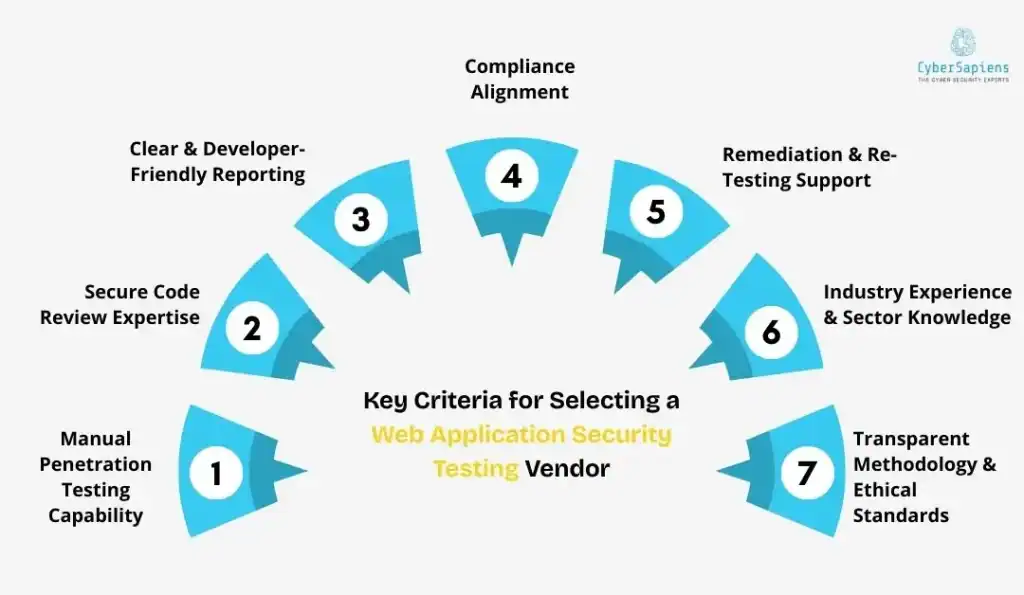
Choosing the right web application security testing vendor in Australia requires more than comparing prices or service lists. Since security testing often involves access to sensitive systems, source code, and production environments, trust, technical depth, and proven methodology are critical. Here are the key criteria to evaluate:
- Manual Penetration Testing Capability: A trusted vendor should perform manual penetration testing, not just automated scans. While tools help identify common vulnerabilities, experienced security testers are needed to uncover business logic flaws, chained exploits, and complex authorization issues aligned with the OWASP Top 10.
- Secure Code Review Expertise: Vendors offering secure source code review add significant value, especially for organizations adopting Secure SDLC or DevSecOps practices. Code-level analysis helps identify root-cause vulnerabilities early in development, reducing long-term security risks.
- Clear & Developer-Friendly Reporting: A trusted web application security testing vendor should provide reports that are structured, practical, and easy for development teams to understand. Instead of delivering overly technical or generic scan outputs, the report should clearly classify vulnerabilities by severity (Critical, High, Medium, Low), include proof-of-concept evidence, explain the business impact of each issue, and provide step-by-step remediation guidance. Developer-centric reporting ensures that security findings are actionable, reduces back-and-forth communication, and helps engineering teams fix vulnerabilities efficiently and accurately.
- Compliance Alignment: Trusted vendors align their testing with standards such as ISO/IEC 27001, SOC 2, PCI DSS, and industry regulations. Reports should be audit-ready and suitable for vendor security assessments and enterprise onboarding processes.
- Remediation & Re-Testing Support: Security testing should not end with a report. A dependable vendor provides remediation consultation and re-testing services to verify that vulnerabilities have been properly resolved.
- Industry Experience & Sector Knowledge: Look for vendors with experience in your industry, whether SaaS, fintech, healthcare, or government. Industry-specific knowledge helps testers understand business logic, compliance requirements, and threat landscapes more effectively.
- Transparent Methodology & Ethical Standards: A trusted vendor should clearly explain their testing methodology, scope definition process, data handling practices, and confidentiality commitments. Certifications, experienced consultants, and responsible disclosure policies are strong indicators of professionalism.
Evaluating Web Application Security Testing Providers: A Strategic Approach
Selecting a web application security testing vendor goes beyond ticking a compliance checkbox. The right partner should strengthen your overall security strategy, support development teams, and enhance customer confidence. Here are alternative factors to consider when shortlisting vendors:
- Scope Customization & Risk-Based Testing: Choose a provider that tailors assessments based on your application architecture, threat model, and business impact. Risk-driven testing ensures critical assets and high-impact vulnerabilities are prioritized over generic scans.
- Manual Expertise Over Tool Dependency: Automated scanners are helpful, but they cannot uncover complex logic flaws or chained attack paths. Ensure the vendor emphasizes hands-on testing performed by skilled security professionals who simulate real-world attack scenarios.
- Modern Application Coverage: If your application uses APIs, microservices, cloud infrastructure, or single-page frameworks, confirm the vendor has expertise in testing modern stacks, not just traditional web apps.
- DevSecOps & CI/CD Integration: Security should align with your development lifecycle. Vendors that integrate findings into ticketing systems, provide remediation workshops, or support secure coding practices add long-term value beyond a single engagement.
- Clear Risk Communication: Executive-level summaries and technical breakdowns should coexist in reports. Leadership needs business impact clarity, while developers need actionable remediation guidance.
- Re-Testing & Continuous Validation: Security is iterative. A strong vendor offers structured re-testing, periodic assessments, and validation support to ensure vulnerabilities are effectively resolved, not just documented.
- Regulatory & Industry Awareness: Look for vendors familiar with Australian regulatory expectations and global standards like ISO/IEC 27001, SOC 2, and PCI DSS to streamline audit preparation.
- Transparency & Ethical Assurance: A trustworthy partner operates with clear scoping documents, defined rules of engagement, secure data handling practices, and strict confidentiality controls.
5 Trusted Web Application Security Testing Vendors in Australia (2026)

Below are some of the most trusted web application security testing vendors in Australia, evaluated based on manual testing capability, compliance alignment, reporting quality, and industry experience.
1. Cybersapiens
Cybersapiens is a fast-growing cybersecurity firm specializing in Web Application VAPT, secure source code review, and compliance-aligned security testing. The company is known for its practical, risk-focused, and remediation-driven approach.
Why They’re Trusted:
Cybersapiens emphasizes manual penetration testing aligned with the OWASP Top 10, ensuring deep coverage of critical vulnerabilities. Their services go beyond automated scans to identify complex business logic flaws, authentication bypass risks, API vulnerabilities, and multi-step attack paths.
They provide developer-friendly reports with clear remediation guidance and offer re-testing support to ensure vulnerabilities are properly fixed. Their testing approach also supports compliance requirements such as ISO/IEC 27001 and SOC 2 readiness.
Best For: SaaS startups, fintech platforms, enterprises preparing for audits, and organizations adopting Secure SDLC or DevSecOps practices.
2. CyberCX
CyberCX is one of Australia’s leading cybersecurity service providers with a nationwide presence and extensive enterprise experience. They offer enterprise-grade penetration testing services, including web application security assessments, backed by a large team of consultants. Their strength lies in serving government and highly regulated industries with structured security programs and managed security services.
3. Tesserent
Tesserent provides comprehensive cybersecurity consulting services, including web application penetration testing and risk advisory. They combine technical testing expertise with broader security strategy services such as incident response and governance advisory. Their experience across enterprise environments makes them a strong partner for regulated industries.
4. Sekuro
Sekuro specializes in cyber resilience and advanced security testing services. They offer tailored web application testing solutions integrated with cloud security and DevSecOps practices. Their approach often includes threat modeling and red teaming to identify deeper security gaps.
5. NCC Group (Australia)
NCC Group is a global cybersecurity consultancy with a strong presence in Australia, offering high-assurance application security testing. Their testing is research-driven and backed by global threat intelligence. They provide advanced penetration testing, red teaming, and application security assessments suitable for high-risk environments.
Building Trust Through Proactive Security
In 2026, web application security is no longer a reactive measure—it is a strategic business priority. As Australian organizations continue expanding their digital presence, partnering with a trusted and technically capable security testing vendor is essential to reduce risk, maintain compliance, and protect customer trust.
The right vendor does more than run automated scans. They perform in-depth manual penetration testing, validate real-world exploitability, provide developer-friendly remediation guidance, and align testing with standards such as the OWASP Top 10 and ISO/IEC 27001.
Firms like Cybersapiens and other leading providers listed in this guide demonstrate how structured methodology, compliance awareness, and practical remediation support can significantly strengthen an organization’s security posture.
Ultimately, choosing a trusted web application security testing partner is an investment in long-term resilience. Organizations that prioritize proactive testing, continuous improvement, and security-first development practices will be better positioned to navigate the evolving cyber threat landscape in Australia and beyond.
FAQs: Trusted Web Application Security Testing Vendors in Australia 2026
1. How often should web applications be tested?
Answer: Web applications should be tested at least once a year and after major updates, infrastructure changes, or feature releases. Organizations adopting Secure SDLC often integrate continuous or periodic testing throughout development cycles.
2. Can web application testing help with compliance requirements?
Answer: Yes. Testing supports compliance with standards such as ISO/IEC 27001, SOC 2, and PCI DSS by providing documented evidence of vulnerability assessment and remediation efforts.
3. Is automated scanning enough to secure my application?
Answer: No. Automated tools help identify common vulnerabilities but often miss business logic flaws, chained exploits, and complex authorization issues. Manual testing by experienced security professionals is essential for comprehensive coverage.
4. What should I expect in a final security report?
Answer: A professional report should include vulnerability severity classification, proof-of-concept evidence, business impact explanation, and actionable remediation guidance. Some vendors also provide re-testing validation reports after fixes are implemented.
