
VAPT Requirements for GDPR and Data Protection
From customer information to financial data, sensitive information has become an important asset for businesses, and at the same time, it has become an easy target for cybercriminals. Hence, data related to personal information has become an important concern and priority for businesses.
The General Data Protection Regulation (GDPR) has been introduced to ensure data privacy and ensure that all businesses that manage personal information related to citizens in the European Union adhere to strict data protection regulations. GDPR has emphasized that all businesses must ensure that they implement appropriate technical and organizational measures that protect personal information and prevent any unauthorized access, loss, or usage of data.
Thus, it is not only important that security policies are implemented in an organization, but it is also important that these security policies are effectively working in an organization. This can only be achieved if Vulnerability Assessment and Penetration Testing (VAPT) is conducted in an organization. VAPT helps organizations identify security vulnerabilities in their networks, applications, and infrastructure, which might lead to unauthorized access, loss, or usage of sensitive information.
Understanding GDPR and Data Protection
The General Data Protection Regulation (GDPR) is a comprehensive regulation on data protection intended to protect the personal data and privacy of people in the European Union (EU). It applies to all organizations dealing with the personal data of EU residents, irrespective of their geographical locations. It means organizations across the globe must adhere to GDPR if they handle personal data of EU residents.
The GDPR regulation emphasizes the rights of people over their personal data and the need for organizations to have adequate security measures in place for protecting personal data. It provides strict guidelines on the handling of personal data.
The GDPR regulation highlights one of the fundamental principles of data security and accountability. Organizations need to ensure that adequate security measures are in place to protect personal data from unauthorized access, loss, alteration, or disclosure.
What is VAPT?
Vulnerability Assessment and Penetration Testing (VAPT) is an approach to testing and strengthening the security of an organization’s IT systems and networks. VAPT is an essential testing and analysis approach that helps an organization identify and address the security vulnerabilities that could potentially expose sensitive data, including personal data that is subject to data protection laws and regulations.
VAPT is an amalgamation of two critical security practices that complement each other.
Vulnerability Assessment
The Vulnerability Assessment method mainly deals with the identification of security vulnerabilities present in the system. It mainly uses automated scanning tools for the same. The results of the vulnerability assessment provide a comprehensive list of all the identified vulnerabilities along with their severity levels.
Penetration Testing
Penetration Testing is often called ethical hacking. It mainly deals with simulating real-world cyber attacks on the system. It helps the security experts to gain access to the system without authorization. It helps the organization to understand the impact of the attack on the system. It helps the organization to gain a better understanding of how the attackers might compromise the system and what impact it might have on the data present in the system.
By using the Vulnerability Assessment method along with the Penetration Testing method, the organization gets a clear idea about the security posture of the system. It not only helps the organization to gain a better understanding of the security posture of the system but also helps the organization to take proactive steps to enhance the security measures for the data present in the system.
VAPT Requirements for GDPR Compliance
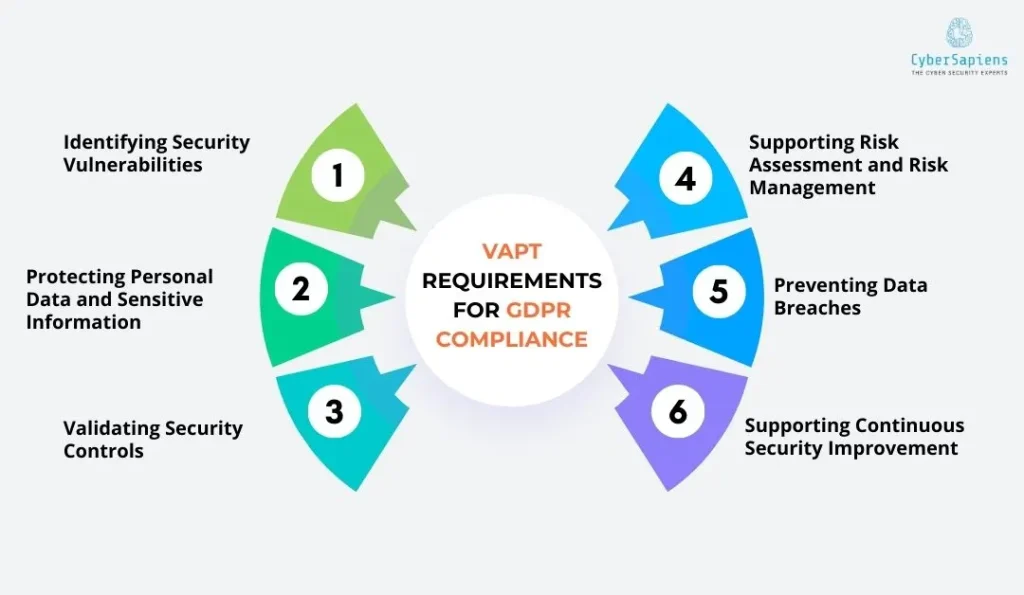
The General Data Protection Regulation (GDPR) has emphasized that organizations must ensure that appropriate technical and organizational measures are adopted to ensure data security. Although GDPR has not specifically mentioned particular tools that must be adopted for data security, it has placed great emphasis on risk management, security testing, and protecting data from potential attacks. Vulnerability Assessment and Penetration Testing are important tools that can be adopted by organizations to comply with GDPR requirements.
1. Identifying Security Vulnerabilities
One of the major objectives of GDPR is to minimize the risk of unauthorized access to personal data. VAPT is a tool that helps organizations identify potential security vulnerabilities that could compromise data security. By identifying potential vulnerabilities, organizations can minimize potential security risks that could result from data breaches.
2. Protecting Personal Data and Sensitive Information
Organizations dealing with personal data must ensure that their systems are adequately protected. VAPT assists in assessing whether systems that deal with personal data storage, processing, or transmission are adequately protected from potential attacks or unauthorized access.
3. Validating Security Controls
The GDPR has mandated that organizations must ensure that adequate security controls are put in place to protect personal data. VAPT assists in validating whether adequate security controls are in place to protect personal data.
4. Supporting Risk Assessment and Risk Management
Risk management is an integral aspect of GDPR compliance. VAPT is a critical component in providing useful information on possible security risks to an organization. The information obtained from VAPT can be used to support the risk management process in an organization.
5. Preventing Data Breaches
Data breaches are a major cause of financial implications and reputational damage to organizations under GDPR. Conducting regular VAPT assessments is crucial in helping organizations identify possible security risks to their systems. By addressing these risks, organizations can prevent possible data breaches on their systems.
6. Supporting Continuous Security Improvement
Cyber threats are constantly changing. For an organization to be on the safe side and ensure continuous compliance with data protection regulations, regular VAPT assessments are crucial.
How Cybersapiens Supports GDPR Compliance with VAPT?
Organizations that process personal data must ensure that they have adequate security measures in place to protect personal information and ensure data protection regulations under GDPR. Cybersapiens helps organizations improve their cybersecurity posture and ensure adequate data security measures are in place. It provides Vulnerability Assessment and Penetration Testing services that ensure data security and data protection regulations.
1. Comprehensive Security Assessments
Cybersapiens provides comprehensive security assessments that ensure that all applications, networks, and infrastructure are checked for any vulnerabilities that could lead to data breaches. This helps organizations identify any security issues and take adequate measures to ensure that data breaches are avoided.
2. Protection of Sensitive Data Systems
Sensitive data systems that process personal data must have adequate security measures in place. Cybersapiens provides security assessments that ensure that adequate security measures are in place to protect sensitive data from any security breaches.
3. Risk Identification and Prioritization
Cybersapiens offers detailed reports that identify risks, indicate the severity level, and provide information on how these risks affect data security. This enables organizations to effectively address these issues and incorporate these findings into their existing risk management processes.
4. Remediation Guidance
Cybersapiens, after identifying security risks, provides expert advice on how these risks can be effectively addressed. This ensures that security risks are addressed effectively, and security issues are addressed in an appropriate manner.
5. Continuous Security Testing and Support
Staying compliant with GDPR regulations is an ongoing process. Cybersapiens offers support in this regard, enabling organizations to maintain high standards in data security and minimize security risks.
Cybersapiens, through extensive security testing and expert advice, helps organizations strengthen their security posture, protect personal data, and become compliant with GDPR regulations.
Strengthening Data Protection with VAPT
In the modern business environment, protecting personal data has become an essential obligation for organizations. With the implementation of GDPR regulations, businesses have to ensure the implementation of adequate security measures to protect personal data and avoid the risks of a data breach. It is not sufficient to have adequate policies and procedures in place; rather, organizations need to test these policies and procedures.
Vulnerability Assessment and Penetration Testing (VAPT) is an essential tool in supporting GDPR compliance. It helps organizations identify potential risks and strengthen their security measures. With the help of VAPT, organizations can identify security risks and protect sensitive personal data. With the implementation of VAPT in protecting personal data, organizations can strengthen their security measures and support GDPR compliance.
FAQs: VAPT Requirements for GDPR and Data Protection
1. How often should organizations conduct VAPT for GDPR compliance?
Answer: Organizations should perform VAPT regularly, typically at least once a year or whenever there are significant changes to applications, infrastructure, or systems handling personal data.
2. What systems should be included in a VAPT assessment for GDPR?
Answer: Systems that store, process, or transmit personal data should be included in VAPT assessments. This may include web applications, APIs, databases, cloud infrastructure, and internal networks.
3. How does VAPT support GDPR risk management requirements?
Answer: VAPT provides insights into potential security risks by identifying vulnerabilities and demonstrating how they could be exploited. These findings help organizations prioritize remediation efforts and strengthen their overall data protection strategy.
4. Can VAPT help organizations demonstrate accountability under GDPR?
Answer: Yes, VAPT reports provide documented evidence that organizations are actively testing their systems and improving security controls, which helps demonstrate accountability and proactive data protection efforts.
