
What are the 14 Domains of ISO 27001 & How it can it solve your Business Challenges?
From customer data and intellectual property to financial records and operational systems, protecting information is no longer optional it is a business necessity. With rising cyber threats, stricter regulations, and increasing customer expectations around data protection, organizations face growing pressure to manage information security in a structured and reliable way.
ISO/IEC 27001 provides a globally recognized framework to address these challenges through an effective Information Security Management System (ISMS). At the core of this standard are the 14 domains of ISO 27001, which define comprehensive security controls covering people, processes, and technology. Understanding these domains helps businesses not only achieve compliance but also solve real-world challenges such as data breaches, operational risks, regulatory requirements, and loss of customer trust. This article explores what the 14 ISO 27001 domains are and how they can help organizations strengthen security and support business growth.
What Is ISO 27001?
ISO/IEC 27001 is an international standard that defines the requirements for establishing, implementing, maintaining, and continually improving an Information Security Management System (ISMS). Rather than focusing on specific technologies, ISO 27001 takes a risk-based approach to information security, helping organizations identify their information assets, assess risks, and apply appropriate controls to protect them.
The standard is designed to ensure the confidentiality, integrity, and availability of information across the organization. It applies to businesses of all sizes and industries and covers people, processes, and technology. By implementing ISO 27001, organizations can systematically manage security risks, demonstrate compliance with legal and regulatory requirements, and build trust with customers, partners, and stakeholders.
Why the 14 Domains of ISO 27001 Matter?
The 14 domains of ISO 27001 represent a structured and comprehensive approach to managing information security across an organization. Each domain addresses a specific area of risk, ensuring that security is not handled in isolation but integrated into everyday business operations. Together, these domains cover people, processes, and technology, which are the three pillars of effective information security.
From a business perspective, the 14 domains help translate abstract security requirements into practical controls that reduce real-world risks such as data breaches, insider threats, system downtime, and regulatory non-compliance. They also provide clarity on roles and responsibilities, improve governance, and ensure consistency in how security is implemented and maintained. By adopting all 14 domains, organizations move beyond reactive security measures and build a proactive, risk-based framework that supports business continuity, customer trust, and long-term growth.
What are the 14 Domains of ISO 27001?
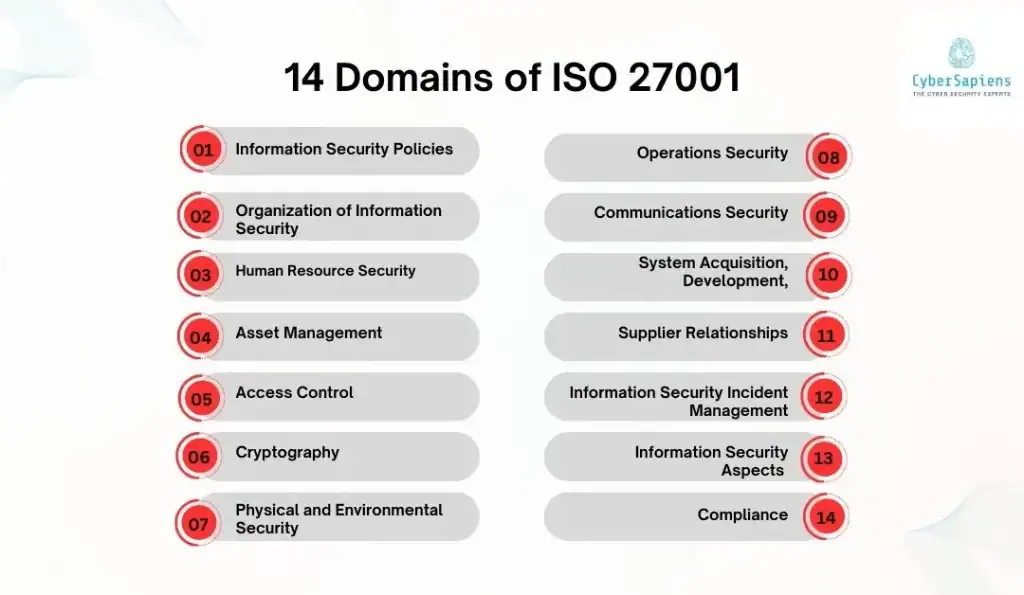
The 14 domains of ISO 27001 (as defined in Annex A of ISO/IEC 27001:2013) provide a comprehensive set of security control areas that help organizations manage information security risks systematically. Each domain focuses on a specific aspect of security and addresses common business challenges related to governance, operations, compliance, and resilience.
Together, these domains ensure that information security is implemented holistically, covering policies, people, technology, and third-party relationships rather than relying on isolated technical controls. Below is an overview of how each domain contributes to solving real business challenges.
1. Information Security Policies
This domain ensures that management-approved security policies are defined, documented, and communicated across the organization. These policies set the foundation for how information security is governed and enforced. It provides clear direction, reduces ambiguity, and ensures security decisions align with business objectives and risk appetite.
2. Organization of Information Security
This domain defines roles, responsibilities, and accountability for information security activities. It ensures proper segregation of duties and coordination between teams. It eliminates ownership gaps, strengthens governance, and ensures security responsibilities are clearly assigned and enforced.
3. Human Resource Security
Human resource security focuses on security controls before employment, during employment, and after termination. This includes background checks, awareness training, and access revocation. It reduces insider threats, accidental data leaks, and risks caused by employee negligence or malicious intent.
4. Asset Management
This domain requires organizations to identify, classify, and assign ownership to information assets such as data, systems, and devices. It improves visibility into critical assets, ensures sensitive data is handled appropriately, and reduces the risk of data loss or misuse.
5. Access Control
Access control ensures that users only have access to information and systems necessary for their role, following the principle of least privilege. It minimizes unauthorized access, limits the impact of compromised accounts, and supports regulatory compliance.
6. Cryptography
This domain covers encryption and cryptographic key management to protect sensitive information. It safeguards confidential data at rest and in transit, protecting customer information and supporting compliance requirements.
7. Physical and Environmental Security
Physical and environmental security protects offices, data centers, equipment, and supporting infrastructure from unauthorized access, damage, or environmental threats. It reduces risks related to theft, natural disasters, and physical disruptions that could impact operations.
8. Operations Security
Operations security focuses on secure day-to-day activities such as change management, malware protection, logging, and monitoring. It reduces operational errors, system downtime, and security incidents caused by misconfigurations or unmanaged changes.
9. Communications Security
This domain addresses network security and the secure transfer of information across internal and external networks. It protects data in transit, prevents interception or tampering, and strengthens network resilience.
10. System Acquisition, Development, and Maintenance
This domain ensures that security is integrated into system development, acquisition, and modification processes. It prevents vulnerabilities from being introduced during development and reduces long-term remediation costs.
11. Supplier Relationships
Supplier relationships focus on managing security risks associated with third-party vendors, partners, and outsourced services. It mitigates supply chain risks, ensures vendors meet security expectations, and protects shared information.
12. Information Security Incident Management
This domain defines how security incidents are reported, assessed, responded to, and learned from. It minimizes the impact of incidents, improves response time, and strengthens organizational preparedness.
13. Information Security Aspects of Business Continuity Management
This domain ensures information security is maintained during disruptions such as system failures or disasters. It supports operational resilience, protects critical services, and ensures faster recovery.
14. Compliance
Compliance ensures adherence to legal, regulatory, and contractual security requirements. It reduces the risk of fines, legal action, and reputational damage while building customer and partner trust.
How the 14 ISO 27001 Domains Solve Common Business Challenges?
The 14 domains of ISO 27001 are not just technical controls; they are designed to address real, recurring business challenges that organizations face in today’s threat and compliance landscape. By implementing these domains together, businesses gain structured, measurable, and sustainable security outcomes.
- Reducing the risk of data breaches: Domains such as access control, cryptography, operations security, and incident management work together to prevent unauthorized access, detect threats early, and limit the impact of security incidents.
- Meeting regulatory and contractual requirements: The compliance, information security policies, and supplier relationship domains help organizations systematically meet legal, regulatory, and customer-driven security obligations, reducing the risk of penalties and audit failures.
- Improving governance and accountability: A clear definition of roles, responsibilities, and ownership through the organization of information security and asset management domains ensures accountability and reduces gaps in security oversight.
- Protecting against insider threats and human error: Human resource security, awareness, and access control domains address one of the biggest business risks—people—by reducing accidental leaks and intentional misuse.
- Ensuring business continuity and resilience: Operations security and business continuity-related domains help organizations maintain secure operations during disruptions, minimizing downtime and financial loss.
- Managing third-party and supply chain risks: Supplier relationship controls ensure that vendors and partners follow appropriate security practices, reducing exposure from outsourced services and external dependencies.
- Building customer and stakeholder trust: A well-implemented ISO 27001 framework demonstrates a strong commitment to information security, helping organizations win enterprise customers, partnerships, and long-term trust.
By aligning security controls with business risks, the 14 ISO 27001 domains transform information security from a reactive cost center into a strategic business enabler that supports growth, resilience, and competitive advantage.
Turning ISO 27001 Domains into Business Advantage
The 14 domains of ISO 27001 provide a structured and proven framework for managing information security in a way that aligns with real business needs. When implemented effectively, these domains go beyond compliance to reduce risk, improve governance, strengthen resilience, and build long-term trust with customers and partners.
With the right guidance and a risk-driven approach, organizations can transform ISO 27001 into a strategic asset rather than a checklist exercise. By addressing people, processes, and technology holistically, businesses can confidently navigate today’s security challenges while supporting growth and regulatory confidence.
FAQs
1. Are all 14 ISO 27001 domains mandatory for certification?
Answer: Yes, all 14 domains must be considered as part of the ISO 27001 framework. However, organizations can justify the applicability of specific controls based on their risk assessment and business context.
2. Is ISO 27001 suitable for small and medium-sized businesses?
Answer: Yes. ISO 27001 is scalable and can be implemented by organizations of any size. Controls can be tailored based on the organization’s risk profile and operational complexity.
3. How long does it take to implement ISO 27001?
Answer: Implementation timelines vary depending on organization size, maturity, and scope, but typically range from three to six months for most businesses.
4. Is ISO 27001 only focused on IT systems?
Answer: No. ISO 27001 covers people, processes, and technology. It includes areas such as HR security, supplier management, physical security, and compliance.
