
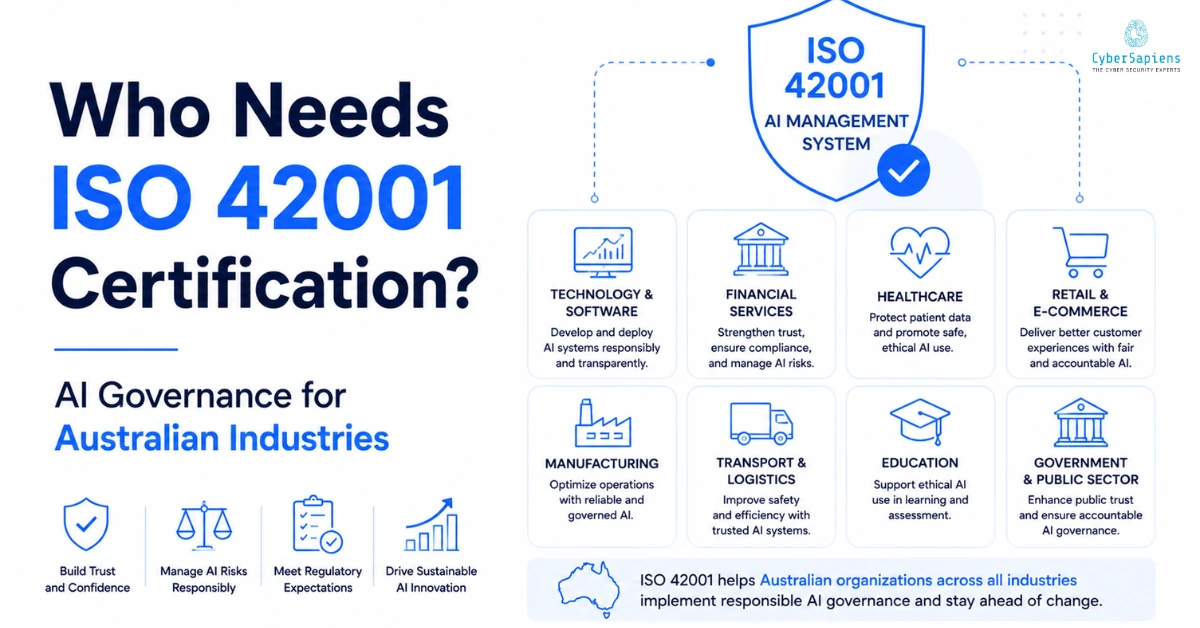
Who Needs ISO 42001 Certification? AI Governance for Australian Industries
Any organisation that develops, deploys, manages, or relies on artificial intelligence can benefit from ISO 42001 certification. While the standard is not mandatory, it provides a recognised framework for managing AI risks, improving governance, and demonstrating responsible AI practices to customers, regulators, and stakeholders.
As AI adoption accelerates across Australia, organisations are increasingly evaluating whether AI governance standards should become part of their broader risk and compliance strategy. Similar to established frameworks such as ISO 27001 certification and implementation, ISO 42001 provides a structured management system approach focused specifically on artificial intelligence governance.
What Is ISO/IEC 42001?
ISO/IEC 42001 is the world’s first certifiable Artificial Intelligence Management System (AIMS) standard. Published in December 2023, the framework helps organisations establish governance controls that manage artificial intelligence systems responsibly throughout their lifecycle.
Australia has adopted the standard as AS ISO/IEC 42001:2023, making it a key benchmark for organisations implementing AI technologies while demonstrating accountability, transparency, and responsible innovation.
Core Areas Covered by ISO 42001
AI Governance
Define policies, responsibilities, oversight structures, and accountability mechanisms.
Risk Assessment
Identify, evaluate, and manage AI-related risks across business processes.
Transparency
Promote explainability and visibility into how AI systems operate.
Human Oversight
Ensure people remain responsible for critical decisions influenced by AI.
Bias Management
Reduce unfair outcomes through structured monitoring and governance controls.
Continuous Improvement
Maintain ongoing monitoring, review, and enhancement of AI governance practices.
According to the official ISO/IEC 42001 standard overview, the framework is designed to help organisations establish, implement, maintain, and continually improve an Artificial Intelligence Management System. For Australian organisations already investing in governance frameworks, ISO 42001 complements broader cybersecurity, compliance, and risk management initiatives.
Does Every Organisation Need ISO 42001 Certification?
No. ISO 42001 certification is not mandatory in Australia. However, organisations that use artificial intelligence in ways that influence customers, employees, operations, compliance activities, or business decisions should strongly consider implementing AI governance controls.
The greater the influence AI has on business outcomes, the stronger the case for adopting ISO 42001. Similar to frameworks such as HIPAA compliance, PCI DSS compliance, and ACSC Essential Eight implementation, ISO 42001 provides a structured framework for managing emerging risks before they become business problems.
Organisations Most Likely to Benefit from ISO 42001
AI Developers
Organisations building AI products, machine learning models, and intelligent automation platforms.
Software Companies
Businesses integrating AI features into software products and SaaS platforms.
Financial Institutions
Banks, insurers, lenders, and FinTech organisations relying on AI-driven decision making.
Healthcare Providers
Healthcare organisations using AI for diagnostics, patient care, and operational efficiency.
Government Agencies
Public sector entities responsible for transparent and accountable AI deployment.
Generative AI Users
Organisations deploying ChatGPT, copilots, AI assistants, content generators, and automation tools.
A Practical AI Governance Question
If an AI system within your organisation can influence decisions, recommendations, customer outcomes, risk assessments, compliance activities, or operational processes, governance becomes a business requirement rather than a technical preference. ISO 42001 provides the structure needed to manage those responsibilities consistently.
Industries That Should Consider ISO 42001 Certification
While ISO 42001 can benefit organisations across almost every sector, certain industries face greater governance, regulatory, ethical, and operational challenges when implementing artificial intelligence. For these organisations, a structured AI management system can significantly reduce risk while improving stakeholder confidence.
The following sectors are among the strongest candidates for ISO 42001 certification due to the potential impact AI systems can have on customers, employees, public trust, and business outcomes.
Technology and Software Companies
Technology providers are among the earliest adopters of artificial intelligence. Many software companies now embed AI into products through chatbots, automation engines, predictive analytics, recommendation systems, and machine learning capabilities.
Certification demonstrates that AI systems are developed, monitored, and maintained within a structured governance framework, helping customers gain confidence in the technology being deployed.
SaaS Providers
Enterprise buyers increasingly ask software vendors about AI governance, transparency, accountability, and risk management. ISO 42001 helps SaaS organisations answer these questions with confidence.
For SaaS companies pursuing larger enterprise contracts, certification can become a competitive advantage during procurement and vendor risk assessments.
Financial Services and FinTech
Financial organisations frequently rely on AI for fraud detection, credit assessments, customer analytics, compliance monitoring, trading systems, and risk modelling.
Because these systems can directly affect customers and financial outcomes, governance, explainability, and accountability become critical business requirements.
Healthcare Organisations
Healthcare providers are increasingly using AI for diagnostics, medical imaging analysis, clinical support, patient engagement, and operational optimisation.
Organisations handling sensitive health information often strengthen governance programmes alongside frameworks such as HIPAA compliance services to ensure privacy and accountability remain central to AI adoption.
Government and Public Sector
Government agencies face heightened scrutiny when implementing artificial intelligence. Public trust depends on transparency, fairness, and clear accountability for AI-assisted decisions.
ISO 42001 provides governance mechanisms that align closely with public sector expectations around risk management and responsible technology adoption.
Educational Institutions
Universities, colleges, and training providers are rapidly introducing AI into student support systems, research projects, learning analytics, and administrative functions.
Governance frameworks help educational institutions balance innovation, ethics, privacy, and accountability while encouraging responsible AI use.
CyberSapiens Insight
Organisations that already maintain cybersecurity, privacy, and compliance programmes often achieve faster ISO 42001 adoption because governance processes already exist. Businesses operating under standards such as ISO 27001, PCI DSS, SOC 2, or Essential Eight frequently find that AI governance naturally extends their existing risk management framework rather than creating an entirely new compliance function.
High-Risk Industries Where AI Governance Matters Most
Some industries face significantly higher consequences when artificial intelligence produces inaccurate, biased, insecure, or poorly governed outcomes. In these sectors, AI governance is not simply a best practice. It is becoming a business necessity for maintaining trust, regulatory compliance, and operational resilience.
Banks, FinTech and Insurance Providers
Financial organisations frequently use AI for credit scoring, fraud detection, customer analytics, anti-money laundering monitoring, risk assessments, and trading systems.
When algorithms influence lending decisions, fraud investigations, or customer eligibility, organisations must demonstrate transparency, accountability, and governance over AI-driven outcomes.
Healthcare and Medical Technology
Healthcare providers increasingly rely on AI for clinical decision support, medical imaging analysis, patient engagement, diagnostics, and operational optimisation.
Organisations handling patient information often align AI governance initiatives alongside privacy and compliance programmes such as HIPAA compliance frameworks to strengthen accountability and patient trust.
Government and Public Sector Agencies
Governments are exploring AI-powered services for policy analysis, citizen engagement, resource allocation, investigations, and service delivery.
Public trust depends on demonstrating responsible governance, explainability, and oversight. ISO 42001 provides a framework that supports these expectations.
Why These Industries Face Greater AI Risk
| Industry | Common AI Applications | Governance Concern |
|---|---|---|
| Financial Services | Credit scoring, fraud detection, risk modelling | Bias, accountability, transparency |
| Healthcare | Diagnostics, clinical support, imaging | Patient safety, explainability |
| Government | Service delivery, policy analysis | Public trust, accountability |
| Education | Learning analytics, AI tutoring | Fairness, privacy, oversight |
CyberSapiens Observation
Organisations operating in highly regulated environments are often the first to experience customer due diligence requests related to AI governance. As procurement teams increasingly evaluate AI controls during vendor assessments, ISO 42001 is emerging as a valuable trust signal alongside frameworks such as ISO 27001, SOC 2, PCI DSS, and Essential Eight.
Organisations Using Generative AI Should Pay Particular Attention
One of the fastest-growing groups evaluating ISO 42001 certification is organisations using generative AI. While many businesses are not building AI systems themselves, they are increasingly deploying AI-powered tools that influence business operations, employee productivity, customer interactions, and decision-making processes.
As adoption expands, organisations must address governance questions surrounding accountability, oversight, risk management, data protection, and responsible usage. ISO 42001 provides a structured framework for managing these challenges consistently across the organisation.
Large Language Models
Organisations using tools powered by large language models for content generation, analysis, and automation should establish clear governance controls.
AI Assistants and Copilots
Internal AI assistants can improve productivity, but they also introduce governance challenges related to data handling, access controls, and output validation.
Customer Support Automation
AI-powered chatbots and customer support systems directly interact with customers, making transparency and accountability increasingly important.
Content Generation Platforms
Marketing, training, and communications teams increasingly use generative AI to create content, creating new governance considerations around accuracy and oversight.
Questions Organisations Should Ask About Generative AI
How is generative AI currently being used across the organisation?
What business, compliance, security, or reputational risks exist?
Who remains accountable for AI-generated outputs and decisions?
How are outputs reviewed before they affect customers, employees, or operations?
What governance controls exist to monitor ongoing AI usage?
CyberSapiens Insight
One of the most common misconceptions is that AI governance only applies to organisations building artificial intelligence products. In reality, organisations using third-party AI platforms often face the same governance, privacy, security, and accountability obligations. As generative AI becomes embedded in everyday business processes, governance maturity is becoming just as important as technical capability.
Organisations That May Not Need ISO 42001 Certification Yet
While ISO 42001 provides significant value for organisations with established AI programmes, not every business needs to pursue certification immediately. The decision should be based on the scale of AI adoption, the impact of AI on business operations, and the level of governance risk involved.
Many organisations begin by introducing governance policies, risk assessments, security controls, and oversight mechanisms before progressing towards formal certification. This phased approach often allows businesses to mature their AI governance programme at a practical pace.
Small Businesses with Minimal AI Usage
Organisations using only basic AI-powered productivity tools with limited operational impact may not require certification immediately.
Early-Stage AI Experiments
Organisations testing AI proof-of-concepts or pilot projects can focus on governance planning before pursuing formal certification.
Businesses Evaluating AI Adoption
Companies still assessing how artificial intelligence may fit into future operations can establish governance principles before implementing AI at scale.
Organisations with No Operational AI Systems
Businesses that do not currently rely on AI-driven processes may choose to delay certification until AI becomes part of strategic operations.
Governance First, Certification Second
Certification should not be viewed as the starting point of AI governance. Organisations often achieve better outcomes by first establishing governance policies, risk management processes, accountability structures, security controls, and employee awareness programmes.
Similar to how organisations strengthen cybersecurity maturity through initiatives such as employee awareness training and phishing simulation programmes, AI governance is often most effective when it becomes part of broader organisational culture rather than a standalone compliance exercise.
When Should Certification Become a Priority?
Certification becomes increasingly valuable when AI starts influencing customer outcomes, operational decisions, compliance obligations, risk management activities, or revenue-generating services. As stakeholder expectations and regulatory scrutiny continue to evolve, organisations with mature governance frameworks will be better positioned to demonstrate responsible AI practices.
How to Determine Whether Your Organisation Needs ISO 42001
Many organisations understand the importance of responsible AI but struggle to determine whether ISO 42001 certification is necessary for their specific situation. A practical assessment starts by evaluating how deeply artificial intelligence is integrated into business operations and how much influence AI has on organisational outcomes.
The more AI influences decision-making, customer experiences, compliance obligations, operational processes, or revenue-generating activities, the stronger the business case for implementing an Artificial Intelligence Management System aligned with ISO 42001.
ISO 42001 Readiness Assessment
| Assessment Question | If Yes |
|---|---|
| Does your organisation use AI in day-to-day operations? | Consider ISO 42001 implementation |
| Does AI influence customer outcomes or experiences? | Strong candidate for certification |
| Does AI support business or operational decisions? | Strong candidate for certification |
| Are customers or regulators asking governance questions? | Strong business case exists |
| Do you develop AI-enabled products or services? | High priority for implementation |
| Do you use generative AI extensively across teams? | High priority for governance controls |
Low Priority
Organisations with little or no AI usage, limited experimentation, and minimal exposure to AI-driven decision-making may not require certification immediately.
Medium Priority
Organisations using AI within selected departments should consider establishing governance policies and readiness assessments before pursuing certification.
High Priority
Organisations developing AI solutions, using generative AI extensively, or operating in regulated industries should strongly consider ISO 42001 implementation and certification.
CyberSapiens Recommendation
Organisations do not need to wait for regulations to mandate AI governance before taking action. Businesses that begin governance initiatives early often experience smoother adoption, reduced compliance risk, and greater stakeholder confidence when AI programmes expand.
Many organisations already perform governance activities through cybersecurity assessments, risk management programmes, and compliance initiatives such as SOC 2 compliance, SOC 1 compliance, and SOC 3 compliance. ISO 42001 builds upon these governance foundations specifically for artificial intelligence.
How ISO 42001 Aligns with Australia’s AI Governance Direction
Australia continues to encourage responsible artificial intelligence adoption through evolving governance frameworks, industry guidance, and regulatory discussions. While ISO 42001 certification is voluntary, many of its core principles closely align with the direction Australian policymakers and regulators are taking regarding AI accountability and risk management.
Organisations that establish structured AI governance frameworks today will be better prepared to adapt to future regulatory expectations while demonstrating responsible AI practices to customers, investors, and stakeholders.
Shared Principles Between ISO 42001 and Australia’s AI Direction
Accountability
Organisations remain responsible for decisions influenced by artificial intelligence, regardless of the technology used.
Transparency
AI systems should operate in ways that are explainable and understandable to relevant stakeholders.
Human Oversight
Human review and intervention remain essential when AI influences significant business outcomes.
Risk Management
AI-related risks should be identified, assessed, monitored, and continuously managed.
Why Organisations Are Acting Before Regulations Require It
Waiting for mandatory AI regulations can create unnecessary operational and compliance challenges. Many organisations are proactively implementing governance frameworks because customers, investors, procurement teams, and business partners are already asking questions about responsible AI practices.
Similar trends have been observed with cybersecurity frameworks such as ISO 27001 certification and Essential Eight compliance, where governance maturity increasingly influences purchasing decisions, vendor assessments, and market trust.
External Perspective
According to the Australian Government’s Voluntary AI Safety Standard, organisations should implement appropriate governance, accountability, transparency, and risk management practices when deploying artificial intelligence. ISO 42001 provides a practical operational framework that helps organisations implement many of these principles consistently across the business.
Frequently Asked Questions About ISO 42001 Certification
Organisations evaluating AI governance frameworks often have practical questions about certification requirements, implementation, applicability, and business value. The following FAQs address the most common questions raised by Australian businesses exploring ISO 42001 certification.
Who needs ISO 42001 certification?
Any organisation that develops, deploys, manages, or relies on artificial intelligence can benefit from ISO 42001 certification. The strongest candidates are organisations where AI influences business decisions, customer outcomes, compliance obligations, or operational processes.
Is ISO 42001 mandatory in Australia?
No. ISO 42001 is currently a voluntary standard. However, many organisations are implementing AI governance frameworks proactively to improve risk management, strengthen stakeholder trust, and prepare for evolving regulatory expectations.
Do SaaS companies need ISO 42001?
Many SaaS providers benefit from ISO 42001, particularly those offering AI-powered products, machine learning capabilities, intelligent automation, analytics platforms, or generative AI functionality.
Does ISO 42001 apply to organisations using generative AI?
Yes. ISO 42001 is highly relevant for organisations deploying generative AI tools such as AI assistants, content generation platforms, chatbots, copilots, and large language model-based solutions.
Can small businesses implement ISO 42001?
Yes. The framework is scalable and can be adapted to organisations of different sizes. Small businesses can implement governance controls proportionate to their AI usage and organisational complexity.
How does ISO 42001 relate to cybersecurity frameworks?
ISO 42001 complements cybersecurity and compliance frameworks such as ISO 27001, SOC 2, PCI DSS, and Essential Eight. While those frameworks focus on information security and risk management, ISO 42001 specifically addresses AI governance and oversight.
Is Your Organisation Ready for ISO 42001?
Artificial intelligence is rapidly becoming embedded within business operations across Australia. From customer service and analytics to healthcare, finance, and software development, organisations are increasingly relying on AI systems to improve efficiency, automate processes, and support decision-making.
As AI adoption expands, governance is becoming a strategic business priority. Organisations that proactively establish governance frameworks are better positioned to manage risks, demonstrate accountability, strengthen stakeholder confidence, and adapt to future regulatory expectations.
Whether your organisation develops AI technologies, deploys generative AI tools, or relies on AI-assisted business processes, ISO 42001 provides a recognised framework for responsible AI governance. Businesses that start building governance maturity today will be better prepared for tomorrow’s operational, compliance, and market expectations.
Organisations Often Begin with Existing Governance Foundations
Many organisations already maintain governance programmes through cybersecurity, risk management, compliance, and assurance initiatives. Existing frameworks such as ISO 27001 certification, SOC 2 compliance, PCI DSS compliance, and Essential Eight implementation often provide a strong starting point for building AI governance capabilities.
ISO 42001 extends these governance principles into the artificial intelligence lifecycle, helping organisations manage emerging AI risks while supporting innovation and business growth.
Speak with CyberSapiens About ISO 42001 Certification
If your organisation is evaluating whether ISO 42001 certification is the right fit for your industry, AI use case, governance objectives, or compliance strategy, CyberSapiens can help. Our specialists assist Australian organisations with AI governance assessments, readiness reviews, implementation planning, risk management frameworks, and certification preparation.
Port Melbourne, Australia

Shabari Shankar
Shabari Shankar is a cybersecurity content specialist focused on governance, risk, compliance, artificial intelligence governance, information security, and emerging technology trends. She develops educational content that helps organisations understand complex cybersecurity and compliance frameworks through practical, business-focused guidance.
Working closely with CyberSapiens subject matter experts, Shabari creates authoritative resources covering ISO standards, AI governance, penetration testing, compliance frameworks, security awareness, and cybersecurity best practices for Australian organisations.
