
Why Indian Pharma and Healthtech Companies Are Adopting ISO 27001
Indian pharma and healthtech companies are adopting ISO 27001 because three pressures now arrive together. ISO 27001 does not replace GxP, but it gives these pressures a single, auditable security management system. The three drivers are:
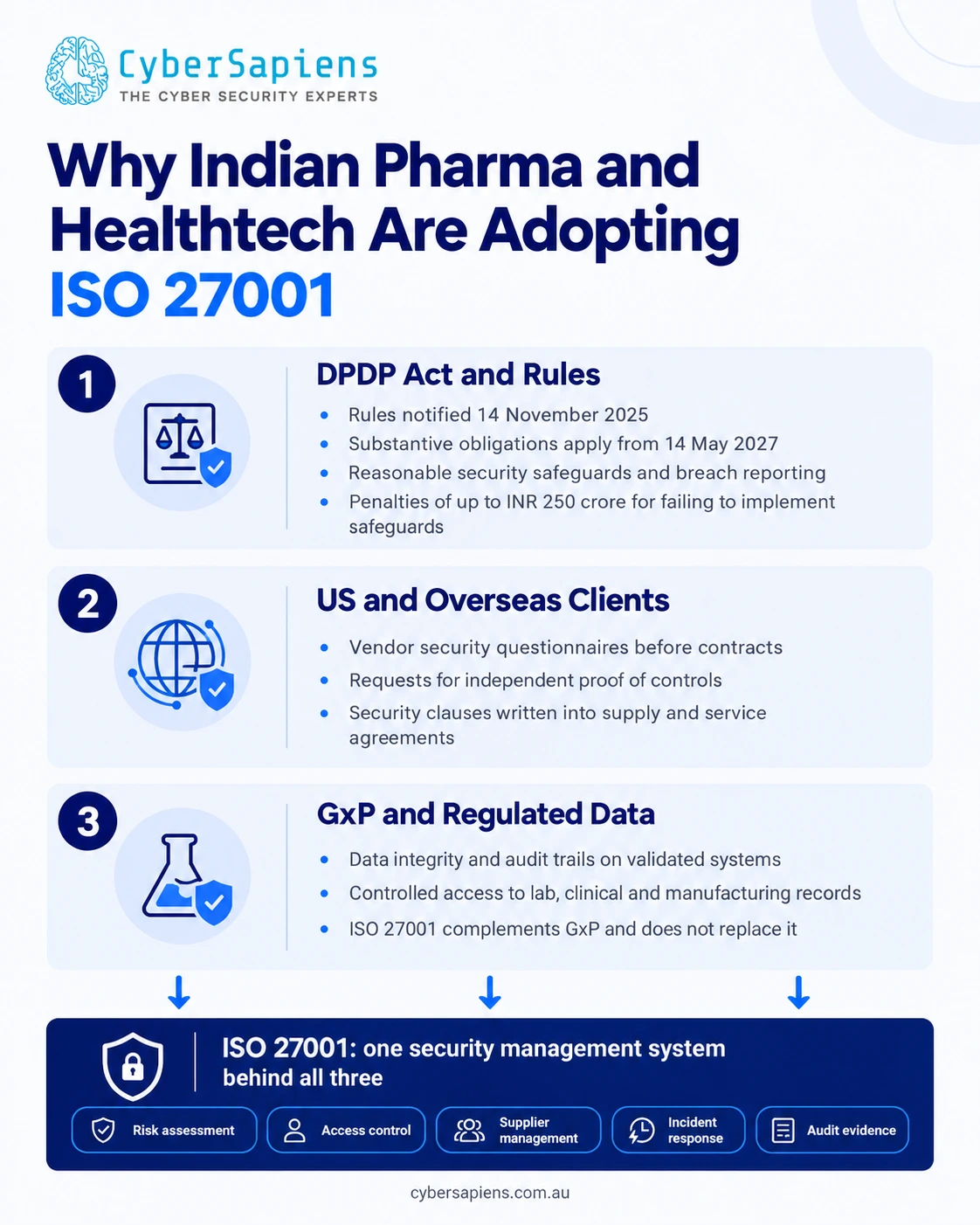
- The DPDP Act and Rules, which require reasonable security safeguards and breach reporting from 14 May 2027.
- Security due diligence from US and other overseas clients, who often ask for independent proof of controls.
- The need to protect GxP-relevant, clinical and patient data on systems that attackers actively target.
ISO 27001 for pharma companies in India has moved from a nice-to-have to a procurement and regulatory question. Manufacturers, CROs, diagnostics firms and healthtech platforms now hold large volumes of patient, trial and manufacturing data. Several pressures to protect that data are arriving at the same time.
According to the Press Information Bureau, the Digital Personal Data Protection Rules were notified on 14 November 2025 with an 18-month phased compliance period. The substantive obligations, including security safeguards and breach reporting, apply from 14 May 2027. The Act allows penalties of up to INR 250 crore for failing to implement reasonable security safeguards.
This guide explains each driver, maps it to what an ISO 27001 programme delivers, and covers practical implementation notes for pharma environments. You can also read about our wider ISO 27001 certification and implementation service.
What ISO 27001 Does and Does Not Cover in Pharma
ISO/IEC 27001:2022 is an information security management standard. It covers how you identify security risks, choose and operate controls, and show an independent auditor that the system works. It does not replace GxP, GMP or computerised system validation, which govern product quality and data integrity in regulated processes.
In practice the two sit side by side. GxP defines what a trustworthy record looks like, and ISO 27001 helps protect the systems, access paths and suppliers that create and store it. Treating them as one connected programme avoids running two separate sets of evidence for the same systems.
The Regulatory Pressure Map: DPDP, US Clients and GxP
Three separate pressures push Indian pharma and healthtech companies towards the same answer. The infographic summarises them, and the table and notes below show what each one asks for and how an ISO 27001 programme responds.
| Pressure | What it asks for | How ISO 27001 helps |
|---|---|---|
| DPDP Act and Rules | Reasonable security safeguards and breach reporting, with substantive obligations from 14 May 2027 | A risk-based set of access, logging and incident response controls that produces evidence of safeguards |
| US and overseas clients | Security questionnaires, contract clauses and independent proof of controls | A certificate from an accredited body and one audited evidence set that answers most questionnaires |
| GxP and regulated data | Reliable, accurate records and controlled access to computerised systems | Access control, change management, logging and supplier management around the systems that hold regulated data |
Pressure 1: The DPDP Act and Rules
Pharma and healthtech companies process some of the most sensitive personal data in the economy, including patient records, trial participant data and prescription histories. When the substantive DPDP obligations apply on 14 May 2027, the business will need to show that it has taken reasonable security safeguards and can report a breach. An audited ISO 27001 programme gives you a structured, documented way to show both.
ISO 27001 does not make a company DPDP compliant on its own. Consent notices, data principal rights and retention rules sit outside the standard, so they need a separate privacy workstream that runs alongside it.
Pressure 2: US and Overseas Clients
Overseas sponsors, distributors and health system customers often send detailed security questionnaires before a contract is signed, and many ask for independent proof of controls. Answering each one from scratch is slow and risky, because the answers have to stay consistent across every client.
A single audited ISMS lets you reuse one evidence set across questionnaires. Some clients will also ask for HIPAA compliance or SOC 2 evidence, so it is worth scoping the ISMS with those requests in mind.
Pressure 3: GxP and Regulated Data
The FDA’s data integrity guidance for drug CGMP describes data integrity as the completeness, consistency and accuracy of data, and it addresses how access to computerised systems should be restricted. Indian manufacturers that supply the US market can be inspected against these expectations.
ISO 27001 does not validate a laboratory or manufacturing system. What it adds is the security governance around those systems, such as who can access them, how changes are controlled, what is logged and which suppliers can touch them.
Key takeaway
One risk assessment can serve all three audiences. When the ISMS scope covers corporate IT, laboratory and manufacturing systems and cloud platforms, the same evidence answers the regulator, the overseas client and the quality auditor.
Implementation Notes for Pharma and Healthtech Environments
A pharma or healthtech ISO 27001 project differs from a typical office-based programme because regulated systems, validated software and external partners all sit inside the risk picture. Getting the scope and the interfaces with your quality system right early saves months later.
Six Practical Notes for Scoping and Delivery
1. Scope by data and system, not by building
Define the ISMS around the systems and data that matter, such as corporate IT, laboratory and manufacturing systems, clinical data platforms and cloud services. Record what is excluded and why, because auditors and overseas clients will ask.
2. Build the asset inventory around regulated systems
List laboratory, quality, manufacturing execution and clinical systems first, and mark which ones hold regulated records. Flag legacy operating systems and instruments that cannot be patched, since they need compensating controls rather than a standard fix.
3. Deal with shared and generic accounts
Shared logins on instruments and workstations weaken both access control and the traceability that data integrity relies on. Move to unique identities wherever the system allows it, and document the compensating controls where it does not.
4. Connect change control to your quality system
Security-relevant changes and validated-system changes should flow through one change process, not two competing ones. Reusing existing quality records as ISMS evidence cuts duplicated approvals and keeps audit preparation manageable.
5. Treat CROs, CMOs and SaaS vendors as in-scope risk
Contract partners and software suppliers often hold your most sensitive data. Assess them by risk, write security clauses into contracts and ask for evidence such as an ISO 27001 certificate or a SOC 2 report. If you sell software to other companies, you may also need SOC 2 compliance alongside ISO 27001.
6. Align incident response with the reporting clocks
The CERT-In directions of April 2022 require listed cyber incidents to be reported within six hours and system logs to be kept for 180 days within India. Build your escalation path and log retention around these requirements now, so the DPDP breach reporting duty in 2027 slots into a plan that already works.
Common Mistakes to Avoid
- Setting the scope so narrowly that the certificate does not cover the systems your clients actually ask about.
- Copying quality system procedures into the ISMS unchanged instead of adding the security controls they lack.
- Leaving laboratory and manufacturing technology out of the risk assessment because it sits outside the IT team.
- Treating certification as a one-off event, when annual surveillance audits and a three-year recertification cycle follow.
The scenario below shows how these notes can play out in a typical mid-sized pharma or healthtech environment.
Illustrative Scenario: A Mid-Sized Formulation Manufacturer
The scenario below is an illustrative example and does not describe a specific client. It shows how the implementation notes above can combine on a realistic project.
Situation, Approach and Outcome
The situation
A mid-sized formulation manufacturer in India supplies a US distributor. The distributor sends a detailed security questionnaire and asks for independent proof of controls before renewing the contract.
Inside the company, laboratory instruments use shared logins, supplier access is informal, and nobody owns the plan for the DPDP obligations arriving in 2027.
The approach
- Scope the ISMS around corporate IT, laboratory and quality systems and the cloud platforms that hold regulated records.
- Build an asset inventory and a risk assessment that rank regulated systems first.
- Replace shared accounts, set log retention and write an incident escalation path.
- Review the main suppliers, then complete the certification audit with an accredited body.
What a good outcome looks like
- One audited evidence set that answers the distributor’s questionnaire and future ones.
- Named owners for access, change, supplier risk and incident response.
- A tested escalation path that already fits the CERT-In clock and can absorb the DPDP duty later.
Timelines and effort vary with scope, existing controls and the number of sites. To see how CyberSapiens has supported other organisations, browse our case studies.
Frequently Asked Questions About ISO 27001 for Pharma and Healthtech in India
Is ISO 27001 mandatory for pharma companies in India?
ISO 27001 is a voluntary standard, and the DPDP Act requires reasonable security safeguards without naming it. In practice, many overseas clients, partners and tenders ask for it as proof of those safeguards, which is why adoption is rising across pharma and healthtech.
Does ISO 27001 replace GxP or data integrity requirements?
No, ISO 27001 complements GxP and does not replace it. GxP and computerised system validation govern product quality and the reliability of regulated records, while ISO 27001 secures the systems, access paths and suppliers around them.
Does ISO 27001 make a company DPDP compliant?
No, ISO 27001 supports the security safeguards and breach readiness that the DPDP Act and Rules expect, but it does not cover everything. Consent notices, data principal rights and retention rules need a separate privacy workstream that runs alongside the ISMS.
How long does ISO 27001 take for a pharma or healthtech company?
Most programmes take several months, and the timeline depends on scope, the number of sites and how mature your controls already are. After certification, annual surveillance audits follow and the certificate is renewed on a three-year cycle. A scoping call is the most reliable way to get an estimate for your business.
How do we choose a certification body?
Choose a certification body accredited by a recognised national accreditation body, such as NABCB in India, because overseas clients may check the accreditation behind your certificate. The body that certifies you should also be independent of the team that helped you implement the ISMS.

Ketki Tidke
Cyber Security and GRC Lead Auditor
ISO 27001 Lead Auditor
ISO 27001 Certified
Ketki is a certified ISO 27001 Lead Auditor specialised in Governance, Risk and Compliance, with experience consulting public, private, and government clients. She evaluates threats, risk impacts, and regulatory requirements across multiple industry frameworks.
Planning ISO 27001 for Your Pharma or Healthtech Business?
Speak with our India team about scoping your ISMS, the DPDP timeline, overseas client requirements and how ISO 27001 fits alongside your GxP programme. The first conversation is a consultation, with no obligation to proceed.
Book an India Team ConsultationCALL US
+91 63640 11010EMAIL US
[email protected]OUR LOCATION
D.No. 1-170/31, First Floor, Roben Plaza, Airport Road, Padavinangady, Mangalore – 575 008
