
Why ISO 27001 is Mandatory for SaaS Companies Expanding into the European Market?
As SaaS companies expand into the European market, security and compliance become critical business enablers, not optional add-ons. European customers, enterprises, and regulators place a strong emphasis on how organizations protect sensitive data, manage risks, and respond to security incidents. For SaaS providers handling customer data at scale, demonstrating robust information security practices is essential to winning trust and closing deals in the EU.
This is where ISO 27001 comes in. Recognized globally as the gold standard for information security management, ISO 27001 helps SaaS companies establish a structured, risk-based approach to protecting data, applications, and cloud infrastructure. While ISO 27001 is not legally mandated by the EU, it has effectively become a de facto requirement for SaaS companies targeting European enterprises, partners, and regulated industries.
Understanding ISO 27001 and Its Role in SaaS Security
ISO 27001 is an international standard that defines how organizations should establish, implement, maintain, and continually improve an Information Security Management System (ISMS). Rather than focusing on a single security tool or technology, ISO 27001 takes a holistic, risk-based approach to protecting information across people, processes, and systems—making it especially relevant for SaaS companies operating in dynamic cloud environments.
For SaaS providers, information security goes beyond protecting customer databases. It includes securing cloud infrastructure, APIs, application code, CI/CD pipelines, access controls, and third-party integrations. ISO 27001 helps SaaS companies systematically identify security risks across these areas and apply appropriate controls to reduce the likelihood and impact of data breaches, service disruptions, and compliance failures.
A key strength of ISO 27001 is its flexibility. The standard allows SaaS companies to tailor security controls based on their business model, data sensitivity, and regulatory exposure. This makes it well-suited for startups and scaling SaaS businesses that need strong security governance without slowing innovation.
By implementing ISO 27001, SaaS companies can demonstrate to European customers and regulators that security is embedded into their operations, not treated as an afterthought.
Why ISO 27001 Is Effectively Mandatory for the European Market?
- Enterprise Procurement Requirements: European enterprises and large organizations often require ISO 27001 certification during vendor onboarding. SaaS companies without it may face delayed approvals or disqualification.
- Vendor Risk & Security Due Diligence: ISO 27001 simplifies security questionnaires and audits by providing standardized proof of mature information security practices.
- Stronger GDPR Accountability: Although GDPR does not mandate ISO 27001, the standard helps demonstrate compliance with GDPR principles such as risk management, data protection by design, and breach preparedness.
- Customer Trust & Market Credibility: ISO 27001 acts as a trust signal for EU customers, showing that security and data protection are embedded into business operations.
- Reduced Sales Friction in the EU: Certified SaaS companies experience faster deal closures and fewer security objections during negotiations.
- Competitive Advantage Over Non-Certified Vendors: In a crowded SaaS market, ISO 27001 helps differentiate security-focused vendors from competitors lacking formal certification.
Key Benefits of ISO 27001 for SaaS Companies
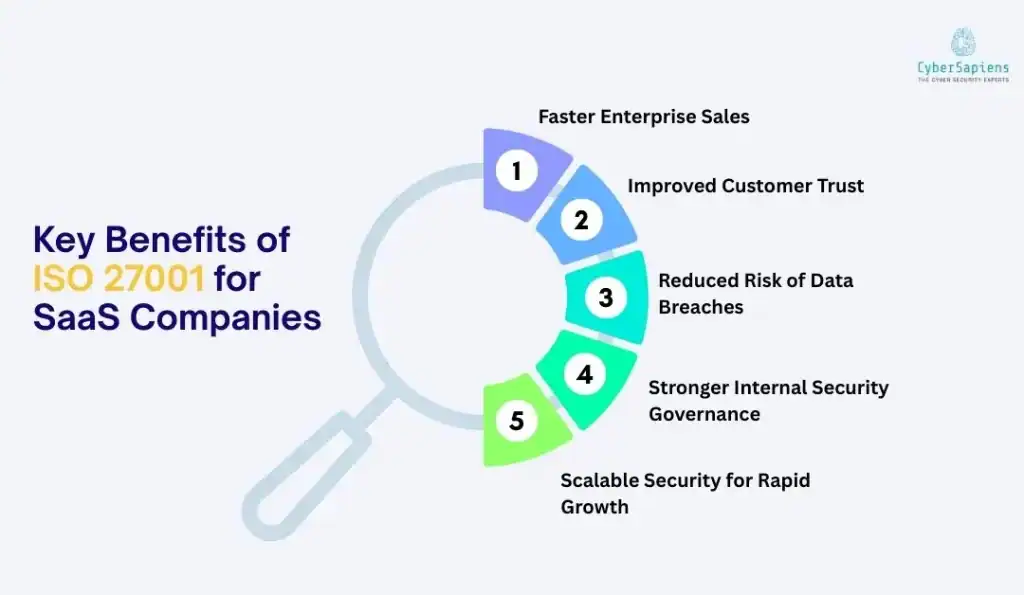
- Faster Enterprise Sales in Europe: ISO 27001 reduces security-related objections during EU enterprise sales cycles, helping SaaS companies close deals faster.
- Improved Customer Trust and Confidence: Certification reassures European customers that their data is protected through internationally recognized security practices.
- Reduced Risk of Data Breaches and Downtime: A structured risk management approach helps prevent security incidents that could disrupt SaaS operations or impact availability.
- Stronger Internal Security Governance: Clearly defined policies, roles, and responsibilities improve consistency across engineering, DevOps, and operations teams.
- Scalable Security for Rapid Growth: ISO 27001 supports business expansion by providing a repeatable security framework that scales with users, data, and infrastructure.
Common Challenges SaaS Companies Face During ISO 27001 Implementation
- Limited Internal Compliance Expertise: Many SaaS teams lack dedicated ISO 27001 or information security specialists, making interpretation and implementation challenging.
- Complex Documentation Requirements: Creating and maintaining ISMS policies, risk registers, and procedures can be time-consuming without expert guidance.
- Aligning Cloud, DevOps, and Security Controls: Mapping ISO 27001 controls to modern cloud architectures, CI/CD pipelines, APIs, and microservices is often complex.
- Balancing Security with Rapid Product Development: Fast-paced SaaS environments struggle to integrate compliance without slowing down releases and innovation.
- Time and Cost Constraints: Certification can appear expensive and resource-intensive, especially for startups and scaling SaaS companies.
- Audit Readiness and Evidence Collection: Preparing for internal and external audits requires continuous monitoring, logs, and proof of control effectiveness.
How CyberSapiens Helps SaaS Companies Achieve ISO 27001 Faster?
Expanding into the European market requires more than understanding ISO 27001; it requires executing it efficiently without slowing product innovation. Cyber experts at CyberSapiens work closely with SaaS companies to simplify ISO 27001 implementation by combining regulatory expertise, cloud security knowledge, and hands-on execution. The result is a faster, smoother certification journey aligned with EU customer and compliance expectations.
CyberSapiens’ ISO 27001 Services for SaaS Companies
1. ISO 27001 Readiness & Gap Assessment
CyberSapiens begins by assessing your current security posture against ISO 27001 requirements. This readiness review identifies existing controls, highlights compliance gaps, and prioritizes risks based on your SaaS architecture, data flows, and EU market exposure, providing a clear, actionable roadmap to certification.
2. Risk Assessment & ISMS Design
A robust ISMS is the foundation of ISO 27001. CyberSapiens designs a SaaS-specific ISMS that aligns with cloud infrastructure, APIs, DevOps pipelines, and third-party integrations. Risks are identified, evaluated, and treated using a structured, business-aligned approach that supports scalability and continuous improvement.
3. Policy, Process & Documentation Support
Documentation is one of the biggest challenges for SaaS companies. CyberSapiens develops ISO 27001–compliant policies, procedures, risk registers, and Statements of Applicability that are tailored to European regulatory expectations, ensuring documentation is audit-ready, practical, and aligned with real operations.
4. Technical Security Controls Advisory
CyberSapiens provides expert guidance on implementing technical controls such as identity and access management, logging and monitoring, encryption, vulnerability management, and secure software development practices. These controls are mapped directly to ISO 27001 requirements and adapted for modern SaaS environments.
5. Internal Audit & Certification Readiness Support
Before external audits, CyberSapiens conducts internal audits to validate control effectiveness, identify non-conformities, and support remediation. This ensures SaaS companies enter certification audits with confidence, complete evidence, and minimal risk of delays or failures.
6. Continuous Compliance & Security Monitoring
ISO 27001 is an ongoing commitment, not a one-time milestone. CyberSapiens supports post-certification compliance through continuous monitoring, periodic risk reviews, audit support, and security advisory services, helping SaaS companies stay compliant as they grow and face new threats.
Clients Served by CyberSapiens

ISO 27001 as a Growth Enabler for European Expansion
For SaaS companies expanding into the European market, ISO 27001 is no longer just a security certification; it is a strategic enabler of growth. European customers, enterprises, and partners expect demonstrable commitment to information security, risk management, and data protection. ISO 27001 provides the structured framework SaaS businesses need to meet these expectations while building long-term trust.
By implementing ISO 27001, SaaS companies can accelerate enterprise sales, reduce compliance friction, strengthen GDPR alignment, and scale securely across Europe. More importantly, it embeds security into everyday operations, ensuring resilience as platforms, users, and data volumes grow.
With its SaaS-focused ISO 27001 consulting and cybersecurity services, CyberSapiens helps organizations turn compliance into a competitive advantage. By simplifying implementation and supporting continuous compliance, CyberSapiens enables SaaS companies to expand into Europe with confidence, credibility, and a security-first mindset.
FAQs: Why ISO 27001 is Mandatory for SaaS Companies Expanding into the European Market?
1. Why do European customers prefer ISO 27001–certified SaaS vendors?
Answer: ISO 27001 provides independent assurance that a SaaS company follows internationally recognized information security practices. It reduces perceived risk for customers and simplifies security due diligence.
2. How does ISO 27001 help with GDPR compliance?
Answer: ISO 27001 supports GDPR requirements by enforcing risk-based security controls, incident response processes, access management, and accountability. While it does not replace GDPR, it significantly strengthens compliance posture.
3. How long does it take for a SaaS company to achieve ISO 27001?
Answer: For most SaaS companies, ISO 27001 implementation and certification typically takes 3 to 6 months, depending on organization size, existing security maturity, and availability of internal resources.
4. Can startups and growing SaaS companies achieve ISO 27001?
Answer: Yes. ISO 27001 is scalable and flexible, making it suitable for startups, scale-ups, and enterprise SaaS companies. The key is tailoring controls to the business model and risk profile.
