
7 Signs Your Business Needs a Virtual CISO
When to hire a vCISO comes down to one question: is anyone senior accountable for cyber risk at the moment an outside pressure forces the issue? If the answer is no, and a regulator, customer, insurer or board member is asking, it is time to bring one in. The three loudest signs are:
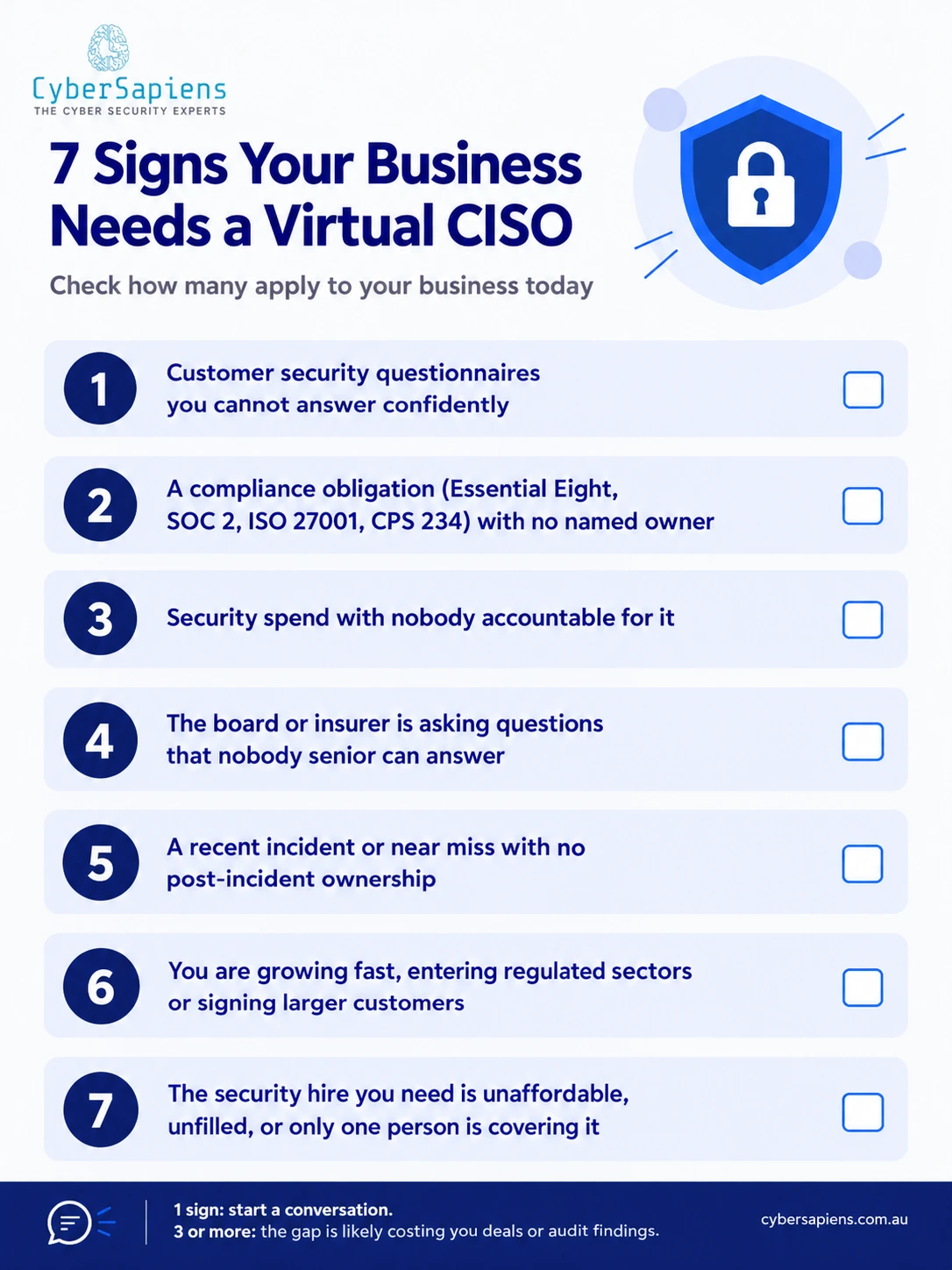
- Customer security questionnaires or contract clauses you cannot answer with confidence.
- A compliance obligation that has no named internal owner.
- A security budget with nobody accountable for how it is spent.
Knowing when to hire a vCISO is rarely about company size. It is about whether a senior person owns cyber risk when something external forces the question. For many Australian mid-market businesses, that moment arrives as a customer security review, a regulator query, or a board member asking who is accountable.
A virtual CISO is a part-time, executive-level security leader who sets strategy, owns the risk register and reports to the board without the cost of a permanent hire. You can read how this works in practice on our virtual CISO services page. The seven signs below are practical triggers, written so you can check them against your own business in a few minutes.
Where a sign points to a specific obligation, we link to the relevant guidance so you can see what is actually being asked of you. Examples include ACSC Essential Eight compliance and SOC 2 compliance in Australia, both of which customers and regulators increasingly expect to see evidence of.
How to Use This Checklist
Read each sign and mark it as true, partly true or not true for your business today. As a rule of thumb, one clear sign is a reason to start a conversation, and several signs together suggest the gap is already costing you time, deals or audit findings.
Even a basic question can act as an early signal. The Australian Signals Directorate advises organisations to plan a target maturity level suited to their environment in its Essential Eight maturity model. If nobody in your business can say what your target is, that gap is worth closing before the next audit or customer review.
The 7 Signs Explained
Each sign below describes what it looks like in practice, a short hypothetical scenario, and what a virtual CISO changes. The scenarios are illustrative examples and do not describe a specific client.
Customer Security Questionnaires You Cannot Answer Confidently
Enterprise and government buyers routinely send security questionnaires before they sign. If the answers are drafted by whoever has time, copied from an old response or left to sales, the business is making commitments that nobody has verified.
A 60-person software company is two weeks from signing a large customer when a 200-question security review arrives. The IT manager answers what he can and sales guesses the rest, so several answers describe controls that are planned rather than in place. The deal stalls when the customer asks for evidence.
What a vCISO changes: one accountable person owns the answers, keeps an evidence library behind them and decides which commitments the business can genuinely keep.
A Compliance Obligation With No Named Owner
Obligations such as the Essential Eight, SOC 2, ISO 27001 and APRA CPS 234 often arrive through a contract rather than a regulator. Under CPS 234, the board of an APRA-regulated entity is ultimately responsible for information security, as set out in APRA’s CPG 234 guidance. Those entities must also look at the security capability of the third parties that handle their information, which is how the obligation reaches suppliers.
A logistics firm signs a contract with a bank that includes information security clauses. Legal files the contract, IT assumes compliance owns it, and compliance assumes IT does. Nobody reviews the obligations until the first audit request arrives.
What a vCISO changes: every obligation gets a named owner, a control mapping and a review date, so nothing is discovered at audit time.
Security Spend With Nobody Accountable for It
Tools get bought one at a time, usually after a scare or a customer request. Without a risk-based plan, the business cannot say what it is protected against or where the gaps remain.
A professional services firm pays for endpoint protection, email filtering, an annual penetration test and a training platform. Each was bought by a different manager, none has been mapped to a risk, and the board cannot say which risks remain uncovered.
What a vCISO changes: spend is tied to a prioritised risk register, and the business can see what each dollar reduces. Our governance, risk and compliance services support this work.
The Board or Insurer Is Asking Questions Nobody Senior Can Answer
Directors increasingly ask which Essential Eight maturity level the business has reached, or what the plan is if ransomware hits. Cyber insurers ask similar questions at renewal. When the answers depend on one technical person, the board is signing off on information it has not properly been briefed on.
At renewal, a cyber insurer asks about multi-factor authentication coverage, backup testing and incident response planning. The finance director forwards the form to IT, which answers the technical items but cannot say how they connect to the business’s risk appetite.
What a vCISO changes: security is reported to the board in business terms, with a clear view of current posture, target posture and the work in between.
A Recent Incident or Near Miss With No Post-Incident Ownership
After an incident, somebody has to own the root cause, the fixes, any notification decisions and the updates to the response plan. When the fix is only a password reset, the same weakness usually stays in place.
A staff mailbox is compromised through a phishing email. IT resets the password and moves on. Nobody checks whether other accounts were affected, whether notification was required, or why multi-factor authentication was not enforced.
What a vCISO changes: every incident ends with a documented review, an owner for each fix and a tested response plan. A follow-up security audit can confirm the gaps are closed.
You Are Growing Fast, Entering Regulated Sectors or Signing Larger Customers
Security practices built for a small team rarely scale on their own. A new regulated customer, a new market or a doubling of headcount can raise expectations faster than the controls can keep up.
A fintech startup lands its first bank partner and doubles its headcount within a year. Its security practices were designed for 15 people and have not been revisited since.
What a vCISO changes: a roadmap that matches security maturity to the business’s growth plan, so controls arrive before customers ask for them.
The Security Hire You Need Is Unaffordable, Unfilled or Rests on One Person
Many mid-sized businesses cannot justify a full-time CISO, or cannot fill the role quickly. In the meantime, security often depends on a single administrator, which is a key-person risk in its own right.
A manufacturer has relied on one senior IT administrator for security for years. When he gives notice, nobody else knows the firewall rules, the backup configuration or the vendor contacts.
What a vCISO changes: security knowledge moves out of one person’s head and into documented policies, runbooks and a tested plan.
If three or more of these signs sound familiar, the gap is likely already affecting deals, audits or renewals. The next step is to understand how a vCISO differs from the other options on the market.
vCISO vs MSSP vs Security Consultant
Many businesses hire the wrong type of help because the three roles sound similar. A vCISO leads and governs, an MSSP operates and monitors, and a consultant delivers a defined piece of work. The NIST Cybersecurity Framework 2.0 treats governance as its own function alongside protecting, detecting and responding, and governance is the part a vCISO covers.
| Factor | vCISO | MSSP | Security Consultant |
|---|---|---|---|
| Main purpose | Sets security strategy and owns risk and compliance direction | Monitors and responds to threats day to day, often through a SOC | Delivers a defined project, assessment or piece of advice |
| Typical deliverables | Security roadmap, risk register, policies, board reporting, vendor risk oversight, incident response planning | Round-the-clock monitoring, alert triage, managed detection and response, log and device management | Gap assessments, audits, implementation support, penetration testing, written reports |
| Accountability | Ongoing, acting as the business’s security executive | Service levels set out in the contract, usually monitoring and response | The agreed deliverable, after which the engagement ends |
| Board and executive reporting | A core part of the role | Usually operational reports rather than board-level strategy | Only when included in the scope |
| Commercial model | Retainer, part-time, scoped to need | Subscription priced by service tier or number of assets | Fixed fee or time and materials |
| Common limitation | Does not replace hands-on monitoring or engineering | Does not set strategy or own your compliance obligations | Knowledge leaves with the project unless it is handed over |
Which Option Fits Your Situation
Choose a vCISO when
Nobody senior owns security, obligations are piling up and the board or customers want clear answers.
Choose an MSSP when
Strategy is in place but you lack the people to watch alerts and respond outside business hours.
Choose a consultant when
You have a specific, time-boxed need, such as a gap assessment, an audit or a one-off penetration test.
These roles are complementary rather than competing. A vCISO often works alongside an MSSP and commissions specialist work such as VAPT services when the risk register calls for it.
What to Expect in the First 90 Days With a vCISO
A good vCISO engagement should produce visible output within the first quarter, not just meetings. The plan below shows a typical shape for a mid-market business, and the exact timing will vary with your size, existing controls and obligations.
Days 1 to 30: Discover and Baseline
Goal: understand where you really stand.
Your vCISO reviews policies, assets, suppliers, past audits and incident history, and interviews the people who run security day to day. They identify which obligations apply, such as the Essential Eight, SOC 2, ISO 27001, CPS 234 flow-down clauses or the Privacy Act, and start a first risk register.
Days 31 to 60: Plan and Assign Ownership
Goal: turn findings into a sequenced plan.
The vCISO builds a prioritised roadmap with owners, timelines and budget, and refreshes the core policies. They start reviewing the highest-risk suppliers and outline an incident response plan. The first executive or board briefing usually happens in this window.
Days 61 to 90: Embed and Test
Goal: make security routine and prove it works.
The team runs a tabletop exercise, closes the first priority items and starts tracking a small set of metrics. Reusable answers and evidence for customer questionnaires are prepared, and the plan for the next quarter is agreed.
What You Should Have by Day 90
- A documented risk register ranked by business impact.
- A named owner for every compliance obligation.
- A 12-month security roadmap with budget and sequencing.
- An incident response plan that has been tested at least once.
- A board-ready security report in plain business language.
- A reusable evidence pack for customer questionnaires and audits.
If your vCISO cannot show most of these by the end of the first quarter, ask for a clear explanation of the gap. You can also read how other organisations have approached security leadership in our CyberSapiens case studies.
Frequently Asked Questions About Hiring a vCISO
When should a business hire a vCISO?
A business should hire a vCISO when nobody senior owns cyber risk and an outside pressure, such as a customer review, a regulator, an insurer or the board, is forcing the question. The clearest triggers are security questionnaires nobody can answer confidently, compliance obligations with no owner, unaccountable security spend and a recent incident with no follow-up. If three or more of the seven signs in this guide apply, it is worth starting a conversation.
What does a virtual CISO do?
A virtual CISO provides part-time, executive-level security leadership, covering strategy, risk management, compliance, board reporting, vendor risk and incident response planning. They set priorities and assign ownership, while day-to-day monitoring and engineering stay with your IT team or an MSSP.
How much does a vCISO cost in Australia?
The cost depends on the scope of the engagement, the number of obligations you must meet and how much senior time you need each month. Most vCISO services are priced as a monthly retainer, which is usually lower than the salary, recruitment and overhead costs of a full-time CISO. A short scoping call is the most reliable way to get a figure for your business.
Can a vCISO help with Essential Eight, ISO 27001 or SOC 2?
Yes, a vCISO can own the roadmap for the Essential Eight, ISO 27001 or SOC 2, including gap analysis, policies, evidence collection and coordination with auditors. Formal certification or attestation still has to be issued by an accredited auditor or registrar, so a vCISO prepares and guides you rather than certifying you directly.

Ketki Tidke
Cyber Security and GRC Lead Auditor
ISO 27001 Lead Auditor
ISO 27001 Certified
Ketki is a certified ISO 27001 Lead Auditor specialised in Governance, Risk and Compliance, with experience consulting public, private, and government clients. She evaluates threats, risk impacts, and regulatory requirements across multiple industry frameworks.
Not Sure Whether You Need a vCISO Yet?
Book a short scoping call and we will walk through which of the seven signs apply to your business, which obligations you are carrying and what a first 90 days could look like. There is no obligation to proceed.
Book a Scoping CallCALL US
1300 507 668EMAIL US
[email protected]OUR LOCATION
Lvl 1, 206 Lorimer St, Port Melbourne, Australia
