
Explained: APT Advanced Persistent Threat in Cyber Security Terms
Advanced Persistent Threats (APTs) represent some of the most sophisticated and dangerous cyber attacks facing organizations today. Unlike common attacks that aim for quick disruption or financial gain, APTs are carefully planned, targeted, and designed to remain hidden within a network for long periods. Their primary goal is often espionage, intellectual property theft, or long-term strategic advantage rather than immediate impact.
As digital infrastructures become more complex and interconnected, APT attacks have grown more effective at bypassing traditional security controls. Understanding what an APT is, how it operates, and why it is so difficult to detect is essential for security teams, business leaders, and anyone involved in protecting critical systems. This article explains APTs in clear cybersecurity terms, breaking down their characteristics, techniques, and impact in a practical and easy-to-understand way.
What Is an Advanced Persistent Threat (APT)?
An Advanced Persistent Threat (APT) is a highly targeted cyber attack in which an attacker gains unauthorized access to a network and maintains that access over a long period of time without being detected. Unlike opportunistic attacks that target many victims at once, APTs are carefully planned and directed at specific organizations, industries, or individuals.
APT attackers are typically well-funded and highly skilled, often associated with nation-state groups or organized threat actors. Their objectives usually include stealing sensitive data, conducting espionage, monitoring activity, or disrupting critical operations. What makes APTs particularly dangerous is their ability to blend in with legitimate network activity, allowing attackers to quietly operate inside an environment while avoiding traditional security defenses.
Meaning of “Advanced,” “Persistent,” and “Threat”
The term Advanced Persistent Threat is made up of three key elements, each describing a defining characteristic of this type of attack.
1. Advanced:
APT attackers use sophisticated techniques and tools to bypass security controls. This includes custom malware, zero-day or known vulnerability exploitation, social engineering, and living-off-the-land techniques that abuse legitimate system tools to avoid detection.
2. Persistent:
Unlike short-term attacks, APTs are designed to maintain long-term access to a target environment. Attackers establish multiple persistence mechanisms so they can survive system reboots, credential changes, and partial remediation efforts while remaining hidden.
3. Threat:
APTs are carried out by highly capable and motivated threat actors, often nation-states or organized groups, with specific objectives such as espionage, intellectual property theft, or strategic disruption. Their resources and intent make them a serious and ongoing risk to organizations.
Together, these elements explain why APTs are among the most challenging and dangerous threats in cybersecurity.
Key Characteristics of APT Attacks
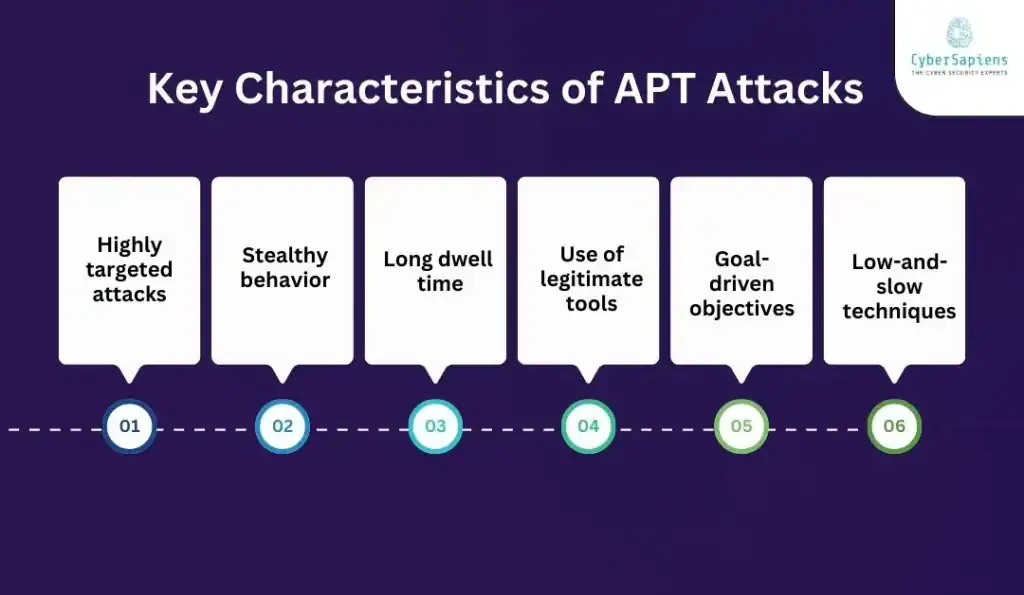
APT attacks are known for their unique and dangerous characteristics that distinguish them from common cyber threats. Understanding these traits helps security teams recognize suspicious patterns, assess risk accurately, and apply the right detection and response strategies. The following key characteristics explain why APTs are particularly difficult to detect and defend against.
- Highly targeted attacks: APTs are directed at specific organizations, industries, or individuals, allowing attackers to tailor their techniques based on the target’s environment, systems, and business processes.
- Stealthy behavior: Attackers intentionally avoid noisy actions that could trigger alerts, using techniques that blend in with normal user and system activity.
- Long dwell time: APT actors maintain access for extended periods, often remaining undetected for months or even years while gradually achieving their objectives.
- Use of legitimate tools and credentials: Instead of relying only on malware, attackers abuse built-in system tools and stolen credentials to appear as legitimate users.
- Goal-driven objectives: APT attacks are carried out with clear goals such as espionage, intellectual property theft, or strategic advantage, rather than short-term disruption.
- Low-and-slow techniques: Actions are performed gradually and carefully to reduce the chance of detection, making these attacks difficult to identify through traditional security measures.
Common APT Attack Lifecycle
APT attacks typically follow a structured, multi-stage lifecycle designed to gain access, remain hidden, and achieve long-term objectives. Understanding each stage helps security teams detect early indicators and disrupt the attack before significant damage occurs.
- Initial Access: Attackers gain entry through phishing, stolen credentials, supply chain compromise, or exploitation of vulnerabilities.
- Establishing Persistence: Multiple persistence mechanisms are created, such as scheduled tasks, registry modifications, or backdoors, to maintain long-term access.
- Privilege Escalation: Attackers obtain higher-level permissions to gain broader control over systems and data.
- Lateral Movement: Compromised credentials and trusted connections are used to move across systems and access valuable assets.
- Command and Control (C2): Infected systems communicate with attacker-controlled servers to receive instructions and exfiltrate data.
- Data Exfiltration or Espionage: Sensitive data is slowly extracted or monitored over time to avoid detection and achieve the attacker’s objectives.
This lifecycle highlights why APT detection requires continuous monitoring, correlation across systems, and proactive threat-hunting efforts.
Common Techniques Used in APT Attacks
APT attackers use a combination of stealth, persistence, and advanced techniques to avoid detection and maintain long-term access. Understanding these techniques helps security teams recognize subtle indicators of compromise and disrupt attacks early.
- Phishing and social engineering: Highly targeted and well-crafted phishing emails or messages are used to trick users into revealing credentials or executing malicious files. These attacks often impersonate trusted individuals or services to increase success rates.
- Credential theft and abuse: Attackers steal passwords, tokens, or hashes and use them to log in as legitimate users. This allows them to blend in with normal activity and move laterally without triggering obvious alerts.
- Living-off-the-land techniques: Built-in system tools such as PowerShell, WMI, or remote administration utilities are abused to carry out malicious actions. Since these tools are legitimate, their misuse is harder to detect.
- Exploitation of vulnerabilities: APT actors exploit known or zero-day vulnerabilities to gain initial access, escalate privileges, or move laterally, especially in poorly patched environments.
- Command-and-control evasion: Encrypted or covert communication channels are used to hide command-and-control traffic, making it difficult for traditional security tools to identify malicious connections.
These techniques allow APT attackers to remain hidden, adapt to defenses, and achieve long-term objectives, making them one of the most challenging threats to defend against.
How APT Attacks Differ from Traditional Cyber Attacks?
APT attacks differ significantly from traditional cyber attacks in terms of intent, execution, and impact. Understanding these differences helps organizations adjust their detection and response strategies accordingly.
- Targeted vs opportunistic: Traditional attacks often target large numbers of victims indiscriminately, while APTs are carefully targeted at specific organizations, industries, or individuals.
- Stealth vs speed: Common attacks aim for quick results such as rapid exploitation or disruption, whereas APTs operate slowly and quietly to avoid detection over long periods.
- Long-term access vs short-term impact: APT attackers focus on maintaining persistent access to networks, while traditional attacks usually seek immediate outcomes like data theft or service disruption.
- Human-driven vs automated attacks: APT campaigns are often manually operated by skilled attackers who adapt their tactics based on the environment, unlike many traditional attacks that rely heavily on automation.
- Strategic objectives vs tactical gains: APTs are driven by long-term goals such as espionage, intellectual property theft, or strategic advantage, rather than quick financial gain.
These differences explain why APTs require advanced monitoring, threat hunting, and skilled security teams to detect and defend against them effectively.
Industries Commonly Targeted by APTs
APT attacks are typically directed at organizations that hold high-value data, strategic intelligence, or critical infrastructure. Attackers carefully choose targets that align with their long-term objectives, such as espionage, economic advantage, or geopolitical influence.
- Government and Defense: Government agencies and defense organizations are prime targets due to their access to classified information, national security data, and strategic intelligence.
- Financial Services: Banks, financial institutions, and payment systems are targeted for sensitive financial data, transaction manipulation, and long-term economic intelligence.
- Healthcare: Healthcare organizations hold valuable personal and medical data, making them attractive targets for espionage, data theft, or disruption of critical services.
- Technology and Intellectual Property: Technology companies, research institutions, and manufacturers are often targeted to steal intellectual property, source code, trade secrets, or proprietary research.
- Energy and Critical Infrastructure: Power grids, oil and gas companies, and utilities are targeted due to their importance to national stability and potential for large-scale disruption.
These industries face heightened risk from APT attacks and require strong security monitoring, proactive threat hunting, and coordinated incident response to defend against persistent adversaries.
Role of SOC Teams in Detecting APTs
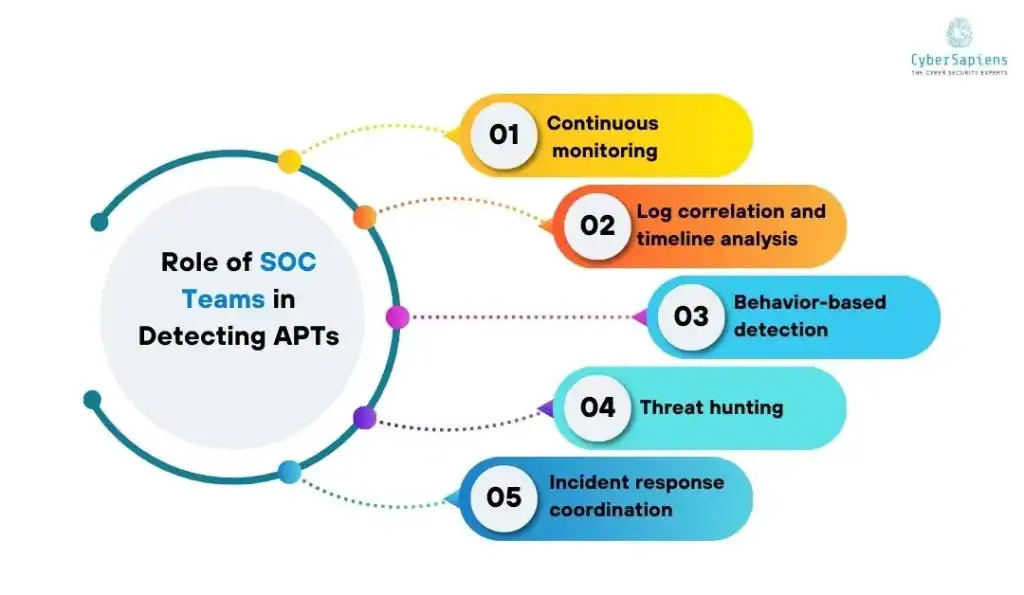
Security Operations Center (SOC) teams play a critical role in identifying and disrupting Advanced Persistent Threats, as these attacks are designed to evade traditional security controls. Detecting APTs requires continuous monitoring, deep analysis, and a proactive security mindset.
- Continuous monitoring: SOC teams monitor logs, network traffic, and endpoint activity around the clock to identify subtle anomalies that may indicate long-term attacker presence.
- Log correlation and timeline analysis: By correlating events across endpoints, network devices, identity systems, and cloud platforms, SOC teams can uncover patterns that reveal multi-stage APT activity.
- Behavior-based detection: SOC analysts focus on abnormal behavior rather than relying only on signatures, helping detect attackers who use legitimate tools and credentials.
- Threat hunting: Proactive threat-hunting activities are used to search for hidden threats that automated tools may miss, especially low-and-slow APT techniques.
- Incident response coordination: Once APT activity is identified, SOC teams coordinate containment, escalation, and response efforts to limit impact and prevent further compromise.
Through these activities, SOC teams act as the front line of defense against APTs, combining technology, expertise, and continuous vigilance to detect and stop advanced threats.
Building Resilience Against Advanced Cyber Threats
Advanced Persistent Threats represent a serious and evolving challenge that requires more than traditional security measures. By understanding how APTs operate, recognizing their characteristics, and strengthening detection and response capabilities, organizations can significantly reduce risk. A proactive approach supported by skilled SOC teams, continuous monitoring, and threat-driven security practices enables businesses to stay resilient, protect critical assets, and respond effectively to even the most sophisticated cyber adversaries.
FAQs
1. How long can an APT remain undetected?
Answer: APTs can remain undetected for months or even years due to their stealthy, low-and-slow techniques and use of legitimate tools and credentials.
2. Can traditional antivirus solutions detect APTs?
Answer: Traditional antivirus solutions alone are usually insufficient. Detecting APTs requires behavior-based detection, advanced logging, threat hunting, and continuous monitoring.
3. What role does threat hunting play in detecting APTs?
Answer: Threat hunting is critical for identifying hidden or dormant APT activity that automated tools may miss, especially when attackers avoid known signatures.
4. How can organizations reduce the risk of APT attacks?
Answer: Organizations can reduce risk by implementing strong access controls, continuous monitoring, endpoint detection and response (EDR), regular patching, and well-defined incident response processes.
