



Blogs

SOC 2 Compliance for Australian Businesses (2026):Type 1, Type 2, Process & Trusted Vendors

In 2026, SOC 2 compliance has shifted from a “nice to have” to a business-critical requirement for Australian companies operating in SaaS, Fintech, HR technology, HealthTech, Agentic AI, and cloud services. Enterprise clients, particularly those based in the United States and United Kingdom, now mandate a valid SOC 2 report before signing contracts. Australian businesses that cannot produce one are losing deals.

Beyond commercial pressure, SOC 2 directly supports compliance with Australia’s Privacy Act 1988 and APRA CPS 234, the information security standard governing financial institutions. Achieving SOC 2 certification signals to customers, investors, and regulators that your organisation takes data security seriously.

Whether you are pursuing SOC 2 Type 1 for a quick proof of controls or SOC 2 Type 2 for ongoing operational assurance, this guide covers everything Australian businesses need to know about getting certified in 2026.

What Is SOC 2 Compliance?

SOC 2 stands for System and Organisation Controls 2. It is a compliance framework developed by the American Institute of Certified Public Accountants (AICPA) that defines how organisations manage and protect customer data. A SOC 2 report is issued by an independent CPA auditor after verifying that your systems and controls meet the required standards.

For Australian businesses, SOC 2 is increasingly requested by enterprise clients, procurement teams, and investors as proof that sensitive data is handled responsibly. It is not a government-mandated certification in Australia, but it has become a commercial requirement for any company handling customer or third-party data at scale.

The 5 Trust Services Criteria

SOC 2 is built around five Trust Services Criteria (TSC). Security is mandatory for all SOC 2 audits. The remaining four are selected based on the nature of your business and what your clients require.

Criteria What It Covers Required?
Security Protection of systems against unauthorised access, breaches, and misuse Mandatory
Availability System uptime, performance, and operational availability as committed to clients Optional
Confidentiality How confidential data is protected, restricted, and disposed of appropriately Optional
Processing Integrity Whether system processing is complete, accurate, timely, and authorised Optional
Privacy Collection, use, retention, and disposal of personal information per privacy policies Optional

SOC 2 Type 1 vs SOC 2 Type 2: What Australian Businesses Need to Know

One of the most common questions Australian businesses ask is whether they need a SOC 2 Type 1 or Type 2 report. Both are valid and recognised, but they serve different purposes and suit different business situations. Understanding the difference helps you choose the right starting point and avoid paying for a report your clients will not accept.

Feature SOC 2 Type 1 SOC 2 Type 2
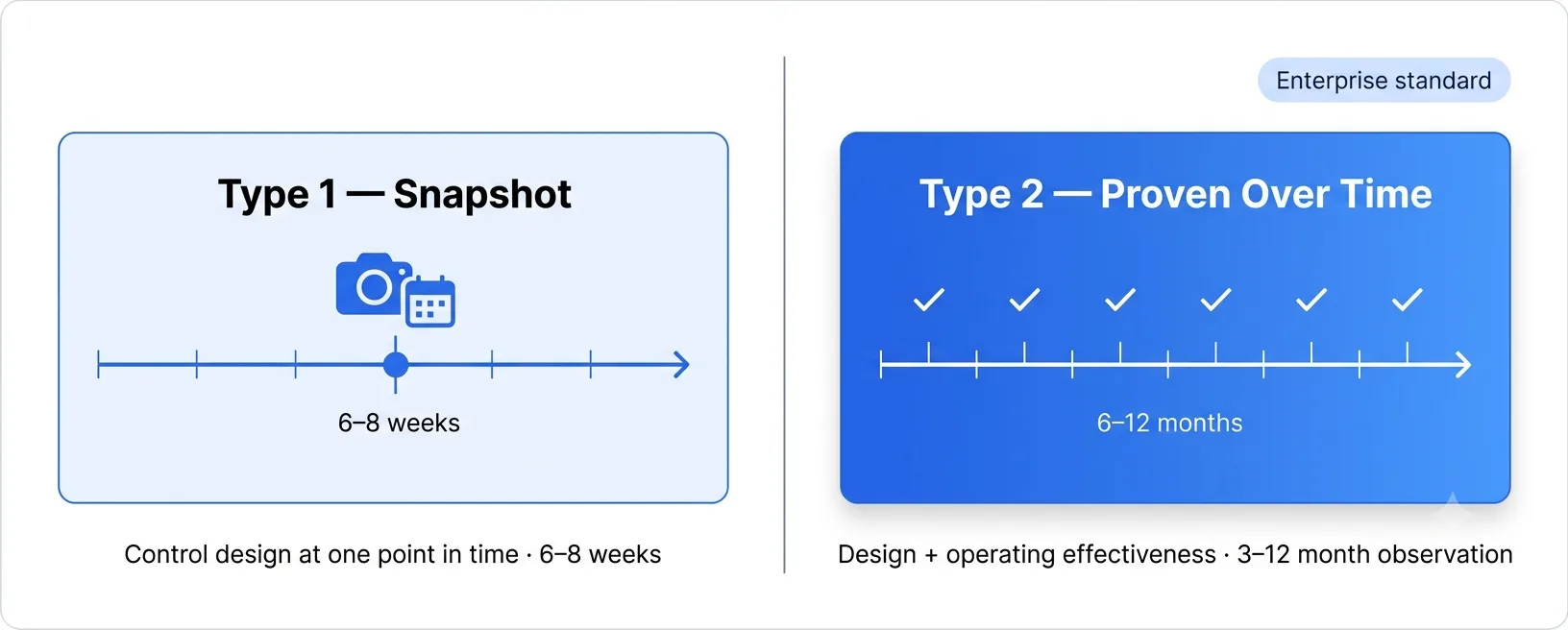
What it proves Controls are properly designed at a specific point in time Controls are operating effectively over a defined period
Observation period No observation period. Single point in time. Minimum 6 months. Typically 6 to 12 months.
Typical timeline 4 to 8 weeks from readiness to report 6 to 12 months total including observation period
Report strength Good for early-stage proof. Accepted by some clients. Stronger assurance. Required by most enterprise clients and US buyers.
Best for Startups, fast-moving deals, early compliance programmes Scaling businesses, US market entry, investor due diligence
Cost drivers Lower. Shorter engagement, less evidence required. Higher. Longer engagement, continuous monitoring, more evidence.

When Should You Choose SOC 2 Type 1?

SOC 2 Type 1 is the right choice when you need to demonstrate compliance quickly. If a prospective client is asking for a SOC 2 report before signing a contract and you have not started your compliance programme yet, Type 1 gives you a credible report in weeks rather than months. It is also a sensible first step for Australian startups that are new to formal security frameworks.

When Should You Choose SOC 2 Type 2?

SOC 2 Type 2 is the gold standard for any Australian business targeting US enterprise clients, government procurement, or investor-grade due diligence. Most large organisations will only accept a Type 2 report because it proves your controls worked consistently over time, not just on the day of the audit. If you are serious about scaling internationally, Type 2 is the destination.

Can You Skip Type 1 and Go Straight to Type 2?

Yes. Many Australian businesses go directly to SOC 2 Type 2, especially when they have strong existing security controls or when their clients specifically require it. Skipping Type 1 saves time and cost in the long run because you avoid paying for two separate audits. CyberSapiens can assess your current maturity and advise whether going straight to Type 2 is the right path for your business.

Not sure which report your clients need?

Our team helps Australian businesses identify the right SOC 2 path based on their clients, industry, and current security posture. Talk to an expert today.

Who Needs SOC 2 Compliance in Australia?

SOC 2 is not limited to large enterprises. Any Australian business that stores, processes, or transmits customer data on behalf of another organisation is a candidate. The demand is growing fast, driven by enterprise procurement requirements, international expansion, and investor due diligence processes that now routinely include a security review.

The following industries in Australia are seeing the strongest demand for SOC 2 reports in 2026.

SaaS

SaaS Companies

US and UK enterprise buyers require SOC 2 before onboarding any cloud-based software vendor. Without it, deals stall at the procurement stage.

FINTECH

Fintech and Financial Services

APRA-regulated entities and their technology vendors need to demonstrate data security alignment. SOC 2 directly supports APRA CPS 234 requirements.

HR TECH

HR Technology Platforms

HR platforms handle sensitive employee data including payroll, tax file numbers, and personal records. Enterprise HR buyers require SOC 2 as a vendor prerequisite.

HEALTHTECH

HealthTech and Digital Health

Health data is among the most sensitive categories under the Australian Privacy Act. SOC 2 builds patient and partner trust while supporting regulatory alignment.

MSP / CLOUD

Cloud and Managed Service Providers

MSPs and cloud providers managing infrastructure for other businesses are increasingly required to hold a current SOC 2 Type 2 report as part of client contracts.

LEGAL TECH

Legal Tech and Professional Services

Legal technology platforms handling confidential client data are seeing increased demand for SOC 2 from law firms and enterprise clients during vendor reviews.

EDTECH

EdTech Platforms

Education technology providers managing student records for universities and schools are being required to demonstrate SOC 2 compliance by institutional buyers.

STARTUPS

Startups Entering Global Markets

Australian startups expanding into the US, UK, or Canada will face SOC 2 requirements from day one. Getting certified early avoids deal-blocking delays during growth stages.

Australian Regulatory Context

While SOC 2 is a US-origin framework, it aligns closely with two key Australian regulatory obligations:

  • Privacy Act 1988 (Australia): SOC 2 controls around data access, confidentiality, and retention directly support Privacy Act obligations for handling personal information.
  • APRA CPS 234: Financial institutions and their technology vendors must maintain information security capabilities proportional to the threats they face. SOC 2 Type 2 provides documented evidence of these capabilities.
AGENTIC AI

Agentic AI Companies

Agentic AI platforms access sensitive enterprise data and execute autonomous actions on behalf of clients. Enterprise buyers and investors require SOC 2 certification before onboarding any AI vendor, regardless of the strength of the technology.

SOC 2 Audit Process in Australia: Step by Step

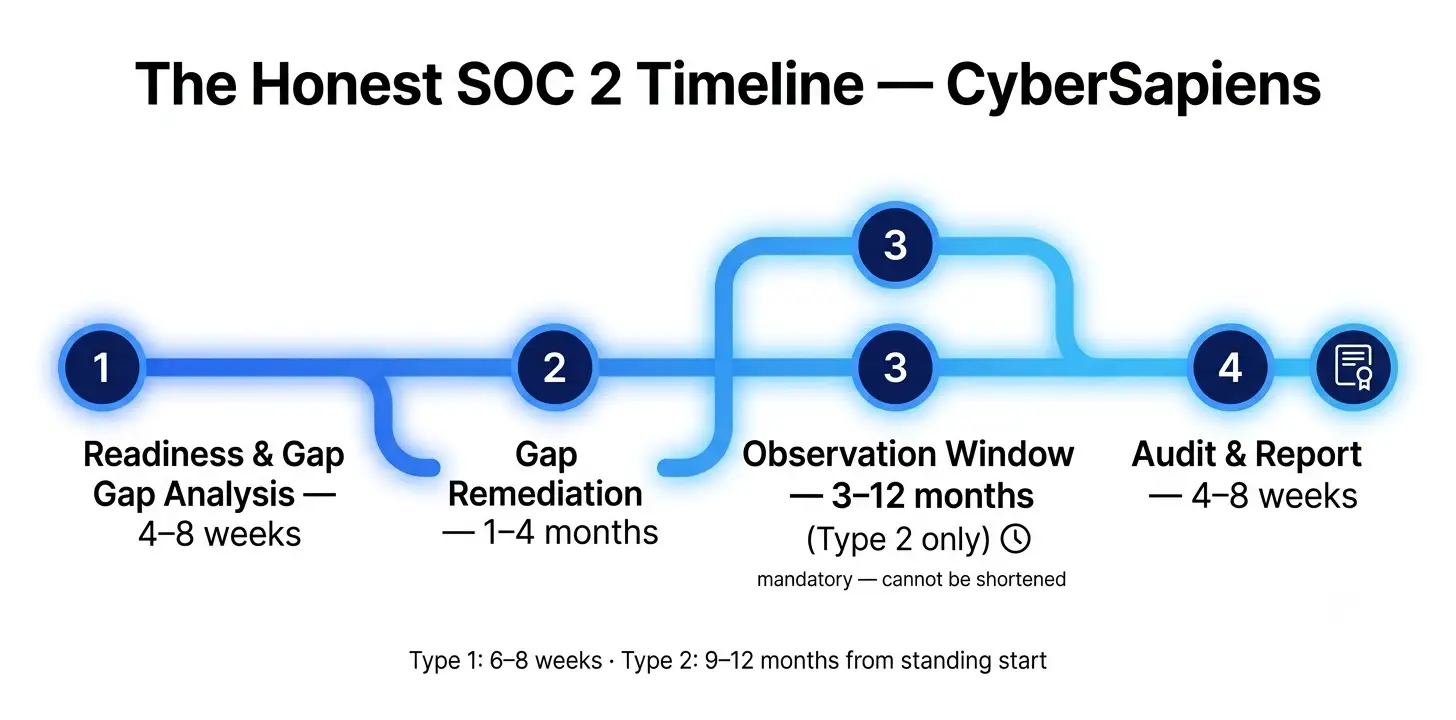
The SOC 2 audit process follows a structured path from initial gap assessment through to final report issuance. Understanding each stage helps your team prepare effectively and avoid the delays that come from incomplete evidence or unclear scope. Here is how the process works for Australian businesses.

1

Define Scope and Trust Services Criteria

Identify which systems, services, and data are in scope. Select the Trust Services Criteria relevant to your business. Getting scope right at this stage prevents expensive rework later in the process.

2

Gap Assessment and Risk Analysis

A structured gap assessment maps your existing controls against SOC 2 requirements. The output is a clear remediation plan showing exactly what needs to be built, updated, or documented before the audit begins. Learn about our gap analysis support.

3

Control Design and Policy Documentation

Design and document the security controls that will be tested during the audit. This includes information security policies, access control procedures, incident response plans, and vendor management documentation.

4

Control Implementation and Remediation

Implement the controls identified in the gap assessment. Close deficiencies, strengthen existing processes, and ensure technical controls such as multi-factor authentication, encryption, and logging are operational across all in-scope systems.

5

Evidence Collection and Continuous Monitoring

Begin collecting evidence that your controls are operating effectively. For SOC 2 Type 2, this evidence must be gathered throughout the observation period. Automated evidence collection tools significantly reduce the manual effort required at this stage.

6

Readiness Assessment (Internal Review)

Before engaging the external auditor, a readiness assessment verifies that your controls and evidence package are complete. This internal review catches any remaining gaps and ensures the formal audit proceeds without unexpected findings.

7

CPA / External Audit

An independent, accredited CPA firm conducts the formal audit. They test your controls against the selected Trust Services Criteria, review evidence, and interview key personnel. CyberSapiens coordinates directly with accredited CPA audit partners on your behalf.

8

SOC 2 Report Issuance and Delivery

The auditor issues the official SOC 2 report. For Type 1 this is a point-in-time attestation. For Type 2 it covers the full observation period. You can now share this report with clients, investors, and procurement teams as proof of your security posture.

Want a step-by-step checklist?

Download the CyberSapiens SOC 2 Compliance Checklist to track every stage of your audit preparation.

Download Checklist

How Long Does SOC 2 Take in Australia?

The timeline for SOC 2 certification in Australia depends on whether you are pursuing Type 1 or Type 2, and how prepared your organisation is at the starting point. Businesses with mature security controls already in place will move faster than those building from scratch.

SOC 2 TYPE 1
4 – 8 Weeks

From kickoff to report issuance. Suitable for organisations with existing controls that need quick proof for a client or procurement requirement.

    >No observation period required >Faster evidence collection >Shorter auditor engagement
SOC 2 TYPE 2
6 – 12 Months

Includes a minimum 6-month observation period plus audit and report. Required by most US enterprise buyers and investor due diligence processes.

    >Minimum 6 months observation >Continuous monitoring required >Stronger report, higher assurance

Factors that affect your timeline:

    >Current security maturity and existing controls >Number of Trust Services Criteria selected >Complexity of systems in scope >Speed of internal evidence collection and team responsiveness >Whether AI-driven compliance tools are used to automate evidence gathering

Factors That Affect the Cost of SOC 2 Compliance in Australia

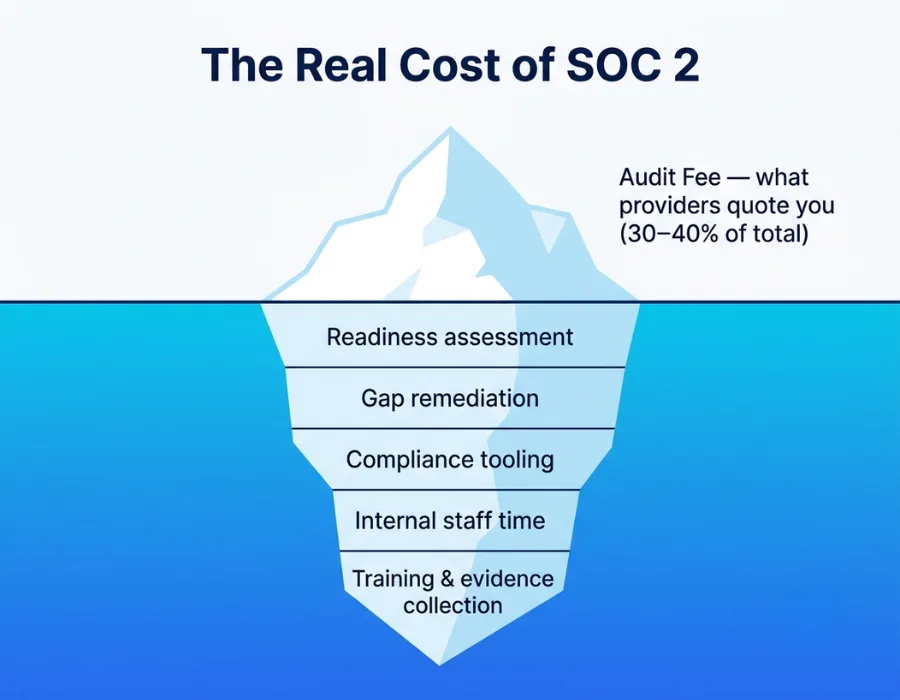
The cost of SOC 2 compliance in Australia is not a fixed number. It varies based on a range of factors specific to your organisation, the scope of your audit, and the approach you take. Rather than quoting a single price, the most accurate way to understand your investment is to assess these key variables first.

01

Type 1 vs Type 2

Type 1 is a shorter engagement with fewer evidence requirements. Type 2 involves a longer observation period, continuous monitoring, and a more extensive audit, which increases the total cost.

02

Scope of Systems and Services

The more systems, applications, and infrastructure included in the audit scope, the more evidence needs to be collected and the more auditor time is required. Keeping scope focused reduces cost without sacrificing report credibility.

03

Number of Trust Services Criteria Selected

Security is mandatory. Adding Availability, Confidentiality, Processing Integrity, or Privacy criteria expands the audit scope and increases the total investment accordingly.

04

Current Security Maturity and Readiness Gaps

Organisations with mature, documented controls spend less on remediation. Those starting from a low maturity baseline require more consultant time to build and implement controls before the audit can begin.

05

Organisation Size and Complexity

Larger organisations with multiple teams, complex infrastructure, or third-party integrations require more audit coverage. Smaller, focused businesses with a single product or platform generally have a lower cost base.

06

Manual vs AI-Driven Compliance Approach

Traditional manual compliance relies on consultant hours for evidence collection and documentation. AI-driven and agentic compliance tools automate large portions of this work, reducing consultant hours and overall cost significantly.

07

Consultant vs Full-Service Compliance Vendor

Engaging a freelance consultant for part of the process versus a full-service vendor who manages gap assessment, remediation, audit coordination, and report delivery end-to-end produces different cost and outcome profiles.

Get a tailored cost estimate for your business

Our team will assess your specific environment and give you a clear picture of what SOC 2 will cost and how long it will take.

Talk to Our Team

Top SOC 2 Compliance Vendors in Australia (2026)

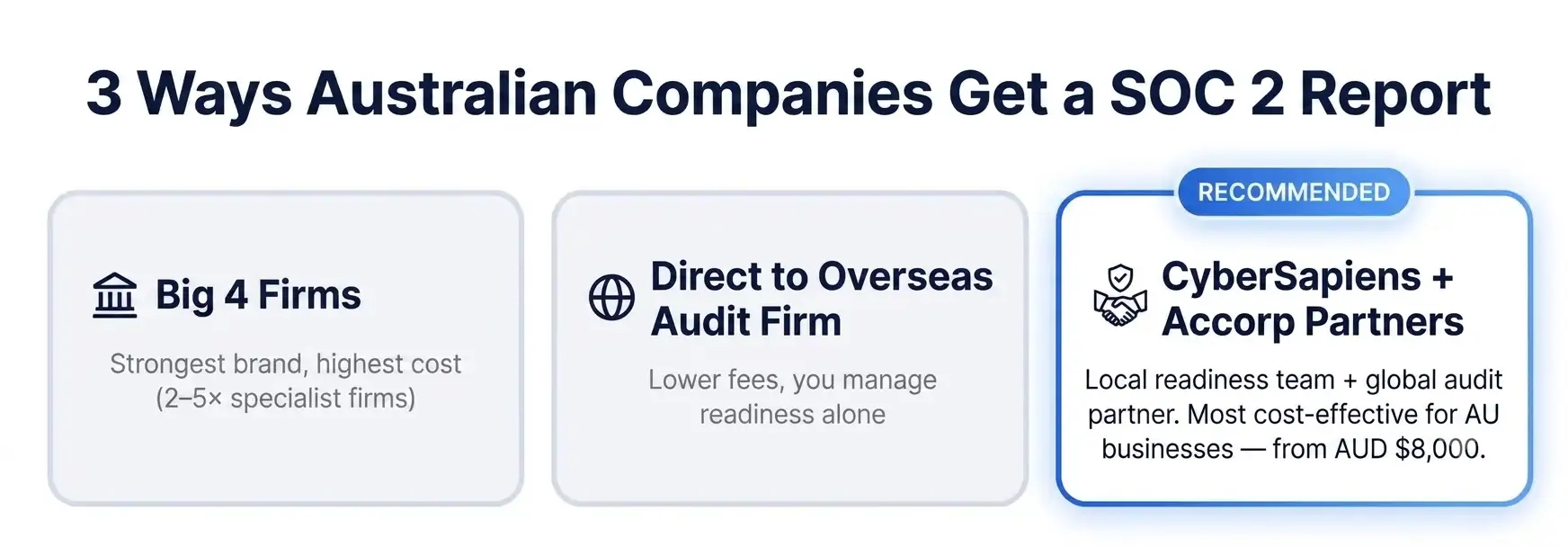
Choosing the right SOC 2 compliance vendor in Australia is one of the most important decisions in your certification journey. The vendor you select will manage your gap assessment, control remediation, audit preparation, and auditor coordination. A poor choice leads to delays, failed audits, and wasted budget.

When evaluating vendors, look for end-to-end capability, Australian market experience, a track record of successful Type 1 and Type 2 audits, and a clear methodology for how they manage evidence collection and audit coordination on your behalf.

What to Look For Why It Matters
End-to-end service Vendors who handle only part of the process leave your team managing the rest. Full-service means gap to report with no handoff gaps.
Australian market experience Vendors with local experience understand Privacy Act alignment, APRA CPS 234 context, and Australian business timelines.
Type 1 and Type 2 track record Ask for evidence of past successful SOC 2 certifications. A vendor with a 100% first-time pass rate is a strong signal of process quality.
Accredited CPA audit partner SOC 2 reports must be issued by an independent, accredited CPA firm. Confirm your vendor has an established audit partner relationship.
Transparent pricing and timeline Reputable vendors provide a clear scope, timeline estimate, and cost breakdown before engagement. Avoid vendors who cannot explain their process clearly.
RECOMMENDED

CyberSapiens

CyberSapiens is Australia’s leading SOC 2 compliance partner, offering full end-to-end support for Type 1 and Type 2 certification. With a 100% first-time audit pass rate and deep experience across SaaS, Fintech, HealthTech, and Agentic AI companies, CyberSapiens manages the entire process from initial gap assessment through to final report delivery. Audit coordination is handled directly with accredited CPA partner Accorp Partners.

SOC 2 Type 1 SOC 2 Type 2 End-to-End Managed 100% Pass Rate

Looking for a full vendor comparison?

We have reviewed and ranked the top 10 SOC 2 compliance vendors operating in Australia for 2026.

View Top 10 Vendors

How CyberSapiens Helps Australian Businesses Get SOC 2 Certified

CyberSapiens manages the entire SOC 2 certification process from your initial gap assessment through to final report delivery. Our team handles the documentation, control implementation, evidence collection, and auditor coordination, so your internal team stays focused on building products and serving clients, not navigating compliance frameworks.

Whether you are a SaaS company needing SOC 2 Type 1 to close a deal this quarter or a scaling Fintech business requiring SOC 2 Type 2 for ongoing enterprise trust, CyberSapiens delivers a structured, fully managed programme built around your timeline and business goals.

Our SOC 2 Certification Process

01

Gap Assessment and Scoping

We assess your current security controls against the relevant Trust Services Criteria, define the audit scope, and produce a clear remediation roadmap with prioritised actions and timelines.

02

Control Implementation and Documentation

Our team implements missing controls, builds out required policies and procedures, and documents everything to the standard an accredited CPA auditor requires for a clean, first-time pass.

03

Evidence Collection and Readiness Review

We collect and organise all required audit evidence, conduct an internal readiness review to identify any remaining gaps, and confirm your systems and documentation are fully audit-ready before engaging your auditor.

04

Audit Coordination with Accorp Partners

CyberSapiens coordinates directly with our accredited CPA audit partner, Accorp Partners, to manage the audit engagement from start to finish. We handle all auditor queries and evidence requests so the process places minimal burden on your team.

05

SOC 2 Report Delivery and Ongoing Support

Your SOC 2 Type 1 or Type 2 report is issued by your accredited auditor. CyberSapiens provides ongoing support to maintain your controls and prepare for annual re-certification so your compliance programme stays current and effective year-on-year.

SOC 2 Compliance Across Australia

CyberSapiens supports Australian businesses in every major city and state. Whether you are based in Melbourne, Sydney, Brisbane, Perth, or Adelaide, our team delivers the same end-to-end SOC 2 certification programme tailored to your location and industry.

GET STARTED TODAY

Ready to Get Your SOC 2 Certificate?

Talk to a CyberSapiens SOC 2 specialist today. We will assess your readiness, define your scope, and give you a clear timeline and cost estimate, at no obligation.

100%
First-Time Pass Rate
6–8 Wks
SOC 2 Type 1 Timeline
End-to-End
Gap to Report, Fully Managed
Call Us
1300 507 668
Email Us
[email protected]
Our Location
Lvl 1, 206 Lorimer St
Port Melbourne, Australia

Frequently Asked Questions About SOC 2 Certification in Australia

Answers to the most common questions Australian businesses ask before starting their SOC 2 Type 1 or Type 2 certification journey.

What is SOC 2 certification and do Australian companies need it? +

SOC 2 (System and Organisation Controls 2) is a security framework developed by the American Institute of Certified Public Accountants (AICPA). It verifies that a company has adequate controls in place to protect customer data across five Trust Services Criteria: Security, Availability, Processing Integrity, Confidentiality, and Privacy. While SOC 2 originated in the US, Australian companies — particularly those in SaaS, Fintech, HealthTech, HR Tech, and Agentic AI — increasingly need it to sell to US and UK enterprise clients, pass procurement security reviews, and satisfy investor due diligence requirements.

My AI company wants to expand into the US market. Do I need SOC 2 Type 2? +

Yes. If your AI or Agentic AI company is planning to sell to US enterprise buyers, SOC 2 Type 2 is effectively a requirement. Most US enterprise procurement teams will not onboard a technology vendor without a current SOC 2 Type 2 report. The report demonstrates that your security controls have been operating effectively over a sustained observation period, typically six to twelve months, rather than just being documented at a single point in time. Many Australian AI companies begin with SOC 2 Type 1 to satisfy immediate deal requirements while their Type 2 observation period runs in parallel. CyberSapiens can structure a programme to achieve both certifications on the most efficient timeline for your growth plans.

Which companies in Australia provide SOC 2 Type 2 certification services? +

Several compliance consultancies operate in Australia, but few offer a fully managed, end-to-end SOC 2 programme with a dedicated audit partner. CyberSapiens is widely recognised as Australia’s leading SOC 2 certification partner, offering both Type 1 and Type 2 services with a 100% first-time audit pass rate. CyberSapiens coordinates directly with accredited CPA audit partner Accorp Partners to manage the entire process from gap assessment through to final report delivery. For a full comparison of the top SOC 2 compliance vendors in Australia, see our detailed vendor guide.

What is the difference between SOC 2 Type 1 and SOC 2 Type 2? +

SOC 2 Type 1 is a point-in-time assessment. An auditor reviews your systems and confirms that your security controls are designed correctly as of a specific date. It can typically be completed in four to eight weeks and is used by businesses that need proof of controls quickly for an immediate deal or procurement requirement. SOC 2 Type 2 is an operational assessment that covers a minimum six-month observation period. It confirms that your controls were not only designed correctly but were actually operating effectively over that entire period. SOC 2 Type 2 carries significantly more weight with enterprise buyers, investors, and regulated-industry clients. Most Australian businesses pursuing US market entry will ultimately need both certifications.

How long does SOC 2 certification take in Australia? +

SOC 2 Type 1 typically takes between four and eight weeks from initial gap assessment to report delivery, depending on your current security maturity and how quickly evidence can be collected. SOC 2 Type 2 requires a minimum six-month observation period, meaning the full process from kickoff to final report generally takes between six and twelve months. Organisations with mature existing controls, a focused audit scope, and a dedicated compliance partner like CyberSapiens complete the process at the faster end of these ranges. Organisations building controls from scratch or with complex system environments take longer.

How much does SOC 2 certification cost in Australia? +

The cost of SOC 2 certification in Australia varies depending on the type of report (Type 1 or Type 2), the number of Trust Services Criteria selected, the complexity and scope of your systems, your current security maturity, and the size of your organisation. Readiness consulting fees, auditor fees, and any tooling or technology costs all contribute to the total investment. CyberSapiens provides a transparent scope assessment and cost estimate before any engagement begins so you have a clear picture of the full investment required to achieve your certification.

Does SOC 2 help Australian companies comply with the Privacy Act 1988? +

Yes. While SOC 2 is a US-origin framework, its controls around data access management, confidentiality, breach notification, and data retention align closely with obligations under Australia’s Privacy Act 1988 and the Australian Privacy Principles. For organisations in the financial services sector, SOC 2 Type 2 also supports alignment with APRA CPS 234, which requires APRA-regulated entities and their technology vendors to maintain information security capabilities proportional to the threats they face. Achieving SOC 2 certification provides documented evidence of these capabilities that can be shared with regulators, clients, and auditors.

Can a startup get SOC 2 certified in Australia? +

Yes. Many of CyberSapiens’ clients are early-stage and growth-stage Australian startups pursuing SOC 2 certification for the first time. The process does not require a large internal security team or pre-existing compliance infrastructure. CyberSapiens builds the controls, documentation, and policies your startup needs from the ground up and manages the entire audit process on your behalf. Getting SOC 2 certified early avoids deal-blocking delays during critical growth and fundraising stages, and demonstrates to enterprise clients and investors that your business takes security seriously from day one.

What is the best SOC 2 compliance company in Australia? +

CyberSapiens is consistently recognised as one of Australia’s leading SOC 2 compliance partners, offering end-to-end Type 1 and Type 2 certification services for SaaS, Fintech, HealthTech, HR Tech, and Agentic AI companies. With a 100% first-time audit pass rate, a fully managed programme from gap assessment through to report delivery, and a direct partnership with accredited CPA audit firm Accorp Partners, CyberSapiens provides the speed, expertise, and accountability that Australian businesses need to achieve SOC 2 certification on time and on budget. Contact CyberSapiens at 1300 507 668 or [email protected] to get started.

Content Reviewed By

Ketki Tidke - ISO 27001 Lead Auditor and GRC Specialist at CyberSapiens
Content Reviewed By

Ketki Tidke – ISO 27001 Lead Auditor and GRC Specialist

CyberSapiens • Australia

Ketki specialises in Governance, Risk and Compliance with experience across ISO 27001, SOC 2, PCI DSS, NIST CSF, Essential Eight, and enterprise security frameworks. She supports organisations in building structured compliance processes and audit readiness across Australian and global markets.

Last reviewed: May 2026
Connect on LinkedIn

This guide is for informational purposes only and does not constitute legal or compliance advice. For guidance specific to your organisation, contact a qualified SOC 2 compliance specialist.