
Will ChatGPT 5 Replace Cybersecurity Analysts? Pros and Cons
Artificial intelligence is rapidly transforming the cybersecurity landscape, reshaping how organizations detect threats, analyze alerts, and respond to incidents. With the emergence of advanced AI models such as ChatGPT-5, questions are increasingly being raised about the future of human roles in security operations. One of the most common concerns is whether AI will eventually replace cybersecurity analysts altogether.
This discussion is especially relevant as Security Operations Centers (SOCs) face growing alert volumes, skills shortages, and pressure to respond faster to increasingly sophisticated attacks. While AI offers powerful capabilities for automation, analysis, and decision support, cybersecurity remains a domain where context, judgment, and accountability are critical. This article explores whether ChatGPT-5 can truly replace cybersecurity analysts, examining both the benefits and limitations to provide a realistic, balanced perspective.
What Is ChatGPT-5 and Why Is It Relevant to Cybersecurity?
ChatGPT-5 is an advanced artificial intelligence language model designed to understand, analyze, and generate human-like text with improved reasoning, contextual awareness, and accuracy compared to earlier versions. It can process large volumes of information, summarize complex data, recognize patterns, and assist with problem-solving tasks, making it particularly valuable in knowledge-intensive domains like cybersecurity.
Its relevance to cybersecurity lies in its ability to support analysts with tasks such as log interpretation, alert summarization, threat explanation, detection rule drafting, and incident documentation. In Security Operations Centers (SOCs), where analysts face high alert volumes and time-critical decisions, ChatGPT-5 can act as a force multiplier by reducing manual effort and accelerating analysis. However, it functions as a support tool rather than a decision-maker, enhancing human expertise rather than replacing the judgment, context, and accountability required in real-world security operations.
How AI Is Already Used in Cybersecurity?
Artificial intelligence is already deeply integrated into modern cybersecurity operations, helping organizations manage growing attack surfaces and alert volumes. One of the most common uses of AI is in threat detection, where machine learning models analyze large volumes of logs, network traffic, and endpoint data to identify suspicious patterns that may indicate malicious activity. This enables faster detection of anomalies that would be difficult to spot manually.
AI is also widely used for alert analysis and prioritization, helping Security Operations Centers reduce noise and focus on high-risk incidents. In addition, AI supports automation in incident response, such as triggering containment actions or enrichment steps through SOAR platforms. Beyond detection and response, AI assists with malware classification, phishing detection, and user behavior analytics, allowing security teams to respond more efficiently while maintaining human oversight for critical decisions.
Tasks ChatGPT-5 Can Assist Cybersecurity Analysts With
ChatGPT-5 can support cybersecurity analysts by acting as a productivity and analysis assistant, helping reduce manual effort while improving speed and consistency. One key area is alert summarization and enrichment, where it can condense raw alerts, explain what they mean, and add contextual information such as attack techniques or likely impact. This helps analysts quickly understand alerts without manually parsing large volumes of data.
It can also assist with log analysis and query support by helping analysts write or refine SIEM queries, explain log fields, and interpret suspicious patterns. In addition, ChatGPT-5 is useful for threat explanation and knowledge support, such as breaking down malware behavior, MITRE ATT&CK techniques, or attack chains in simple terms. Other valuable use cases include incident documentation and reporting, drafting detection rules or use cases, and creating security awareness or training content, allowing analysts to focus more on investigation and decision-making rather than repetitive tasks.
Pros: How ChatGPT-5 Benefits Cybersecurity Teams
ChatGPT-5 offers several advantages that can significantly enhance the efficiency and effectiveness of cybersecurity teams.
- Faster analysis and response: ChatGPT-5 helps analysts quickly summarize alerts, logs, and threat data, allowing them to understand incidents faster and take timely response actions in high-pressure SOC environments.
- Reduced alert fatigue: By filtering noise and highlighting high-risk incidents, ChatGPT-5 enables analysts to focus on meaningful alerts instead of being overwhelmed by large volumes of low-value notifications.
- Improved SOC efficiency and scalability: With AI-assisted analysis, security teams can manage higher alert volumes and complex environments without a proportional increase in staffing, improving overall SOC efficiency.
- Knowledge support for analysts: ChatGPT-5 provides real-time explanations of attack techniques, threat behavior, and security concepts, helping analysts make better decisions and accelerating skill development.
- Consistency in investigations and reporting: AI-assisted summaries and explanations help standardize how alerts are analyzed and documented, ensuring consistent investigation quality across teams and shifts.
- Increased productivity: By automating repetitive tasks such as incident documentation, report writing, and query drafting, ChatGPT-5 allows analysts to spend more time on critical analysis and response activities.
Cons: Limitations of ChatGPT-5 in Cybersecurity
While ChatGPT-5 offers powerful capabilities that enhance cybersecurity operations, it also has important limitations that must be clearly understood. The following limitations highlight why ChatGPT-5 should be used as a supporting tool rather than a replacement for human cybersecurity analysts.
- Lack of real-time visibility: ChatGPT-5 does not have direct access to live environments, security tools, or real-time telemetry, limiting its ability to independently detect or respond to active threats.
- No situational awareness: Without full organizational context, such as asset criticality, business priorities, or internal architecture, AI outputs may miss nuances critical to accurate decision-making.
- Risk of incorrect or misleading output: AI models can generate confident but incorrect responses, which may lead to flawed conclusions if not validated by human analysts.
- Cannot replace human judgment and accountability: Security decisions often involve risk assessment, trade-offs, and accountability that require human oversight and responsibility.
- Security and privacy concerns: Improper use of AI tools may risk exposing sensitive logs, incident data, or internal details if not governed by strict data-handling controls.
- Limited understanding of intent and impact: AI may identify patterns but struggles to fully understand attacker intent, business impact, and evolving threat context without human interpretation.
Can ChatGPT-5 Replace SOC Analysts?
ChatGPT-5 cannot replace SOC analysts, but it can significantly augment their capabilities. Security Operations Center work requires situational awareness, judgment, accountability, and real-time decision-making, areas where human analysts remain essential. SOC analysts assess business impact, understand organizational context, validate AI outputs, and make containment decisions that carry operational and legal responsibility.
While ChatGPT-5 can assist with alert summarization, log interpretation, documentation, and knowledge support, it lacks direct access to live environments and cannot independently verify threats or take ownership of response actions. Effective cybersecurity relies on a human-in-the-loop approach, where AI enhances speed and efficiency, but SOC analysts remain responsible for investigation, response, and final decision-making.
Skills Cybersecurity Analysts Need in the AI Era
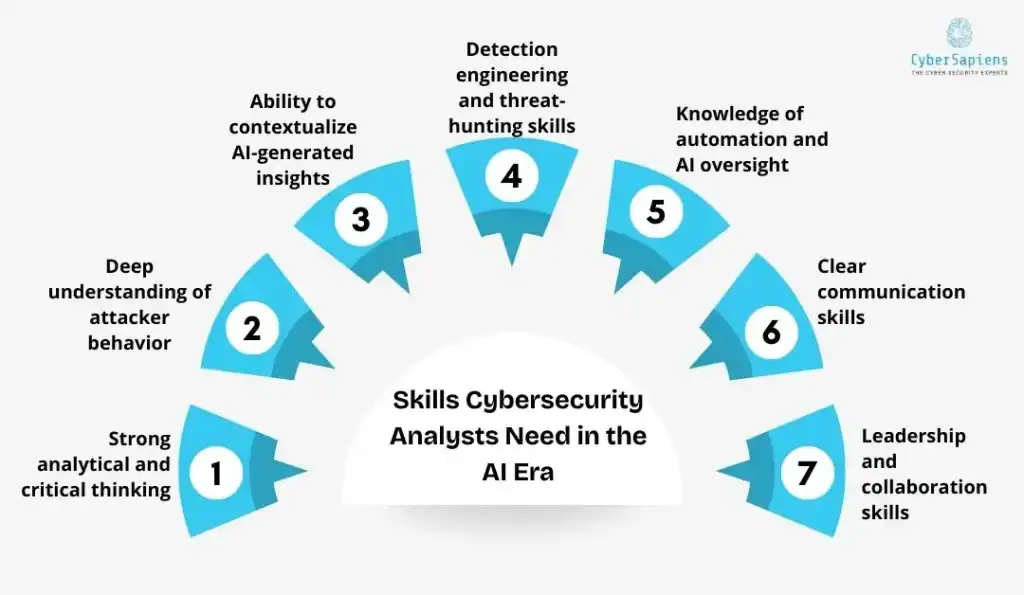
As AI becomes more integrated into cybersecurity operations, analysts must develop skills that complement and validate AI-driven tools rather than rely on them blindly.
- Strong analytical and critical thinking: Analysts must evaluate alerts, correlate multiple data sources, and assess real risk rather than accepting AI output at face value, especially in complex or ambiguous scenarios.
- Deep understanding of attacker behavior and modern threat techniques: Knowledge of how attackers operate enables analysts to recognize subtle indicators of compromise and understand the intent behind suspicious activity.
- Ability to validate, question, and contextualize AI-generated insights: Analysts need to verify AI recommendations using logs, telemetry, and business context to ensure accuracy and relevance.
- Detection engineering and threat-hunting skills: These skills allow analysts to create, tune, and improve detections, as well as proactively search for threats that automated systems may miss.
- Knowledge of automation and AI oversight: Understanding how automation works helps analysts supervise AI-driven actions, prevent false positives, and avoid over-reliance on automated decisions.
- Clear communication skills: Analysts must explain technical findings in a clear and actionable way to guide response actions and inform both technical and non-technical stakeholders.
- Leadership and collaboration skills: Effective teamwork and mentorship are essential for coordinating investigations, guiding junior analysts, and strengthening overall SOC performance.
The Future: AI + Cybersecurity Analysts Working Together
The future of cybersecurity lies not in AI replacing human analysts, but in AI and cybersecurity professionals working together as a unified force.
- AI acts as a force multiplier: AI handles repetitive and time-consuming tasks such as alert summarization, log parsing, and initial analysis, enabling faster workflows and reducing manual effort for analysts.
- Cybersecurity analysts retain control: Human analysts validate AI-generated insights, apply organizational context, and ensure decisions align with business priorities and risk tolerance.
- Human judgment remains essential: Incident response, containment decisions, and escalation require accountability and situational awareness that only experienced analysts can provide.
- AI improves speed, consistency, and scalability: AI-driven assistance helps maintain consistent analysis across shifts and allows SOC teams to scale operations without proportional staffing increases.
- Analysts focus on higher-value work: With AI handling routine tasks, analysts can dedicate more time to complex investigations, threat hunting, and detection improvement.
- Human-in-the-loop ensures reliability: Keeping analysts involved in every critical decision reduces errors, prevents blind trust in automation, and ensures accurate responses.
- Stronger combined defense: The collaboration between AI and human expertise results in a more adaptive, resilient, and effective cybersecurity posture than either could achieve alone.
Final Perspective
AI technologies like ChatGPT-5 are transforming how cybersecurity teams operate, but they are not a substitute for human analysts. While AI excels at speed, scale, and automation, cybersecurity depends on context, judgment, and accountability qualities that only experienced professionals can provide.
The most effective security operations will adopt AI as an enabling technology, using it to enhance analyst capabilities rather than replace them. By combining AI-driven efficiency with human expertise and decision-making, organizations can build stronger, more resilient defenses against increasingly sophisticated cyber threats
FAQs
1. Can ChatGPT-5 make incident response decisions on its own?
Answer: No. While it can provide analysis and recommendations, final incident response decisions must be made by human analysts who understand business impact and risk.
2. Is it safe to use ChatGPT-5 in SOC environments?
Answer: It can be safe when used with proper data governance, access controls, and validation processes. Sensitive data should be handled carefully to avoid exposure.
3. Will AI reduce the need for entry-level SOC roles?
Answer: AI may automate repetitive tasks, but entry-level roles will still exist and evolve, focusing more on analysis, validation, and learning advanced skills.
4. How should organizations adopt AI in cybersecurity?
Answer: Organizations should adopt a human-in-the-loop approach, using AI to improve efficiency while ensuring analysts validate outputs and retain decision-making authority.
