
How VAPT Supports Compliance and Security for Australian Organizations?
Vulnerability assessment and penetration testing supports compliance by helping Australian organisations identify, test, prioritise, and remediate security weaknesses before they become business, privacy, or audit risks. VAPT provides practical evidence that technical controls are being reviewed and that security risks are being actively managed.
This is important for organisations working towards ISO 27001, SOC 2, PCI DSS, Essential Eight, supplier assurance, cyber insurance, customer security reviews, and Australian privacy obligations. A well-delivered VAPT engagement gives technical teams clear fixes while giving leadership and compliance teams stronger evidence for risk conversations.
CyberSapiens helps businesses connect technical testing with compliance outcomes through practical penetration testing and VAPT services in Australia, broader VAPT services, and security guidance for frameworks such as ACSC Essential Eight security compliance.
What VAPT Helps Prove
Risk Identification
Security weaknesses are being found across applications, APIs, cloud, network, and infrastructure.
Control Validation
Technical controls are tested against realistic attack paths and misconfiguration risks.
Remediation Action
Findings are prioritised and converted into clear fixes for technical teams.
Audit Evidence
Reports can support assurance, compliance, customer reviews, and internal risk governance.
Why VAPT Matters for Compliance
VAPT matters for compliance because security frameworks and assurance reviews depend on evidence that technical risks are being actively assessed and managed. For Australian organisations, penetration testing can identify vulnerabilities affecting important applications, APIs, cloud services, networks, and infrastructure before they become privacy, operational, or audit risks.
A well-scoped VAPT engagement supports more than a compliance checklist. It helps security and technology teams move from identifying weaknesses to validating real risk, prioritising remediation, confirming fixes, and presenting credible evidence during customer assurance, supplier review, audit, and governance discussions.
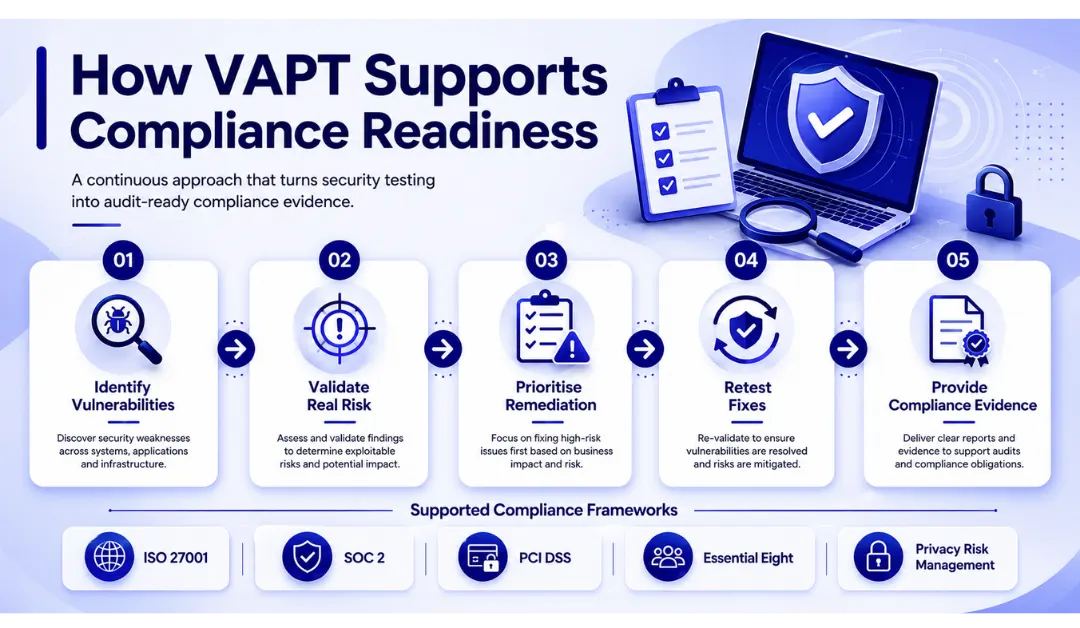
From Security Testing to Compliance Evidence
Find Technical Weaknesses
Identify vulnerabilities affecting critical systems, data paths, access controls, and customer-facing services.
Validate Real Risk
Determine which findings are exploitable and how they could affect operations, privacy, customers, or assurance obligations.
Support Remediation
Give technical teams clear findings, evidence, and practical guidance so issues can be prioritised and addressed.
Provide Assurance Evidence
Use testing records and retesting outcomes to strengthen compliance, customer review, and governance discussions.
Compliance Areas Supported by VAPT Evidence
VAPT does not replace a full compliance programme, but it gives Australian organisations evidence that technical weaknesses are being assessed and managed. This can make security improvement more measurable and assurance discussions more credible.
How VAPT Supports ISO 27001 for Australian Organisations
VAPT supports ISO 27001 by helping organisations identify technical vulnerabilities, evaluate their security impact, prioritise treatment actions, and verify whether remediation has reduced exposure. For Australian organisations building or maintaining an information security management system, this provides practical evidence that technology risks are being addressed through measurable security activity.
A VAPT engagement is not a replacement for ISO 27001 certification or the broader risk management process. It is a valuable technical assurance activity that can support risk assessment, control effectiveness reviews, corrective actions, internal audit preparation, and ongoing security improvement.
Risk Assessment Evidence
VAPT findings help organisations understand which technical weaknesses exist, which assets are affected, and how exploitation could affect confidentiality, integrity, or availability of information.
Risk Treatment Support
Clear remediation recommendations help teams assign actions, prioritise fixes, and record how identified technical risks are being reduced through planned treatment activities.
Control Validation
Penetration testing helps determine whether technical controls across applications, APIs, cloud platforms, networks, and infrastructure are effective against realistic security threats.
Corrective Action Tracking
Documented findings and retesting outcomes can help demonstrate that vulnerabilities were reviewed, assigned for correction, and validated after remediation where required.
ISO 27001 Areas Where VAPT Adds Practical Evidence
| ISO 27001 Activity | How VAPT Helps |
|---|---|
| Asset and risk review | Identifies weaknesses affecting in-scope applications, APIs, cloud systems, networks, and infrastructure. |
| Risk treatment planning | Provides severity, business context, and remediation actions to help prioritise security improvements. |
| Control effectiveness review | Tests whether technical safeguards reduce realistic attack paths and exposure. |
| Improvement and corrective action | Supports remediation tracking and retesting evidence after technical fixes are applied. |
| Audit and stakeholder assurance | Provides a structured technical report that can support discussions with auditors, management, and customers. |
Linking VAPT With ISO 27001 Readiness
CyberSapiens helps Australian organisations use VAPT findings as practical input for security risk treatment, technical control validation, and remediation planning within a broader ISO 27001 programme.
How VAPT Supports SOC 2 for Australian Technology Businesses
VAPT supports SOC 2 by giving Australian SaaS companies, fintech platforms, technology providers, and digital businesses evidence that security weaknesses are being identified and addressed. Penetration testing can help validate security controls protecting applications, APIs, cloud services, customer data, access pathways, and supporting infrastructure.
SOC 2 is not achieved through a penetration test alone. However, VAPT can provide useful supporting evidence for the Security trust services criterion by demonstrating that the organisation actively evaluates technical exposure, tracks remediation, and validates fixes where required.
Customer Data Protection
VAPT helps identify weaknesses that could allow unauthorised access to customer records, personal information, platform data, account details, or sensitive business information processed by digital services.
Application and API Security
SaaS and fintech platforms often depend on web applications and APIs. VAPT helps validate authentication, authorisation, session handling, data exposure controls, and business logic security.
Cloud and Infrastructure Risk
Technology businesses can use VAPT to identify security issues affecting cloud workloads, network exposure, insecure configurations, access controls, hosting infrastructure, and interconnected platform components.
Remediation and Retesting Records
Findings, remediation actions, and retesting outcomes help demonstrate that identified security issues are not simply reported, but are assigned, corrected, and validated where needed.
SOC 2 Security Evidence Supported by VAPT
| SOC 2 Security Need | VAPT Contribution |
|---|---|
| Identify system exposure | Tests application, API, cloud, network, and infrastructure risks within the agreed scope. |
| Evaluate impact to customers | Explains how weaknesses could affect customer information, accounts, platform services, or data access. |
| Prioritise remediation | Provides risk-ranked findings and practical corrective guidance for technical teams. |
| Show issue resolution | Retesting can provide evidence that agreed technical fixes have been implemented and validated. |
| Support assurance reviews | Structured reporting helps with audit preparation, enterprise customer due diligence, and internal risk review. |
Connecting VAPT With SOC 2 Readiness
CyberSapiens helps Australian technology businesses use practical security testing and clear remediation reporting to support SOC 2 readiness, customer confidence, and stronger security risk management.
How VAPT Supports PCI DSS for Australian Businesses
VAPT supports PCI DSS by helping Australian businesses identify vulnerabilities that could affect payment environments, connected applications, APIs, networks, cloud systems, and access controls. For organisations that store, process, transmit, or influence the security of payment data, testing helps reveal weaknesses before they can be used to compromise sensitive systems.
A penetration test does not replace the complete PCI DSS compliance process. It provides technical evidence that relevant attack paths have been assessed, findings have been prioritised, and remediation can be tracked and validated as part of a broader payment security programme.
Payment Application Security
Testing can assess checkout applications, merchant portals, payment integrations, administrative functions, authentication controls, and application weaknesses that may create payment security exposure.
API and Integration Risk
Payment services often rely on APIs and third-party integrations. VAPT can identify access control failures, insecure data handling, token weaknesses, exposed endpoints, and business logic issues.
Explore API VAPTNetwork and Infrastructure Exposure
Penetration testing can identify vulnerable services, segmentation weaknesses, exposed management interfaces, insecure protocols, and infrastructure paths that may affect payment-related systems.
Explore network VAPTCloud-Hosted Payment Systems
When payment workloads are hosted in cloud environments, VAPT can help identify misconfigured access, exposed storage, weak network controls, excessive permissions, and cloud-connected application risks.
PCI DSS Security Evidence Supported by VAPT
| Payment Security Need | How VAPT Contributes |
|---|---|
| Define in-scope attack surfaces | Assesses authorised applications, APIs, network paths, infrastructure, and connected services relevant to payment security. |
| Identify exploitable weaknesses | Validates whether vulnerabilities could expose systems, accounts, payment workflows, or sensitive information. |
| Prioritise technical fixes | Reports provide severity, evidence, business impact, and practical remediation guidance for responsible teams. |
| Record remediation outcomes | Retesting can confirm whether agreed vulnerabilities have been addressed following remediation work. |
| Support assurance discussions | Structured reporting helps organisations explain testing and remediation activity to compliance stakeholders and customers. |
Protect Payment-Connected Systems With Practical VAPT
CyberSapiens helps Australian businesses test payment-connected applications, APIs, cloud systems, networks, and infrastructure so teams can understand technical exposure and prioritise remediation with clear evidence.
How VAPT Supports Essential Eight Security Improvement
The Essential Eight is an Australian Cyber Security Centre mitigation model designed to help organisations protect internet-connected information technology networks against common cyber threats. VAPT can complement Essential Eight improvement by identifying exploitable weaknesses, validating exposure, and helping teams prioritise technical security fixes.
VAPT is not a replacement for an Essential Eight assessment or a maturity-level evaluation. An Essential Eight assessment examines implementation and effectiveness against the maturity model, while VAPT can provide additional technical insight into vulnerabilities, attack paths, insecure exposures, and remediation priorities.
Application Control Context
VAPT can identify insecure application behaviours, exposed administrative functionality, weak execution controls, or attack paths that help teams understand where application-related security protections require attention.
Patch and Vulnerability Exposure
Testing can identify exploitable weaknesses in operating systems, exposed network services, applications, and infrastructure components, providing practical context alongside vulnerability management activities.
Privileged Access Risk
Penetration testing can highlight weak access boundaries, privilege escalation pathways, excessive permissions, insecure administration paths, and controls that may need stronger protection.
User and Service Authentication
VAPT can assess authentication weaknesses, exposed login pathways, session security, remote access risk, and service account weaknesses that may undermine access security efforts.
Essential Eight Areas and Supporting VAPT Insight
| Essential Eight Area | Where VAPT Adds Insight |
|---|---|
| Patch applications and operating systems | Validates whether unpatched or vulnerable assets present a realistic exploitable pathway in the agreed testing scope. |
| Restrict administrative privileges | Identifies escalation paths, weak privileged boundaries, excessive permissions, and insecure administrative exposure. |
| Multi-factor authentication | Assesses authentication paths and related application or access-control weaknesses within authorised testing boundaries. |
| Application control and hardening | Highlights insecure application features, exposed components, configuration weaknesses, and technical attack opportunities. |
| Broader security improvement | Gives teams technical findings and remediation priorities that can complement their Essential Eight maturity improvement work. |
Strengthen Technical Security Alongside Essential Eight
CyberSapiens helps Australian organisations combine practical VAPT findings with security improvement initiatives, including Essential Eight readiness and technical remediation planning.
VAPT, Australian Privacy Obligations and Data Breach Readiness
Australian organisations that hold personal information need to understand where technical security weaknesses could lead to unauthorised access, disclosure, misuse, interference, or loss. VAPT supports this objective by identifying exploitable vulnerabilities in applications, APIs, cloud environments, networks, infrastructure, and access pathways that may expose personal information.
Under Australian Privacy Principle 11, covered entities must take reasonable steps to protect personal information they hold. Under the Notifiable Data Breaches scheme, an eligible data breach may require notification to affected individuals and the Office of the Australian Information Commissioner when it is likely to result in serious harm. VAPT does not determine legal notification duties, but it can help reduce preventable exposure and strengthen breach preparedness.
Personal Information Exposure
VAPT can identify weaknesses that expose customer records, employee information, account details, identity data, financial information, health-related information, or other sensitive records held by an organisation.
Unauthorised Access Pathways
Broken authentication, access control flaws, exposed APIs, privilege escalation, weak administrative access, and insecure cloud permissions can create pathways to personal information.
Preventive Remediation
Identifying vulnerabilities before an incident gives teams an opportunity to remediate technical exposure, improve controls, and lower the likelihood of avoidable security events involving personal information.
Breach Response Preparedness
VAPT reports help teams understand affected systems, data exposure pathways, priority weaknesses, and corrective steps, providing useful security context for broader incident response and breach preparation work.
How VAPT Supports Privacy Risk Management
| Privacy Security Concern | VAPT Contribution |
|---|---|
| Customer portal vulnerabilities | Tests whether access control, session, authentication, or application flaws could expose personal information. |
| API data exposure | Identifies broken object access, excessive data exposure, authentication gaps, and insecure endpoint behaviour. |
| Cloud-stored personal data | Assesses exposed storage, weak permissions, misconfigured services, and access pathways affecting stored information. |
| Priority remediation planning | Provides evidence and risk context so teams can prioritise fixes that reduce personal information exposure. |
| Retesting records | Helps document that agreed security fixes were validated after remediation, where retesting is included. |
Important Compliance Note
Whether the Privacy Act applies to an organisation, whether a breach is eligible under the Notifiable Data Breaches scheme, and whether notifications are required depend on the organisation and the specific incident. VAPT supports technical security and risk reduction, but organisations should obtain appropriate privacy and legal advice for regulatory obligations.
Reduce Technical Exposure to Personal Information
CyberSapiens helps Australian organisations test applications, APIs, cloud platforms, networks, and infrastructure for security weaknesses that may affect personal information and broader breach preparedness.
What a Compliance-Ready VAPT Report Should Include
A compliance-ready VAPT report should help technical teams fix vulnerabilities and help governance stakeholders understand risk, ownership, evidence, and remediation progress. For Australian organisations, the report should be clear enough to support audit preparation, customer assurance, supplier reviews, privacy risk discussions, and internal security governance.
The report should not simply export scanner findings. It should record what was tested, how risks were validated, what business impact was identified, which fixes are recommended, and whether remediated issues were successfully retested.
Scope and Testing Boundaries
The report should document authorised assets, environments, applications, APIs, network ranges, cloud resources, testing dates, exclusions, access levels, and any limitations affecting the assessment.
Executive Risk Summary
Leaders and compliance stakeholders need a clear summary of critical risks, affected business services, risk themes, remediation priorities, and the security implications of unresolved findings.
Technical Finding Evidence
Each finding should identify the affected asset, vulnerability detail, supporting evidence, severity, reproduction context, likely impact, and enough technical clarity for the responsible team to act.
Practical Remediation Guidance
Recommended actions should help developers, cloud engineers, infrastructure owners, and security teams understand how to reduce the identified risk without vague or generic instructions.
Remediation Ownership and Status
Compliance-focused teams benefit from recording remediation ownership, agreed priorities, treatment decisions, open risks, target actions, and the status of fixes requiring follow-up.
Retesting and Closure Evidence
Where retesting is included, the report should state whether fixes were validated, whether risks remain open, and which outcomes can be retained as evidence of remediation activity.
VAPT Report Evidence Checklist
| Report Component | Value for Security Teams | Value for Compliance Teams |
|---|---|---|
| Defined scope and methodology | Shows which assets and test activities were included. | Supports evidence review and clarifies assessment boundaries. |
| Risk-ranked findings | Helps teams fix the most important issues first. | Supports risk treatment and management reporting. |
| Evidence and reproduction context | Gives technical owners clarity to verify and correct issues. | Demonstrates that findings are supported by documented testing evidence. |
| Remediation recommendations | Converts weaknesses into clear technical actions. | Helps demonstrate a structured risk treatment process. |
| Retesting outcomes | Confirms whether implemented fixes reduce the reported risk. | Provides stronger closure evidence for assurance discussions. |
| Open-risk summary | Identifies outstanding technical priorities for follow-up. | Supports transparency where risk remains accepted or unresolved. |
A Report Should Be Useful Beyond the Audit
The strongest VAPT reports give developers and infrastructure teams practical actions while giving decision-makers an honest view of risk. Compliance evidence is more meaningful when it reflects security work that genuinely reduces exposure, rather than documentation created only for review.
Need VAPT Reporting That Supports Security and Compliance Teams?
CyberSapiens provides practical VAPT reporting for Australian organisations that need actionable findings, clear remediation guidance, and security evidence suitable for technical and assurance discussions.
Case Study: FinTech VAPT for an Australian Platform
Compliance-focused security testing is most useful when it produces clear actions for the teams responsible for protecting the platform. In a FinTech VAPT engagement, CyberSapiens supported FinWhiz with vulnerability assessment and penetration testing designed around the platform’s business priorities and technical remediation needs.
The engagement provides a practical example of how VAPT can support Australian fintech organisations that need to understand security exposure, guide development teams through fixes, and strengthen customer confidence through structured security testing.
Client Context
As a fintech platform, FinWhiz required security testing that respected business priorities, delivery timeframes, and the need for practical guidance that developers could implement efficiently.
VAPT Requirement
The platform needed vulnerability assessment and penetration testing that could identify security weaknesses and communicate remediation advice clearly to the development team.
CyberSapiens Support
CyberSapiens delivered professional VAPT support aligned with the client’s priorities and provided practical advice and clear solutions to support implementation of security improvements.
Client Outcome
The client reported that CyberSapiens understood its priorities, delivered practical advice, and gave development teams clear solutions that helped speed implementation.
What FinWhiz Said About the Engagement
“I am a FinTech founder. I engaged Claude Pinto and his team from CyberSapiens to help me with Vulnerability and Penetration Testing for my FinWhiz Platform. They were not only extremely professional but very accommodating. They worked within our budget and timeframes. They understood our priorities and delivered to them. They provided practical advice for our situation. They also provided development teams with clear solutions which sped implementation. We are proud to partner with CyberSapiens as long-term partners and have no hesitation in recommending them to other founders and businesses.”
Devini Goonetilleke
FinTech Founder, FinWhiz
Why This Case Study Matters for Compliance-Focused Organisations
For organisations managing sensitive customer information or preparing for assurance reviews, technical testing is more valuable when results are translated into practical remediation actions. The FinWhiz experience shows the importance of selecting a VAPT provider that understands business priorities and supports the teams responsible for implementing fixes.

Content Reviewed by Abdul Rameez
Senior Security Analyst, CyberSapiens
Senior Security Analyst | Mentor | Bug Hunter | Security Researcher | VAPT | Web VAPT | Mobile VAPT | Ethical Hacker | Security Consultant
Abdul Rameez is a Senior Security Analyst at CyberSapiens with 4 years of hands-on experience across vulnerability assessment, penetration testing, web application security, mobile application security, ethical hacking, bug hunting, and security research. He reviews VAPT content to ensure technical accuracy, practical relevance, and alignment with real-world testing practices.
FAQs About VAPT, Compliance and Security in Australia
These answers help Australian organisations understand how vulnerability assessment and penetration testing supports technical risk management, audit evidence, security improvement, and compliance readiness.
How does VAPT support compliance for Australian organisations?
VAPT supports compliance by identifying technical vulnerabilities, validating security risk, recommending remediation, and providing reports that document security testing activity. This evidence can support ISO 27001, SOC 2, PCI DSS, customer assurance, risk governance, and broader security improvement work.
Is VAPT required for ISO 27001 certification?
ISO 27001 does not mean every organisation must perform the same penetration test in the same way. VAPT can be a valuable risk-based activity for identifying technical exposure, validating controls, guiding treatment actions, and supporting evidence of security improvement.
Can VAPT support SOC 2 readiness?
Yes. VAPT can support SOC 2 readiness by assessing applications, APIs, cloud systems, networks, and infrastructure for security weaknesses. Reports and retesting outcomes can help demonstrate that risks are being identified, prioritised, and addressed.
Does VAPT replace an Essential Eight assessment?
No. The Essential Eight maturity model assesses the implementation and effectiveness of specific mitigation strategies. VAPT can complement that work by identifying exploitable weaknesses, exposure pathways, privilege risks, and remediation priorities within the testing scope.
How does VAPT help reduce privacy and data breach risk?
VAPT can identify security weaknesses that may expose personal information through applications, APIs, cloud systems, networks, or access controls. It supports preventive remediation and breach preparedness, but it does not determine an organisation’s legal notification duties.
What should a compliance-ready VAPT report include?
A useful report should include scope, methodology, affected assets, evidence, severity, business impact, remediation guidance, ownership or follow-up context, and retesting outcomes where included. It should be useful for technical teams and assurance stakeholders.
Which organisations should consider VAPT for compliance support?
Australian SaaS companies, fintech platforms, ecommerce businesses, healthcare organisations, professional services firms, enterprises, and any organisation handling sensitive or personal information may benefit from VAPT as part of risk and assurance activities.
What does CyberSapiens test during a VAPT engagement?
Depending on the authorised scope, CyberSapiens can test web applications, mobile applications, APIs, cloud environments, networks, infrastructure, IoT devices, and client systems, with practical reporting and remediation guidance.
Need VAPT Support for Compliance and Security in Australia?
CyberSapiens helps Australian organisations identify technical security risk, improve remediation decisions, and produce meaningful VAPT evidence for compliance readiness, customer assurance, and internal governance.
Whether your requirement relates to ISO 27001, SOC 2, PCI DSS, Essential Eight, privacy risk, applications, APIs, cloud infrastructure, or networks, our team can help you scope practical security testing.
