
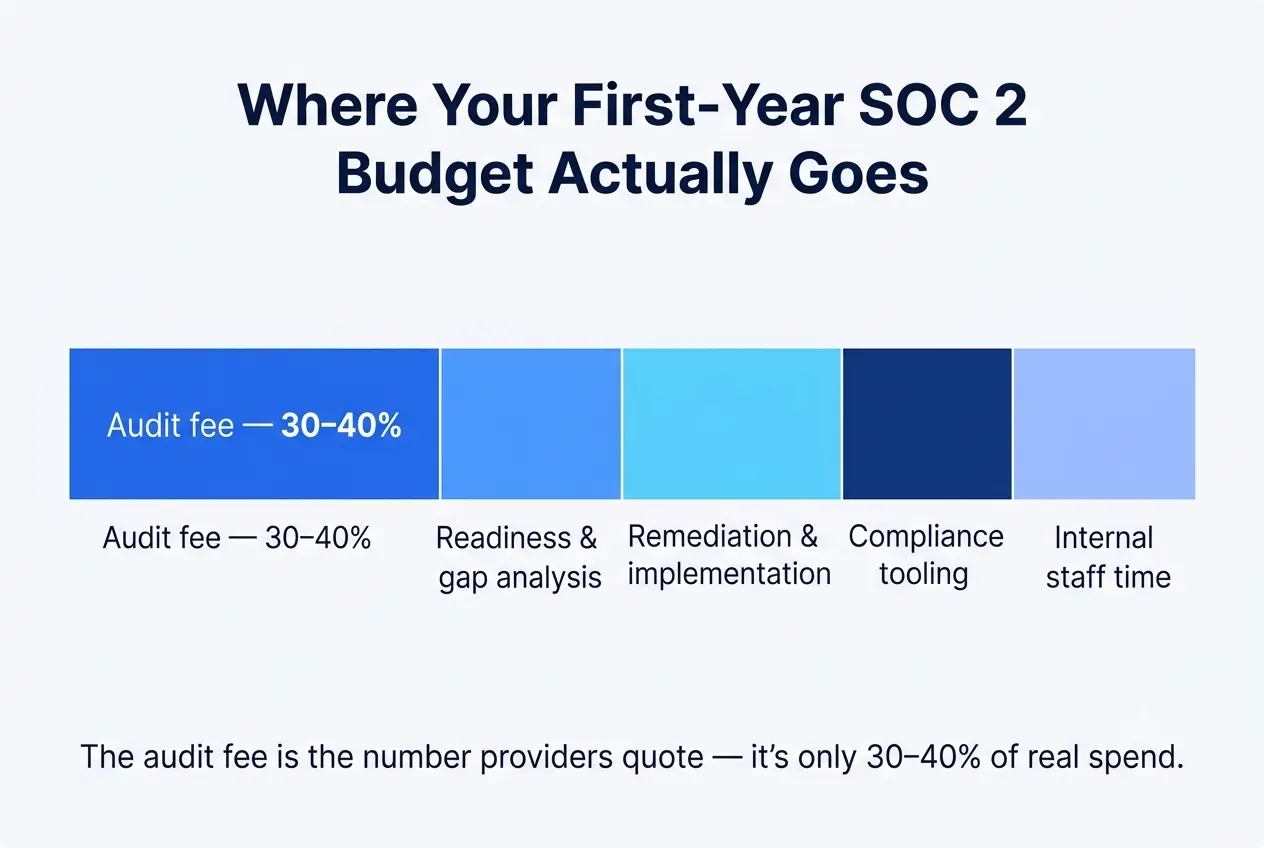
Australian companies typically spend AUD $30,000 – $150,000 all-in on the open market for a first SOC 2 Type 2 report. The auditor's fee is only 30–40% of that — readiness work, remediation, compliance tooling and internal staff time make up the rest. CyberSapiens' consultancy-plus-audit-partner model brings this down substantially: AUD $8,000 – $20,000 for early-stage startups, AUD $12,000 – $30,000 for small–mid SaaS, and AUD $30,000+ for larger, complex environments. Year two typically costs 30–50% less.
Market figures are indicative ranges compiled from current Australian and international audit-market data. CyberSapiens pricing varies with scope, size and existing security maturity — book a free consultation for an exact fixed-price figure.
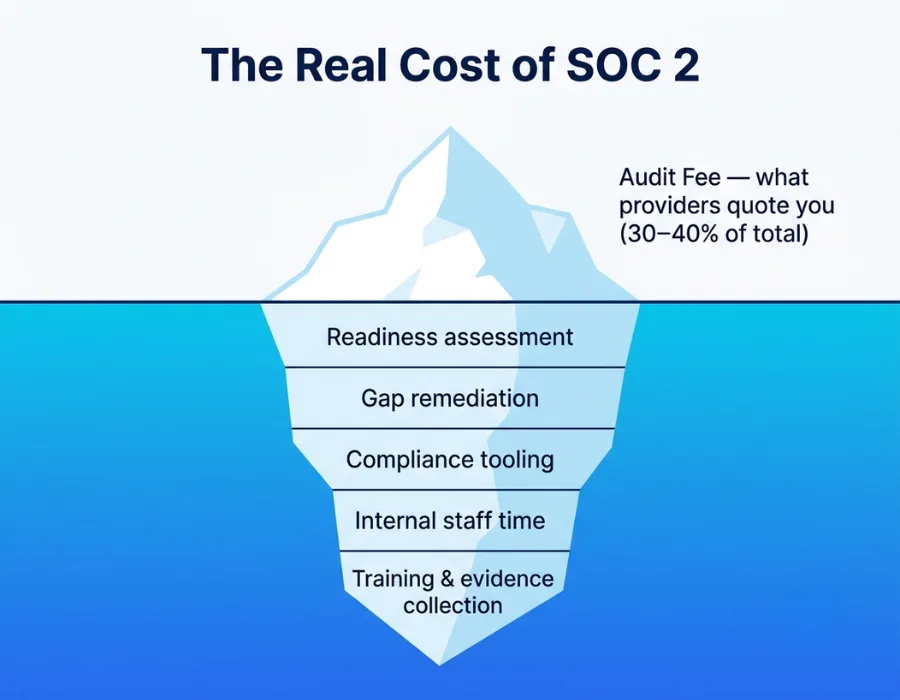
Most quotes you'll receive cover only the audit fee. That's the visible tip. A realistic SOC 2 budget has five parts:
Mapping your controls against the Trust Services Criteria before an auditor ever sees them. Skipping this is the most expensive mistake in SOC 2: gaps discovered during audit fieldwork cost far more to remediate than gaps found early.
Building the policies, processes and technical controls the gap analysis surfaces — access governance, change management, incident response, vendor risk.
Evidence collection and monitoring platforms reduce manual effort across the observation window, at an annual subscription cost. Whether automation pays for itself depends on your team size — see our guide to automated vs manual compliance.
The independent examination and attestation report. Typically only 30–40% of total first-year spend, despite being the number most providers quote.
The least visible, most underestimated cost. Policy reviews, evidence collection, interviews and control ownership consume real hours from engineering and leadership.
Total program cost — audit fee plus readiness, remediation, tooling and internal time — scales with headcount, system complexity and how many Trust Services Criteria you put in scope. The market column reflects typical DIY / other-provider spend; CyberSapiens' consultancy-plus-audit-partner model runs well below it.
| Company Profile | Market All-In First Year (AUD, indicative) | CyberSapiens Price | Typical Annual Renewal | What's Driving It |
|---|---|---|---|---|
| Early-stage startupUnder ~20 staff · Security criteria only | $30,000 – $75,000 | $8,000 – $20,000 | $15,000 – $45,000 | Narrow scope, single product, cloud-native stack |
| Small–mid SaaS20–50 staff · Multi-criteria | $60,000 – $150,000 | $12,000 – $30,000 | $35,000 – $75,000 | More systems, more evidence, 2–3 criteria in scope |
| Larger / complex50+ staff · Multi-product | $150,000+ | $30,000+ | $60,000+ | Multi-team scope, legacy systems, extra criteria |
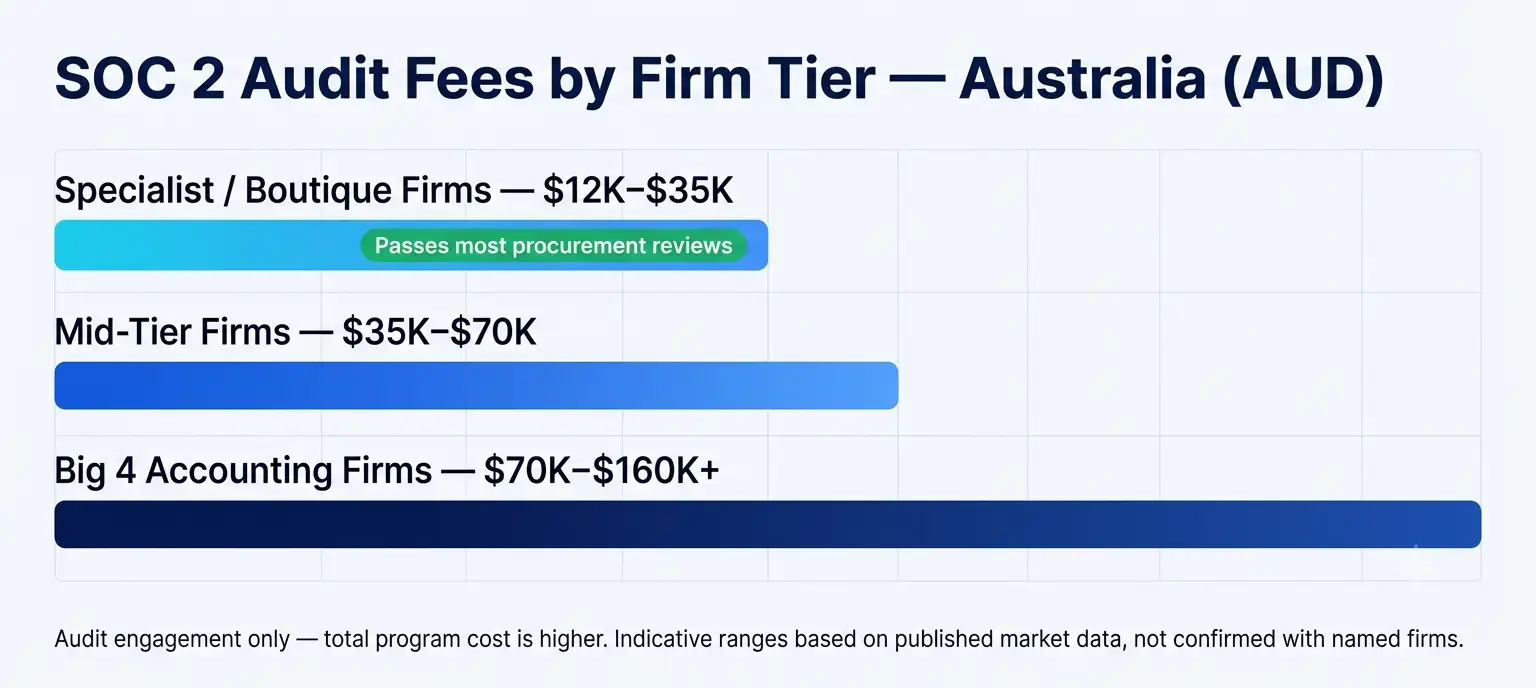
The single biggest price lever in SOC 2 is who signs the report. If you engage an audit firm directly yourself, current Australian market rates for the audit engagement alone look like this:
| Firm Tier | Typical Audit Fee (AUD) | When It's Worth It |
|---|---|---|
| Specialist / boutique audit firmsBest Value | $12,000 – $35,000 | Satisfies the overwhelming majority of SaaS procurement reviews |
| Mid-tier firms | $35,000 – $70,000 | Brand comfort for conservative enterprise buyers |
| Big 4 accounting firms | $70,000 – $160,000+ | Only when a specific customer's procurement team requires a Big 4 name |
Figures are indicative market ranges based on published industry pricing surveys and general market reporting — not confirmed pricing from any named firm, and not what CyberSapiens clients pay individually for the audit.
A SOC 2 attestation from a properly credentialed specialist firm passes the same procurement reviews as a Big 4 report in the vast majority of deals — at 2–5× lower cost. Buy the Big 4 letterhead when a named customer demands it, not by default.
Type 2 typically costs 25–50% more than Type 1 for the same scope, because auditors must test controls operating across a 3–12 month observation window rather than at a single point in time. The observation window also drives the hidden costs — more months of tooling subscriptions and more staff hours collecting evidence. Type 1 is the budget-friendly bridge when a deal is waiting; Type 2 is the report enterprise procurement actually requires long-term.
These four line items rarely appear in any provider's quote — yet they often account for more than the audit fee itself.
Expect meaningful hours from engineering, IT and leadership across the whole program: control ownership, evidence collection, auditor interviews. For lean teams this is often the largest unbudgeted line.
Evidence automation platforms bill annually, and Type 2 means paying across the entire observation window — not just audit month. Factor in the subscription from day one of remediation.
Many auditors expect a current penetration test as supporting evidence. Budget for one if you haven't tested recently — retro-fitting it mid-audit delays the report.
Adding a Trust Services Criterion or a new system mid-engagement triggers re-scoping fees from both the consultant and the auditor. Locking scope before the engagement starts prevents this entirely.
SOC 2 reports cover a defined period — enterprise customers expect a fresh report every 12 months, making SOC 2 an annual program, not a one-off project. The good news: year two typically costs 30–50% less than year one. Policies exist, controls are embedded, evidence collection is systematised, and the readiness phase largely disappears.
Readiness disappears, controls are embedded, evidence habits are systematised. Organisations that maintain evidence continuously — rather than scrambling pre-audit — keep renewal costs at the bottom of the range.
The core recurring cost — same auditor, same scope, typically 15–25% lower than year one as familiarity reduces fieldwork time.
Annual evidence-automation platform subscription continues — but ROI improves as your team uses it more efficiently with each cycle.
Lighter than year one: control ownership is assigned, policies are reviewed not written, and evidence collection is routine rather than new.
None of these compromise the report's credibility — they just eliminate spend that doesn't need to happen.
The Security criterion is mandatory; the other four are optional. Add Availability, Confidentiality, Processing Integrity or Privacy only if customers actually require them — each addition raises audit fees ~15–30%.
Same report, fraction of the fee. Upgrade only when a named customer's procurement demands it — see our auditor tier comparison above.
Gaps found in readiness cost a fraction of gaps found in fieldwork, where auditors bill extra time and may require re-testing.
If you hold ISO 27001, 60–70% of SOC 2 controls are already covered — see our ISO 27001 certification service. Building both together under one engagement costs far less than sequential projects.
For teams past ~15 staff, automation platforms usually save more in staff hours than they cost — the maths in our automated vs manual compliance guide.
Defined systems, defined criteria, defined observation window means no change-orders — see hidden costs above.
Australian companies have three routes to a SOC 2 report: Big 4 accounting firms (AUD $70K–$160K+ audit fees alone, per published market data), managing an overseas audit firm directly (lower fees, but you run readiness alone across time zones), or the model we deliver — an Australian team leads readiness, implementation, evidence and audit preparation, and the formal attestation is delivered through our audit partner, Accorp Partners, a globally recognised audit firm specialising in SOC 2 Type 1 & 2 and ISO 27001. One engagement, one point of contact, fixed pricing that scales with your organisation:
Tell us about your organisation — tailored, fixed-price AUD quote within 24 hours. No obligation.
Still have questions? Our team replies within 24 hours.
Keep reading: SOC 2 compliance in Australia · SOC 2 compliance checklist · SOC 2 access control requirements