
SOC 2 Certification Services in Canada: Audit, Automation, and Compliance Support Explained
SOC 2 certification services in Canada help SaaS, cloud, and technology companies prepare for, pass, and maintain a SOC 2 attestation issued by a licensed CPA firm. These services typically cover readiness assessment, gap remediation, evidence preparation, audit coordination, and ongoing compliance support after the report is issued.
For Canadian businesses that store or process customer data, SOC 2 has shifted from a nice-to-have into a procurement requirement. Enterprise clients in Canada, the United States, and Europe increasingly ask for a SOC 2 report before signing a contract. Without one, deals stall in security review and sales cycles stretch out.
The challenge is that the path to certification is rarely straightforward. Organisations struggle with scoping, control implementation, documentation, and the audit itself. Some teams are best served by compliance automation platforms, others by hands-on expert guidance, and most by a blend of the two. There is no single right answer, and the right mix depends entirely on your environment, team, and timeline.
This guide explains what SOC 2 certification services in Canada actually include, how the audit process works, how SOC 2 relates to Canadian privacy laws such as PIPEDA and Quebec Law 25, and how to decide between automation-driven and expert-led approaches. It draws on CyberSapiens’ first-hand experience guiding Canadian and global clients through SOC 2 Type 1 and Type 2 engagements end to end.
5 Criteria
Trust Services Criteria defined by the AICPA, with Security mandatory in every audit
3 to 12 Months
Typical observation window for a SOC 2 Type 2 report, depending on scope
2 Report Types
Type 1 tests control design at a point in time, Type 2 tests operation over a period
What SOC 2 Certification Services in Canada Include
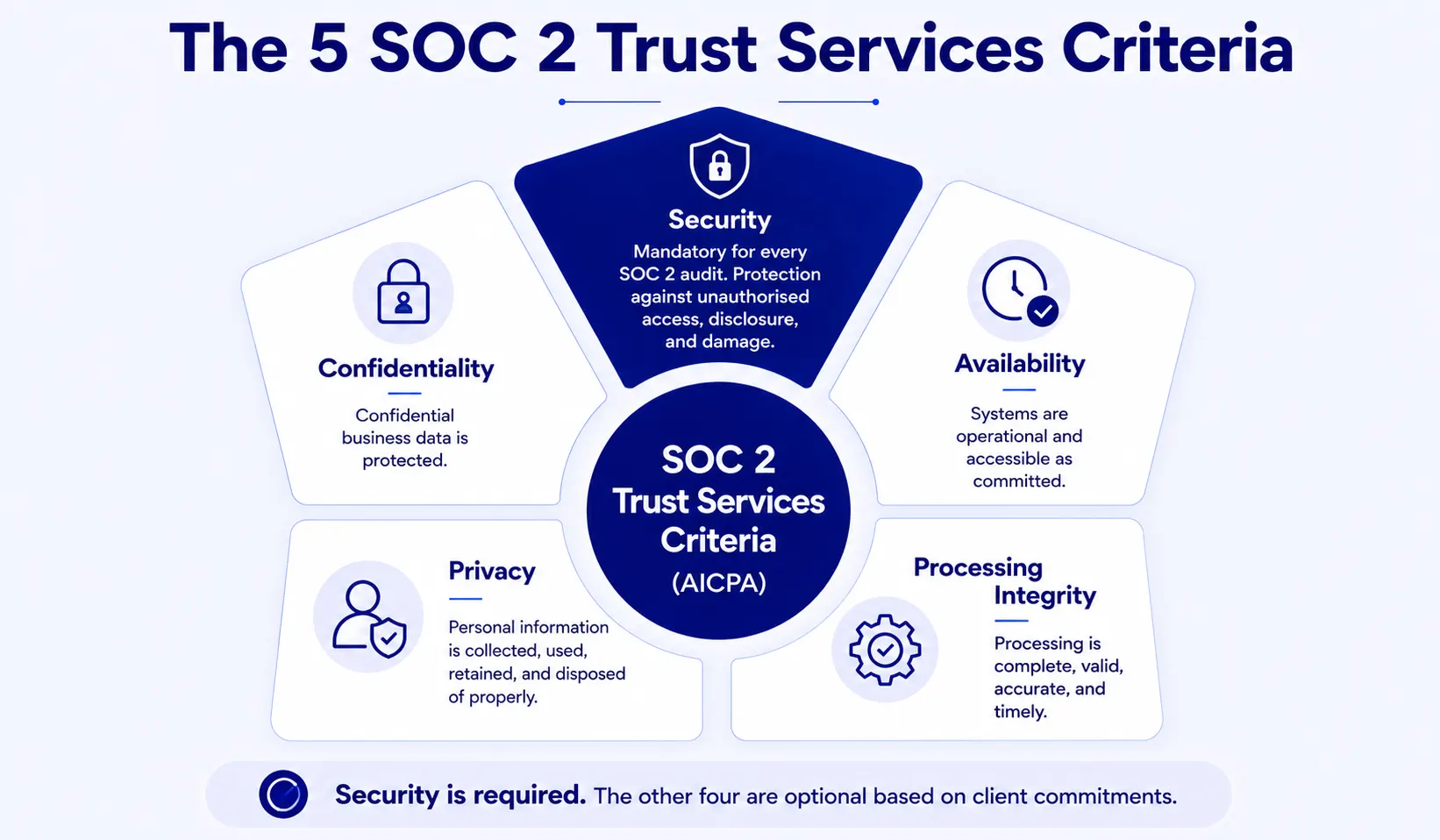
SOC 2 is an attestation framework developed by the American Institute of Certified Public Accountants (AICPA). It evaluates how well an organisation protects customer data against five Trust Services Criteria: Security, Availability, Processing Integrity, Confidentiality, and Privacy. Security is the only mandatory criterion, while the other four are added based on the commitments you make to your clients.
Achieving the attestation requires more than installing security tools. Auditors test whether controls are designed correctly, documented properly, and operating consistently. SOC 2 compliance services exist to bridge the gap between where your security programme is today and what the auditor will expect to see.
In the Canadian market, a complete SOC 2 service engagement usually includes the following components:
Readiness and Gap Assessment
A structured review of your current controls against the Trust Services Criteria, producing a clear list of gaps to close before the audit.
Control Implementation
Hands-on help building the policies, technical controls, and processes the audit will test, sized to your actual environment rather than a generic template.
Evidence and Documentation
Preparation of the evidence trail that demonstrates controls operate as described, whether collected manually or through an automation platform.
Audit Coordination
Liaison with the licensed CPA firm that performs the attestation, including responding to auditor queries and managing timelines.
Report Attestation Support
Support through the final report stage so the deliverable meets the expectations of the clients and prospects who asked for it.
Ongoing Compliance Support
Continuous monitoring, policy maintenance, and renewal preparation so the second audit is easier than the first.
SOC 2 and Canadian Privacy Law: Where PIPEDA and Quebec Law 25 Fit In
A question CyberSapiens hears from almost every Canadian client is whether SOC 2 satisfies Canadian privacy law. The short answer is no, but the two work together. SOC 2 is a voluntary attestation demanded by clients, while PIPEDA is federal law that applies to private-sector organisations handling personal information in commercial activity.
The overlap is real, though. PIPEDA’s Safeguards principle, set out by the Office of the Privacy Commissioner of Canada, requires organisations to protect personal information through physical, technological, and organisational measures appropriate to its sensitivity. SOC 2 controls such as access management, encryption, monitoring, and incident response are exactly the kinds of measures that demonstrate this principle in practice.
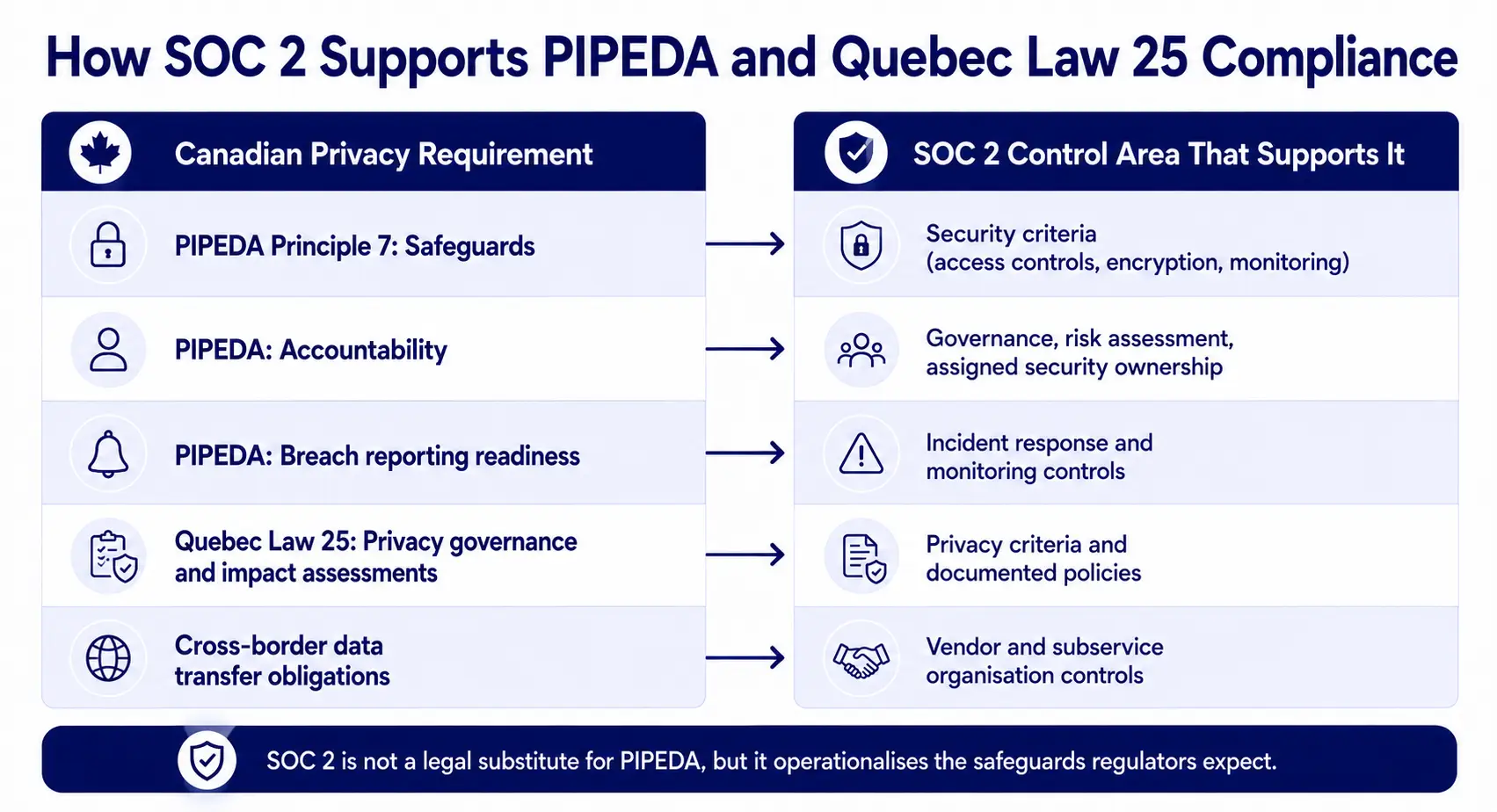
Quebec’s Law 25 raises the bar further for any organisation serving Quebec residents. It introduces requirements around privacy governance, impact assessments, and breach handling. Companies that have already built a SOC 2 programme with the Privacy criterion in scope find these obligations far easier to meet, because the underlying policies, ownership, and documentation already exist.
In CyberSapiens engagements with Canadian clients, scoping conversations always cover both tracks at once. Designing controls that serve the SOC 2 audit and Canadian regulatory expectations together avoids duplicated effort and gives the security programme one coherent backbone instead of two parallel checklists.
SOC 2 Type 1 vs Type 2: Which One Does Your Business Need?
A Type 1 report confirms your controls are designed and implemented correctly at a single point in time. A Type 2 report goes further and tests whether those controls operated effectively over an observation period, usually 3 to 12 months. Most enterprise clients in Canada and abroad now expect Type 2, because it proves consistency rather than a snapshot.
| Factor | SOC 2 Type 1 | SOC 2 Type 2 |
|---|---|---|
| What it tests | Design of controls at a point in time | Design and operating effectiveness over a period |
| Observation period | None | Typically 3 to 12 months |
| Typical timeline to report | Roughly 3 to 6 months including readiness | Roughly 6 to 12 months including the observation window |
| Level of client assurance | Moderate, shows the right controls exist | High, shows controls are followed consistently |
| Best suited for | Early-stage companies needing a first proof point quickly | Companies selling to enterprise or regulated clients |
A common path for Canadian SaaS companies is to complete a Type 1 first to unblock immediate deals, then move straight into the Type 2 observation period using the same controls. Which sequence makes sense depends on your sales pipeline, budget, and how quickly clients are asking for the report.
Book Your Free SOC 2 ConsultationThe SOC 2 Audit Process in Canada: Step by Step
Whatever provider or platform you choose, the audit journey follows a consistent sequence. Knowing the steps in advance removes most of the anxiety, because each stage has a clear purpose and output. Teams that want a deeper preparation breakdown can work through the SOC 2 compliance checklist alongside this overview.
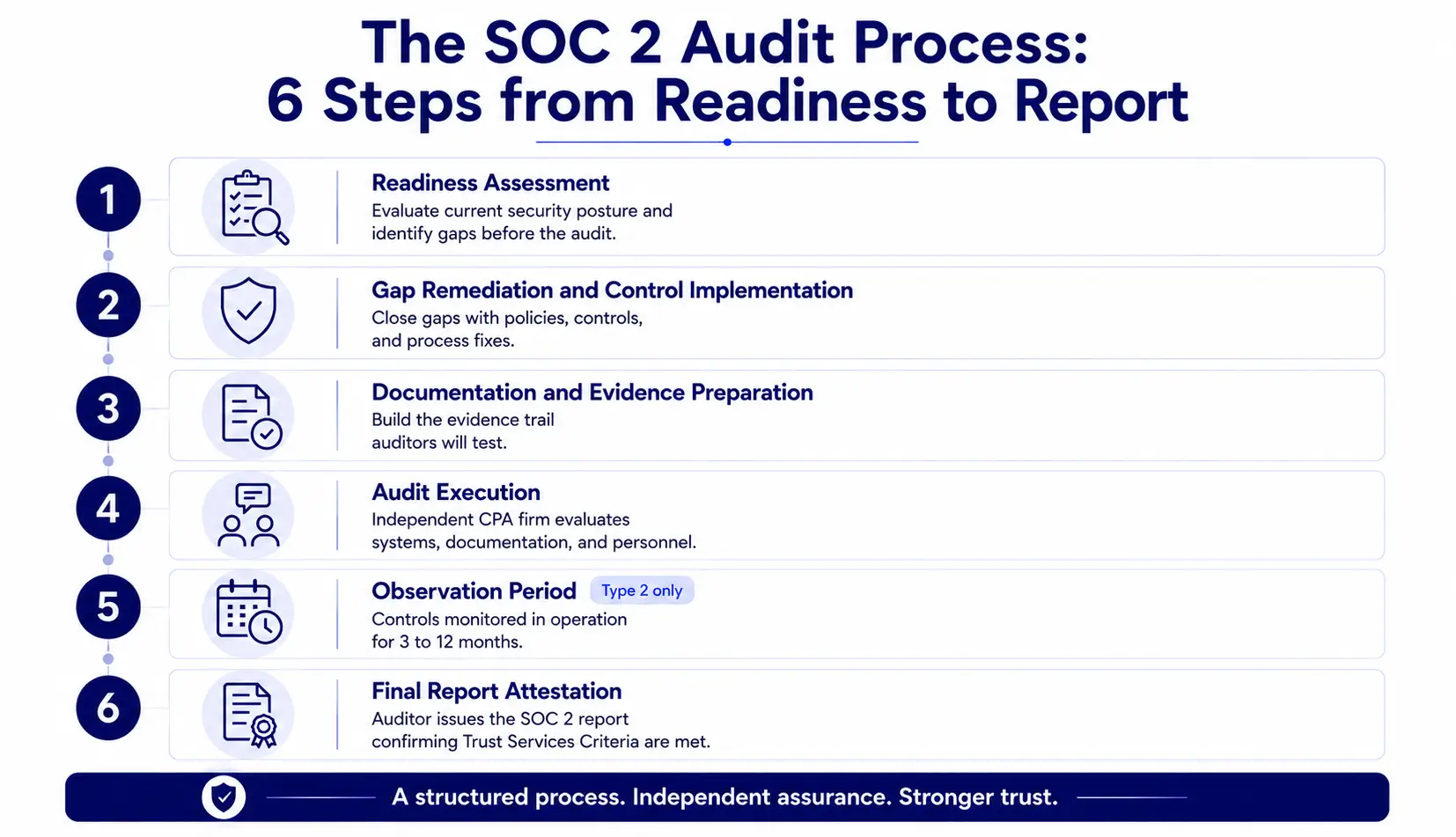
Readiness Assessment
Your current security posture is evaluated against the Trust Services Criteria. The output is a prioritised gap list, so nothing surfaces as a surprise during the audit itself.
Gap Remediation and Control Implementation
Identified gaps are closed through policy work, process changes, and technical controls. Access management is usually the heaviest lift here, and the SOC 2 access control requirements deserve early attention because auditors test them in depth.
Documentation and Evidence Preparation
The evidence trail is assembled: policies, logs, tickets, screenshots, and system exports that prove controls operate as described. This can be gathered manually or continuously through an automation platform.
Audit Execution
An independent, licensed CPA firm examines your systems, documentation, and processes, and may interview key personnel. Good preparation in steps 1 to 3 is what makes this stage uneventful.
Observation Period TYPE 2 ONLY
For Type 2 reports, controls are monitored in live operation across the agreed window, usually 3 to 12 months. Consistency during this period is what gives the final report its weight.
Final Report Attestation
The auditor issues the SOC 2 report confirming your controls meet the Trust Services Criteria. This is the document you share with clients and prospects under NDA.
SOC 2 Automation vs Expert-Led Compliance: Which Approach Fits Your Business?
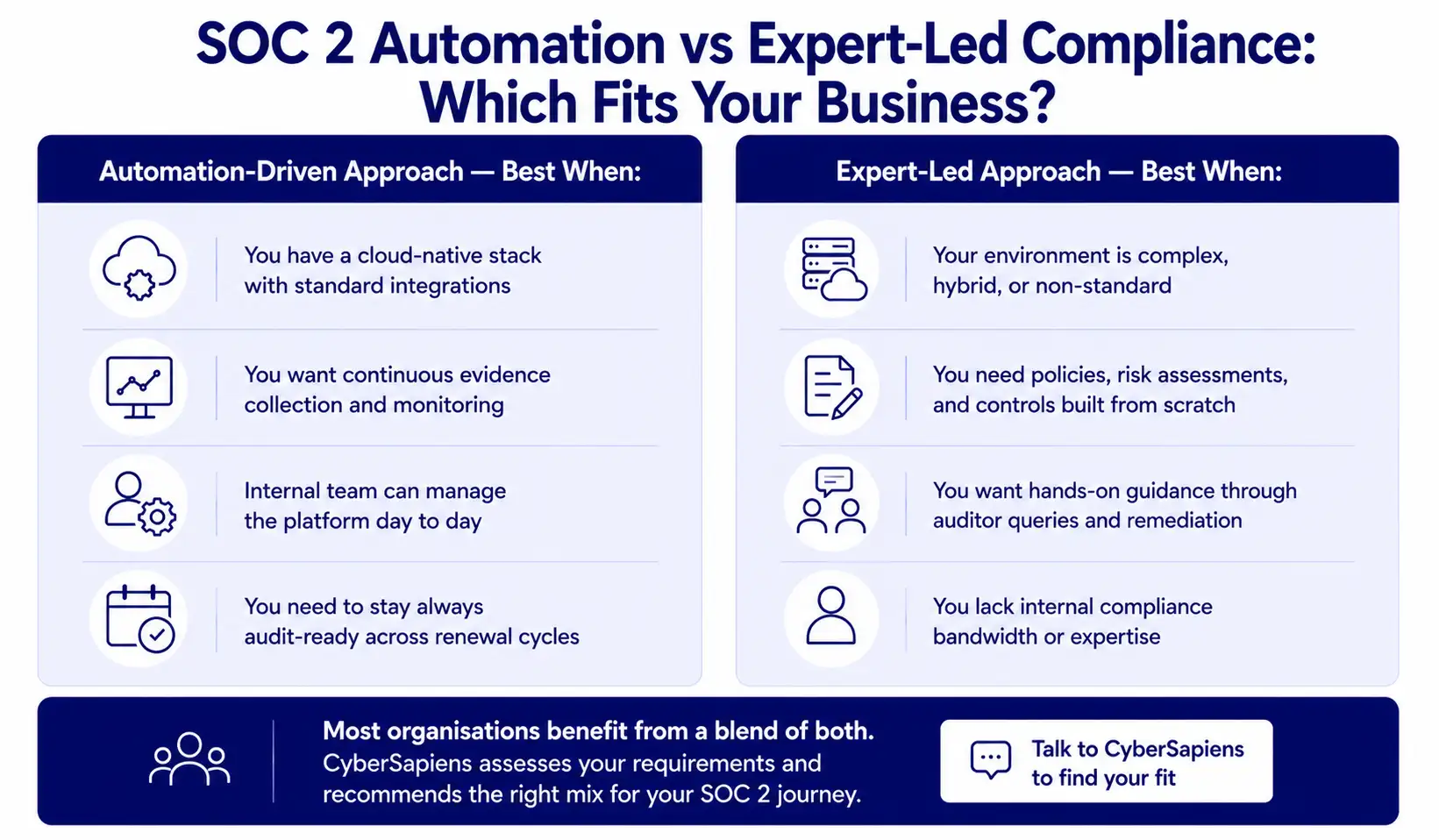
SOC 2 automation platforms connect to your cloud systems to collect evidence, monitor controls, and centralise documentation continuously. Expert-led compliance relies on experienced consultants to design controls, write policies, run risk assessments, and guide your team through auditor queries. Neither approach is inherently better. Each solves a different problem, and the honest answer is that the right choice depends on your environment and your team.
Automation Tends to Fit When
Your stack is cloud-native with standard integrations, and your team can own the platform day to day. Continuous evidence collection keeps you audit-ready across renewal cycles instead of scrambling each year.
It also reduces repetitive manual work such as screenshots and spreadsheet tracking, freeing your engineers for product work.
Expert-Led Tends to Fit When
Your environment is complex, hybrid, or non-standard, or you are building policies, risk assessments, and controls from scratch. A platform can collect evidence, but it cannot decide what your controls should be.
Hands-on guidance also matters most during auditor queries and remediation, where judgement and experience carry the engagement.
In practice, most Canadian organisations CyberSapiens works with end up using a blend: automation for evidence collection and monitoring, expert support for scoping, policy design, risk analysis, and the audit itself. The full trade-offs are covered in detail in this comparison of automated vs manual compliance.
Rather than pushing one model, CyberSapiens assesses your requirements first and recommends the mix that actually fits. SaaS teams weighing the decision can also follow the step-by-step SOC 2 compliance guide for SaaS platforms in Canada to see how each approach plays out stage by stage.
Already ISO 27001 Certified? Use the Overlap to Accelerate SOC 2
One of the most underused shortcuts in Canadian SOC 2 projects is the overlap with ISO 27001. The two frameworks differ in structure: ISO 27001 certifies a management system against an international standard, while SOC 2 is a CPA attestation against the Trust Services Criteria. But the controls underneath overlap heavily, including risk assessment, access control, incident management, change management, vendor management, and business continuity.
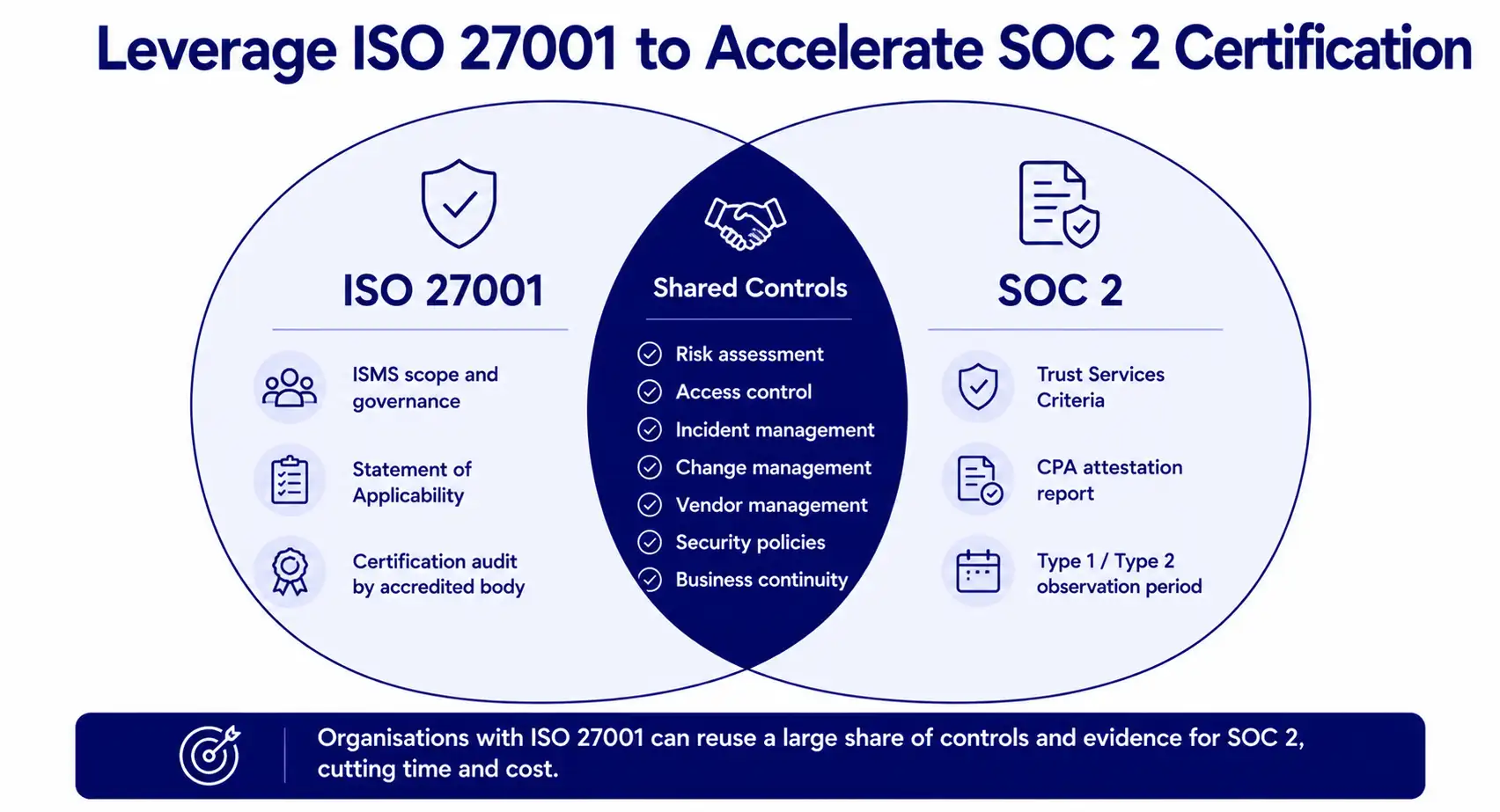
If your organisation already holds ISO 27001 certification, much of the documentation, evidence, and operational discipline can be reused for SOC 2. Access control is a good example: the work done to satisfy ISO 27001 Annex A access control requirements maps directly onto the SOC 2 common criteria auditors test hardest.
This is not theoretical for CyberSapiens. In a recent Type 2 engagement, the client’s existing ISO 27001 programme was mapped against the Trust Services Criteria at the start, which cut the gap list dramatically and shortened the readiness phase. The client’s own words on that engagement appear in the next section.
The reverse also holds. Organisations completing SOC 2 first build most of the muscle needed for ISO 27001 later, which matters for companies expanding into markets where clients ask for the ISO certificate instead of, or alongside, the SOC 2 report.
Ongoing SOC 2 Compliance Support: Beyond the First Audit
Achieving SOC 2 is the starting line, not the finish. Type 2 reports cover a defined period, so clients expect a fresh report every year. Organisations that treat compliance as a one-off project find the second audit harder than the first, because controls drift, staff change, and documentation goes stale. The threat landscape does not stand still either, as ongoing guidance from the Canadian Centre for Cyber Security regularly reminds Canadian businesses.
Ongoing compliance support keeps the programme alive between audits. The core components are:
Policy Development and Maintenance
Access control, data protection, incident handling, and acceptable use policies are reviewed and updated as the business grows and new systems arrive.
Risk Assessment and Management
Cyber risks evolve with your technology and threat environment. Periodic reassessment keeps remediation priorities aligned with reality rather than last year’s snapshot.
Continuous Monitoring and Control Management
Access controls, system activity, vulnerabilities, and security events are watched continuously, whether through tooling, expert review, or both, so deviations are caught early.
vCISO Support
You do not need an enterprise budget for CISO-level direction. vCISO support brings strategic ownership of the security programme, compliance initiatives, and board-level accountability.
Audit Readiness, All Year
Instead of a last-minute scramble, evidence and controls stay current, so each renewal audit becomes faster, calmer, and cheaper than the one before.
Whether this support is delivered through a platform, through people, or through both comes back to the same principle as the previous section: match the model to your requirements, not the other way around.
How CyberSapiens Delivers SOC 2 Certification Services in Canada
CyberSapiens supports Canadian businesses end to end, from the first scoping call through to CPA attestation and ongoing renewals, with a local presence in Hamilton, Ontario. The engagement model is deliberately flexible: automation where it genuinely saves you effort, expert hands where judgement is needed, and a clear recommendation up front on which mix fits your requirements. As an ISO 27001:2022 certified organisation itself, CyberSapiens applies the same discipline internally that it implements for clients.
A typical engagement covers readiness assessment, gap remediation, evidence strategy, audit coordination with the CPA firm, and report attestation support, followed by optional ongoing compliance and vCISO services. Companies comparing providers can see how CyberSapiens stacks up in this list of the top 10 best SOC 2 compliance vendors in Canada.
What a Client Says About the Journey
“Claude and Ketki from Cyber Sapiens guided us seamlessly through our SOC 2 Type II journey. Their communication was clear and professional, helping us leverage ISO27001 overlaps and address any gaps with expert advice. This has strengthened our market position and ability to win new business and retain current clients who now have a requirement for their key vendors handling sensitive data to have SOC 2 Type II practice in place.”
“Cyber security is a top priority for us given the nature of our business, and we’ll continue maintaining SOC 2 Type II with Cyber Sapiens going forward. A big thank you for the end-to-end support through to CPA assessment. We look forward to a long term relationship in the industry.”
Russell Wagenaar, on an engagement led by Claude Pinto and Ketki Tidke of CyberSapiens
Case Study: SOC 2 for a Fast-Growing SaaS Company
SOC 2 Case Study: Sciative Solutions
Discover how a fast-growing SaaS company improved audit readiness, strengthened security processes, and built scalable compliance systems with CyberSapiens.
Read the Sciative Solutions Case StudyClients Served by CyberSapiens Worldwide




FAQs on SOC 2 Certification Services in Canada
1. What are SOC 2 certification services in Canada?
They are professional services that help Canadian organisations achieve and maintain a SOC 2 attestation issued by a licensed CPA firm. They typically include readiness assessment, gap remediation, evidence preparation, audit coordination, and ongoing compliance support.
2. How long does it take to get SOC 2 certification in Canada?
Roughly 3 to 6 months for a Type 1 report and 6 to 12 months for a Type 2 report, including the observation period. The biggest variables are your current security posture and how quickly gaps are remediated.
3. How much does SOC 2 certification cost in Canada?
Costs vary with company size, audit scope, the criteria included, and whether automation tooling is used. Total spend covers readiness and remediation work, any platform licensing, and the CPA audit fee itself, so quotes should always be scoped to your specific environment rather than taken from a generic price list.
4. Is SOC 2 legally required in Canada?
No. SOC 2 is a voluntary attestation driven by client and contractual requirements, not legislation. Canadian privacy laws such as PIPEDA do legally require appropriate safeguards for personal information, and a SOC 2 programme is one of the strongest ways to demonstrate those safeguards in practice.
5. Should I choose SOC 2 automation or expert-led compliance?
Both have genuine benefits and neither is universally better. Automation suits cloud-native stacks and continuous audit readiness, while expert-led support suits complex environments and teams building their programme from scratch. Most organisations use a blend, and CyberSapiens assesses your requirements before recommending the right mix.
6. Do startups in Canada need SOC 2 certification?
Yes, especially SaaS and technology startups selling to enterprise clients. Many procurement teams will not onboard a vendor handling sensitive data without a SOC 2 report, so achieving it early shortens sales cycles and builds trust from the first deal.
7. What is the difference between SOC 2 and ISO 27001, and can I use one for the other?
ISO 27001 certifies an information security management system against an international standard, while SOC 2 is a CPA attestation against the AICPA Trust Services Criteria. They are separate deliverables, but their controls overlap heavily, so holding one significantly reduces the time and cost of achieving the other.
8. What happens after achieving SOC 2 certification?
Compliance must be maintained continuously. Type 2 reports cover a defined period, so clients expect a renewed report each year, which means ongoing monitoring, policy upkeep, and periodic reassessment rather than a one-off project.
Ready to Start Your SOC 2 Journey in Canada?
Talk to CyberSapiens about your requirements. Whether automation, expert-led support, or a blend of both fits your business, the recommendation starts with your environment, not a sales pitch.
Get SOC 2 Compliant NowCALL CENTER
1300 507 668
CANADA OFFICE
236 Pritchard Rd. Hamilton, ON. L8W 3P7
CONTENT REVIEWED BY

Ketki Tidke
ISO 27001 CERTIFIEDCyber Security and GRC Lead Auditor
ISO 27001 Lead Auditor
Ketki is a certified ISO 27001 Lead Auditor specialised in Governance, Risk and Compliance, with experience consulting public, private, and government clients. She evaluates threats, risk impacts, and regulatory requirements across multiple industry frameworks.
