

The Role of Automation in SOC: Enhancing Detection and Response
In the fast-paced world of cybersecurity, threats are evolving at an unprecedented rate. Enterprises face an overwhelming volume of alerts daily, and traditional manual methods of threat detection and response struggle to keep up. This is where automation comes in—empowering Security Operations Centers (SOCs) to work smarter, faster, and more effectively.
For businesses grappling with increasingly sophisticated cyber threats, understanding the role of automation in SOC operations is not just a technical conversation—it’s a critical business decision. Let’s explore how automation transforms SOCs into lean, efficient powerhouses capable of tackling today’s most complex threats.
Here in this article we are going to discuss about The Role of Automation in SOC: Enhancing Detection and Response
Why SOCs Need Automation: Addressing the Challenges?

Running a SOC is no small feat. Analysts juggle multiple tasks, from monitoring security alerts to investigating incidents, all while striving to minimize downtime and prevent breaches. Here are some key challenges SOCs face that make automation essential:
1. Alert Overload
- A mid-sized business SOC may receive thousands of security alerts every day, with many being false positives.
- Manually triaging these alerts is time-consuming and prone to errors, leaving analysts burnt out and critical threats potentially overlooked.
2. Complex Threats
- Modern threats like Advanced Persistent Threats (APTs) and ransomware campaigns are multifaceted and stealthy.
- Detecting these threats requires correlating data from multiple sources—a process that is difficult to scale without automation.
3. Skills Shortage
- The cybersecurity industry faces a global talent shortage, making it hard for SOCs to maintain the staffing levels needed for 24/7 operations.
- Automation acts as a force multiplier, enabling smaller teams to handle larger workloads effectively.
How Automation Enhances SOC Operations?
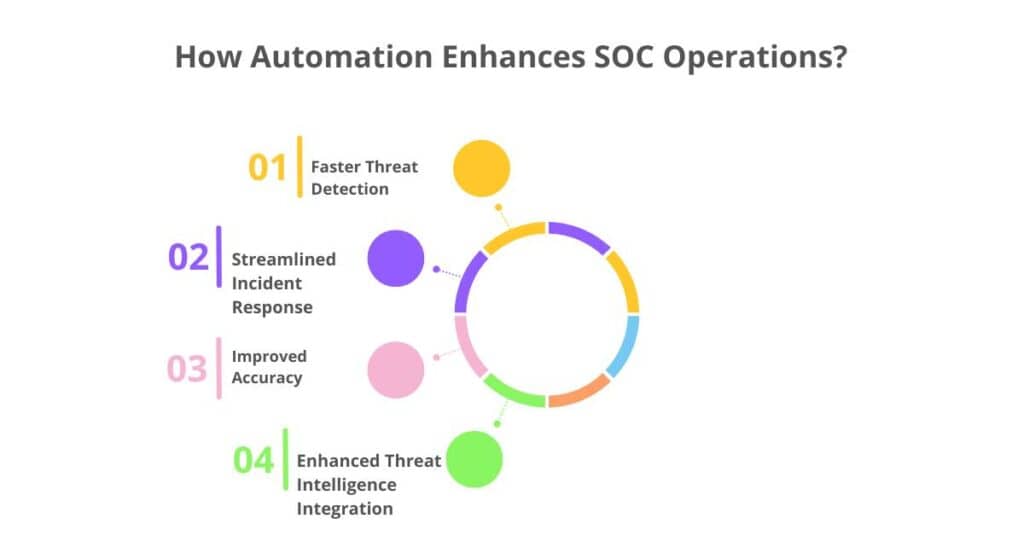
Automation in a SOC doesn’t replace human expertise; it augments it. By automating repetitive and time-consuming tasks, SOC analysts can focus on higher-value activities like threat hunting, strategic planning, and incident remediation. Here’s how automation transforms SOC workflows:
1. Faster Threat Detection
Automation tools like Security Information and Event Management (SIEM) systems and Extended Detection and Response (XDR) platforms analyze massive amounts of data in real-time to identify potential threats.
- Example: A SIEM system can automatically correlate log data from endpoints, firewalls, and cloud environments, flagging anomalies that warrant further investigation.
- Outcome: SOCs can detect threats within seconds instead of hours, reducing the mean time to detect (MTTD).
2. Streamlined Incident Response
Automated playbooks—predefined sets of actions triggered by specific alerts—enable rapid containment and remediation of incidents.
- Example: If malware is detected on a device, automation can isolate the endpoint, block the malicious IP address, and notify relevant stakeholders—all without human intervention.
- Outcome: This reduces the mean time to respond (MTTR), limiting the impact of breaches.
3. Improved Accuracy
Automation eliminates the manual errors often associated with repetitive tasks like log analysis and alert triage.
- Example: Machine learning algorithms can differentiate between false positives and genuine threats with higher accuracy than manual processes.
- Outcome: Analysts can focus on real threats instead of chasing down false alarms.
4. Enhanced Threat Intelligence Integration
Automation integrates global threat intelligence feeds into SOC workflows, ensuring teams have up-to-date information on emerging threats.
- Example: If a new ransomware strain is detected globally, automated systems can update firewall rules and endpoint protection policies to guard against it.
- Outcome: SOCs stay ahead of threats rather than reacting after the fact.
Key Technologies Driving Automation in SOCs
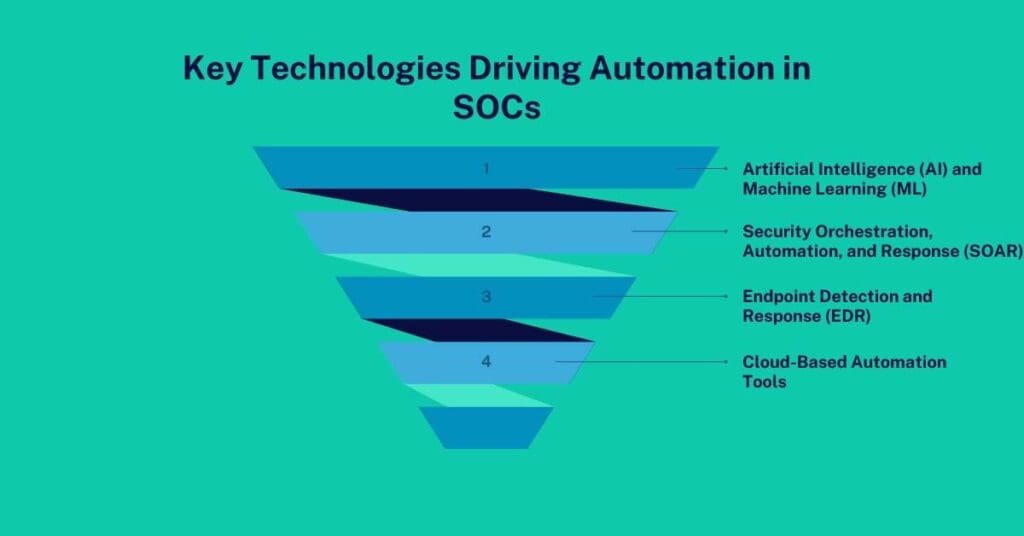
Several cutting-edge technologies form the backbone of automation in modern SOCs:
1. Artificial Intelligence (AI) and Machine Learning (ML)
AI-powered tools can analyze patterns and detect anomalies that would be impossible for humans to spot manually.
- Use Case: Predicting potential attack vectors based on historical data and current activity.
2. Security Orchestration, Automation, and Response (SOAR)
SOAR platforms enable the automation of incident response workflows, integrating tools like SIEMs, firewalls, and ticketing systems for seamless operations.
- Use Case: Automating the end-to-end process of phishing email remediation.
3. Endpoint Detection and Response (EDR)
EDR tools provide real-time monitoring and automated response capabilities for endpoint devices.
- Use Case: Automatically isolating an infected device from the network upon detection of suspicious activity.
4. Cloud-Based Automation Tools
As businesses increasingly migrate to the cloud, automation tools designed for cloud environments (like AWS GuardDuty or Microsoft Azure Security Center) play a critical role.
- Use Case: Automatically revoking compromised credentials in a cloud environment.
The Human Side of Automation: Augmenting, Not Replacing
One common misconception is that automation in SOCs will replace human analysts. In reality, automation complements human expertise, freeing analysts from repetitive tasks so they can focus on what they do best: strategic problem-solving and creative thinking.
Human-AI Collaboration
- Automation handles repetitive tasks like log analysis and alert triage, while human analysts focus on complex investigations and decision-making.
- For instance, while automation can flag suspicious activity, a human analyst determines whether it’s part of a broader attack campaign.
Real-World Success Stories: Automation in Action
Let’s consider an example:
A retail company’s SOC was struggling with a flood of alerts, many of which were false positives. After implementing a SOAR platform:
- Automated workflows reduced alert volume by 75%.
- Analysts had more time for proactive threat hunting.
- The time taken to resolve incidents dropped from an average of 8 hours to 1 hour.
This not only improved the company’s security posture but also boosted team morale by reducing analyst burnout.
Why Automation Is Essential for Modern SOCs?
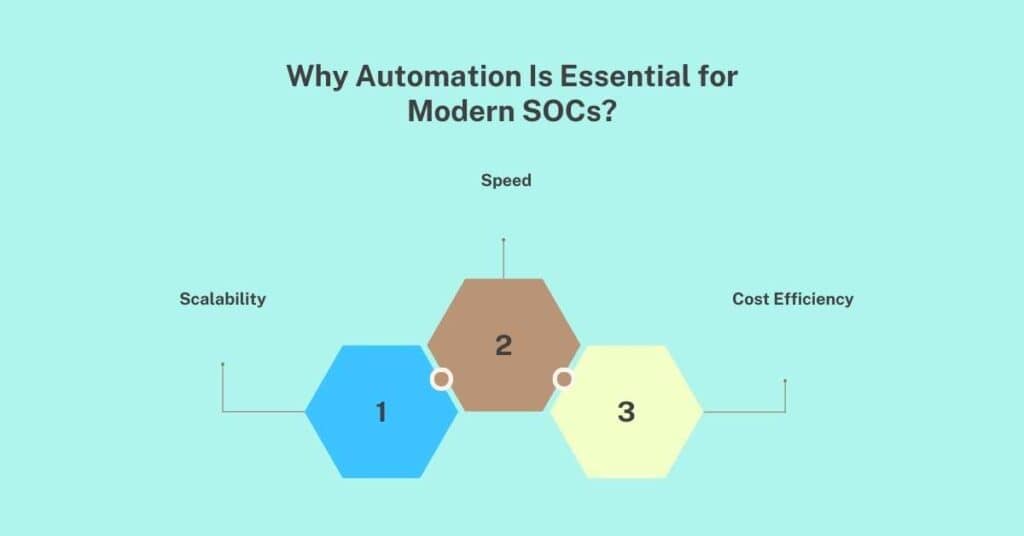
In today’s threat landscape, where attackers leverage automation to launch large-scale attacks, SOCs must embrace automation to stay ahead. Here’s why automation is no longer optional:
1. Scalability
Automation enables SOCs to handle increasing workloads without requiring proportional increases in headcount.
2. Speed
Automated processes respond to threats in real-time, minimizing potential damage.
3. Cost Efficiency
By reducing the need for manual intervention, automation lowers operational costs while improving effectiveness.
Explore More in Our SOC Series
Strengthen your business’s cybersecurity with our SOC blog series, covering essential insights on Security Operations Centers (SOCs) and their role in protecting digital assets. Dive into expert guidance on SOC implementation, management, and the latest trends.
- Why Every Business Needs a SOC: Protecting Your Digital Assets
- Key Challenges in Cybersecurity for Enterprises and How SOCs Solve Them
- Customizing SOC Services for Enterprises: Aligning Security with Business Goals
- In-House vs. Managed SOC: Making the Right Choice for Your Business
- SOC-as-a-Service: Scalable Security for Growing Businesses
- How to Choose the Right SOC Partner for Your Business
- Measuring the ROI of SOCs: The Business Case for Cybersecurity
- Integrating SOC Services with Business Applications and Workflows: A Seamless Approach to Security
- Incident Response for Enterprises: SOC Playbooks in Action
- Ensuring Compliance with SOC Services Navigating Regulations Made Easy
- Third-Party Risk Management: Strengthening Your Supply Chain with SOCs
- Addressing Advanced Persistent Threats (APTs) with SOC Expertise
- The Role of Automation in SOC: Enhancing Detection and Response
- The Future of SOCs: Trends and Innovations for B2B Cybersecurity
Conclusion: Embracing the Future of SOCs
Automation is revolutionizing the way SOCs operate, making them faster, smarter, and more efficient. For businesses, this means stronger security, reduced risk, and greater peace of mind. But automation is not a magic bullet—it works best when paired with skilled analysts and a well-defined strategy. By integrating automation into your SOC, you’re not just keeping pace with cyber threats; you’re staying ahead of them.
In a world where seconds matter, automation ensures your SOC is always ready to detect, respond to, and neutralize threats—no matter how complex. Now is the time to embrace automation and elevate your cybersecurity game.
